
Chapter 1: Introduction to Agentic AI
Modern enterprises are rapidly embracing artificial intelligence to automate complex tasks, enhance decision‑making, and deliver superior customer experiences.
Banks, insurance companies, healthcare providers, and retailers are moving beyond simple chatbots and recommendation engines. They are building intelligent agents that can perceive their environment, reason about goals, plan actions, and execute them autonomously or with minimal human oversight.
In this chapter, we will explore the foundations of Agentic AI, understand how it differs from traditional AI, and learn why it is becoming the cornerstone of enterprise digital transformation.
Throughout this tutorial, we will use a simplified Enterprise AI Assistant Platform (EAAP) with a focus on banking use cases—such as customer service, fraud detection, loan processing, and compliance—to ground our examples.
🎯 Learning Objectives
By the end of this chapter, you will be able to:
- Define Agentic AI and distinguish it from other AI paradigms
- Explain the evolution from rule‑based systems to autonomous agents
- Identify the key characteristics of agentic systems
- Understand the value proposition of Agentic AI for enterprises
- Differentiate between AI assistants, copilots, and full agents
- Recognize common banking and financial services use cases
- Articulate the challenges and opportunities of deploying agentic AI
What is Agentic AI?
Agentic AI refers to artificial intelligence systems that can act independently—or semi‑independently—to achieve specific objectives. Unlike traditional AI models that produce outputs based solely on a single input (e.g., a classification or a text completion), agentic systems are designed to pursue goals over extended time horizons, adapt to changing circumstances, and interact with external tools and systems to get work done.
An AI agent is a software entity that:
- Perceives its environment (via inputs, APIs, or sensors)
- Reasons about the current state and possible actions
- Plans sequences of actions to achieve a goal
- Acts by executing actions (e.g., calling APIs, generating responses, updating systems)
- Learns from feedback and adapts its behaviour over time
An agent is not just a model that generates text; it is a system that can take initiative, make decisions, and execute tasks with a degree of autonomy.
This autonomy is what sets agents apart. An agent is given a high‑level objective—such as "process all incoming loan applications" or "monitor customer transactions for fraud"—and it figures out the steps needed to accomplish that objective, often without step‑by‑step human guidance. It can invoke internal reasoning, external data sources, and even other agents to complete its mission.
Analogy: A Banking Personal Assistant
Think of a human personal assistant in a bank.
- They receive instructions (e.g., "prepare the loan approval package")
- They gather information from multiple sources (customer records, credit scores, internal policies)
- They reason about what documents are needed and in what order
- They take actions: send emails, fill forms, escalate to a manager
- They learn from past approvals and refine their process
An AI agent mimics this behaviour—but at machine speed and scale. For example, an agent can simultaneously review hundreds of loan applications, cross‑reference them with real‑time credit data, and generate preliminary approval or rejection letters, all while adapting to changes in underwriting policies.
Real‑World Banking Example
Suppose a customer contacts the bank via chat to request a loan status update.
Customer: "What is the status of my home loan application HL-2026-003?"

Agentic AI System:
(Perceives: customer intent, loan ID, authentication context)
(Retrieves: loan application data from core banking system)
(Checks: underwriting progress, document completeness)
(Decides: if more information is needed or if status can be provided)
(Generates: a clear, empathetic response with next steps)
(Optionally: triggers a follow-up task to notify the customer when status changes)
The agent does not simply return a static answer—it orchestrates multiple subsystems, applies business rules, and acts proactively. It may even detect that the customer has not uploaded the latest pay stubs and, as part of its response, send a secure link to upload them, thus moving the process forward without human intervention.
Why Agentic AI Matters
Without Agentic AI, enterprises struggle with:
- Manual, repetitive tasks that consume human time. For example, bank employees spend hours reconciling data between core banking, CRM, and compliance systems.
- Siloed systems that require human integration. Data lives in different databases, APIs, and legacy mainframes; employees must manually copy information across platforms.
- Slow response times to customer and market changes. When interest rates shift, banks need to adjust loan offers quickly; manual processes cannot keep up.
- Inconsistent decision‑making across teams. Different underwriters may interpret policies differently, leading to customer frustration and regulatory risk.
- Scalability limits of human‑only operations. As transaction volumes grow, hiring more staff becomes expensive and unsustainable.
Agentic AI provides:
- Automation of end‑to‑end workflows. Instead of automating a single step, agents can drive entire processes from start to finish.
- Intelligent orchestration across data, APIs, and models. Agents act as the "glue" that connects various systems and makes decisions based on aggregated information.
- Consistency and compliance with business rules. Agents can be programmed to follow policies strictly, reducing human error and bias.
- 24/7 availability with instant responses. Customers get immediate attention, improving satisfaction and retention.
- Continuous improvement through feedback loops. Agents can log their decisions and outcomes, then fine‑tune their behaviour over time.
Evolution of AI: From Rules to Agents
AI has evolved through several distinct phases. Understanding this progression helps clarify why agentic AI is a natural next step.
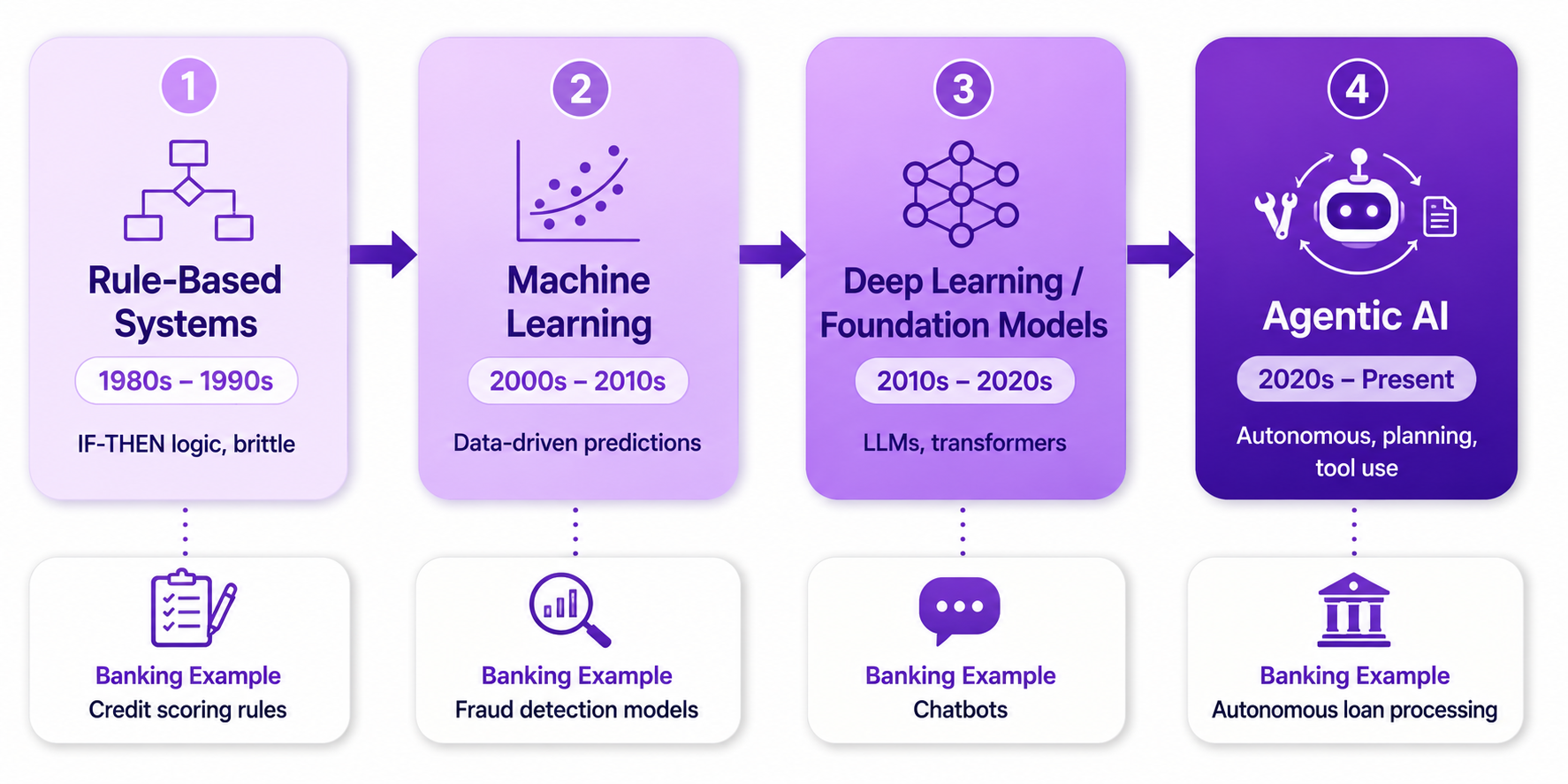
Diagram Placeholder 1: Evolution of AI to Agentic AI
Phase 1: Rule‑Based Systems (1980s‑1990s)
These systems use explicit IF‑THEN rules written by domain experts. For example:
IF customer_risk = HIGH THEN reject_loan
- Characteristics: Hard‑coded logic, deterministic, transparent, but brittle.
- Strengths: Easy to understand and audit; perform well for stable, well‑defined processes.
- Weaknesses: Cannot handle novel situations; require constant manual updates; no learning capability.
- Banking example: Credit scoring rules that assign a score based on fixed thresholds for income, debt, and payment history.
Phase 2: Machine Learning (2000s‑2010s)
Instead of explicit rules, ML models learn patterns from historical data:
Data → Model → Prediction
- Characteristics: Data‑driven, probabilistic, can handle more complexity.
- Strengths: Adapt to new data; can find subtle patterns humans might miss.
- Weaknesses: Require feature engineering and periodic retraining; limited to specific tasks; no reasoning or planning.
- Banking example: Fraud detection models that score transactions based on learned patterns, but still require human analysts to investigate alerts.
Phase 3: Deep Learning & Foundation Models (2010s‑2020s)
Large neural networks pre‑trained on vast amounts of data produce general‑purpose models:
Large neural networks → Language, vision, reasoning
- Characteristics: Pre‑trained models (LLMs), transfer learning, multi‑modal capabilities.
- Strengths: Can handle natural language, generate creative content, and answer questions with context.
- Weaknesses: Still reactive—they produce outputs based on prompts but do not plan or act autonomously.
- Banking example: Chatbots that answer customer queries using an LLM, but they do not execute actions like blocking a card or updating a database.
Phase 4: Agentic AI (2020s‑Present)
Agentic AI combines foundation models with planning, tool use, and memory to create autonomous systems:
Foundation Model + Planning + Tools + Memory = Agent
- Characteristics: Autonomous reasoning and action; dynamic tool use; multi‑step planning; memory and adaptation.
- Strengths: Can complete complex, multi‑step goals; interact with external systems; learn from feedback; work alongside humans or independently.
- Banking example: An agent that handles a customer's request to refinance a mortgage: it gathers current property value, checks credit, compares rates, generates offers, and schedules a call with a human advisor—all with minimal human input.
AI Agent Architecture
An AI agent is composed of four core components that work together in a continuous cycle.

Diagram Placeholder 2: AI Agent Architecture
Perception
The agent gathers data and observes its environment. It may receive inputs from user messages, system events, API responses, or sensor data.
Banking example: Reads transaction data, customer messages, and market feeds.
Technologies: APIs, Sensors, Data streams, User input
Key consideration: Perception must be secure and trustworthy—agents must validate the source and integrity of incoming data.
Reasoning
The agent analyzes information and makes decisions. This is where the agent's "brain" operates: it evaluates options, predicts outcomes, and selects the best course of action.
Banking example: Assesses risk, evaluates options, and chooses actions (e.g., approve a transaction, flag for review, or block).
Technologies: LLMs, Decision trees, Rule engines, Planning algorithms
Key consideration: Reasoning must be transparent and auditable, especially in regulated environments. Agents should be able to explain why they made a decision.
Action
The agent executes decisions and interacts with the environment. Actions can be digital (API calls, database updates, sending messages) or physical (controlling devices).
Banking example: Blocks cards, transfers funds, sends alerts.
Technologies: APIs, Workflows, Automations, Notifications
Key consideration: Actions must be idempotent, secure, and reversible where possible. The agent should have guardrails to prevent unintended consequences.
Learning
The agent improves from feedback and experience. This can happen online (in real time) or offline (batch retraining). The agent adjusts its strategies, updates its knowledge, and refines its decision‑making.
Banking example: Adapts fraud patterns, personalizes offers, and improves response accuracy.
Technologies: ML models, Feedback loops, Reinforcement learning
Key consideration: Learning should be safe—agents should not drift too far from intended behaviour. Monitoring and periodic human review are essential.
        Perception
            ↑
            |
    Learning ← → Reasoning
            |
            ↓
          Action
AI agents perceive, reason, act, and learn in a continuous cycle.
Key Characteristics of Agentic AI
An agentic system exhibits several defining traits. These characteristics distinguish it from simpler AI systems.
Autonomy
The agent can operate without constant human intervention. It makes its own decisions within its defined scope.
Banking example: An agent monitors transactions for fraud and automatically blocks suspicious activity, only alerting a human when necessary (e.g., for high‑value transactions or unusual patterns).
Why it matters: Autonomy reduces operational overhead and enables 24/7 operation. However, the degree of autonomy should be calibrated based on risk and regulatory requirements.
Reactivity
The agent responds to changes in its environment in a timely manner. It does not need to wait for a human trigger; it watches for events and acts accordingly.
Example: A customer service agent detects a frustrated tone in the customer's messages (via sentiment analysis) and escalates to a human manager immediately, rather than proceeding with a standard script.
Why it matters: Reactivity enables real‑time interventions, which is critical in banking for fraud, customer satisfaction, and operational resilience.
Proactivity
The agent takes initiative to achieve goals, not just react. It can anticipate needs and act before being explicitly asked.
Example: An agent proactively reminds customers about upcoming premium payments or suggests refinancing options when interest rates drop, based on their loan profile.
Why it matters: Proactive agents drive business value by identifying opportunities and mitigating risks early.
Social Ability
The agent can collaborate with other agents or humans. It can communicate its plans, request information, and coordinate actions.
Example: Multiple agents—a loan processing agent, a credit check agent, and a document verification agent—work together to approve a loan. They exchange data and statuses to complete the workflow efficiently.
Why it matters: Complex tasks often require specialization. Multi‑agent systems can tackle problems that a single agent cannot handle alone.
Adaptability
The agent learns from experience and improves over time. It can adjust its behaviour based on outcomes, user feedback, and changing conditions.
Example: A recommendation agent refines its suggestions based on customer acceptance rates, gradually improving its accuracy.
Why it matters: In dynamic banking environments, adaptability ensures that agents remain effective as markets, regulations, and customer preferences evolve.
Tool Use
The agent can leverage external tools, APIs, and databases to accomplish tasks. It is not limited to its internal knowledge; it can query external systems, invoke functions, and manipulate data.
Example: An agent calls a credit bureau API, a CRM system, and an email service to complete a customer onboarding process.
Why it matters: Tool use is what makes agents practical in enterprise settings. They can integrate with the existing tech stack and automate real work.
Agentic AI vs. Traditional AI
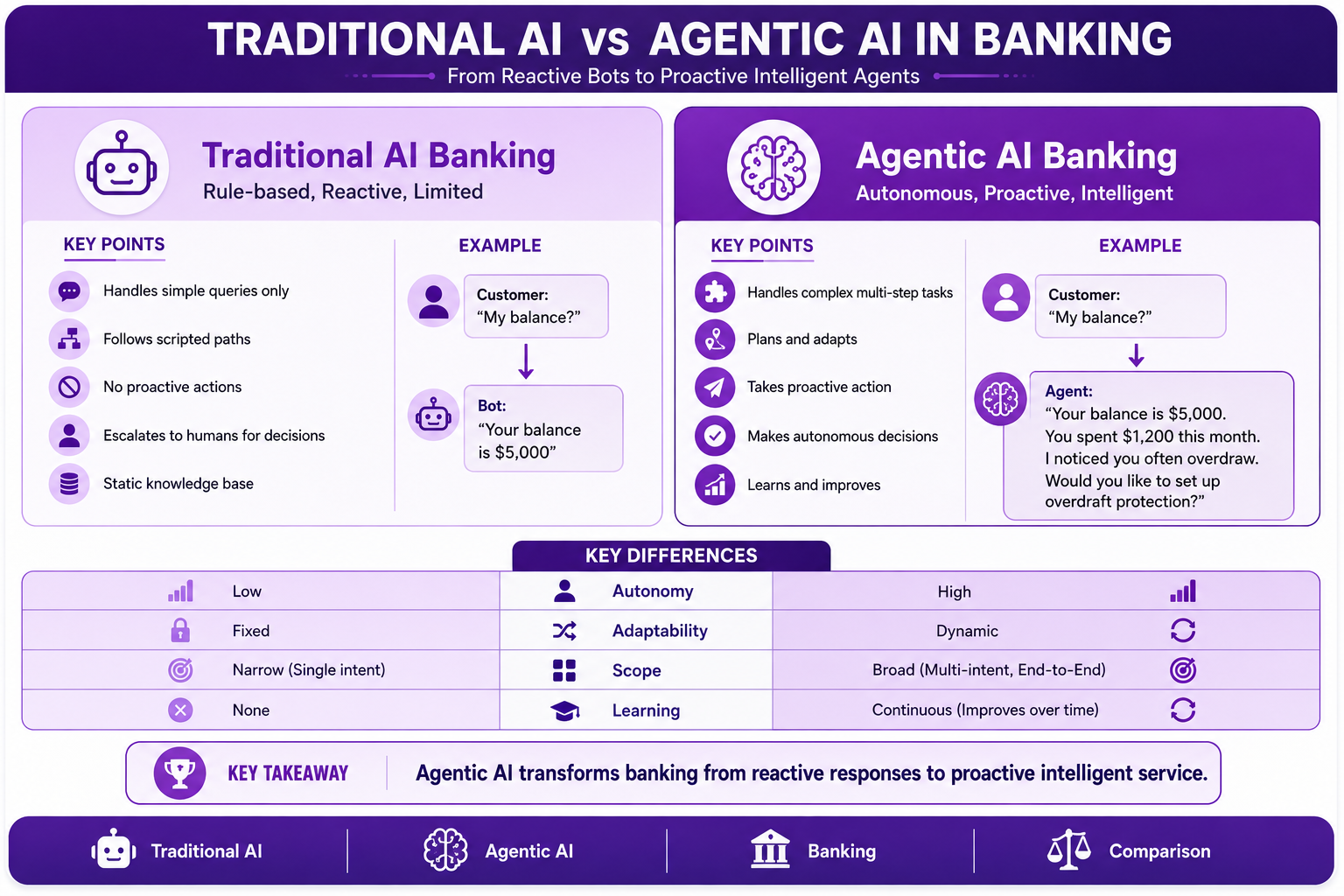
Diagram Placeholder 3: Traditional vs Agentic AI in Banking
| Aspect | Traditional AI | Agentic AI |
|---|---|---|
| Interaction | Single turn (question‑answer) | Multi‑turn, goal‑oriented |
| Scope | Task‑specific | Multi‑step, cross‑domain |
| Planning | None or static | Dynamic, adaptive |
| Memory | Stateless or limited context | Short‑term and long‑term memory |
| Tool Use | None or fixed | Flexible, on‑demand |
| Adaptability | Retraining required | Continuous learning from feedback |
| Human Oversight | High | Low to moderate |
| Examples | Chatbots, classifiers | Autonomous assistants, orchestrators |
The key shift is from reactive systems that produce outputs on demand to proactive systems that take initiative and manage workflows. In banking, this means moving from a bot that answers "What is my balance?" to an agent that not only answers but also suggests actions—like moving excess funds to a savings account or alerting about an upcoming bill.
Banking Agent Workflow
The following diagram illustrates how an AI agent handles a customer request end‑to‑end in a banking context.
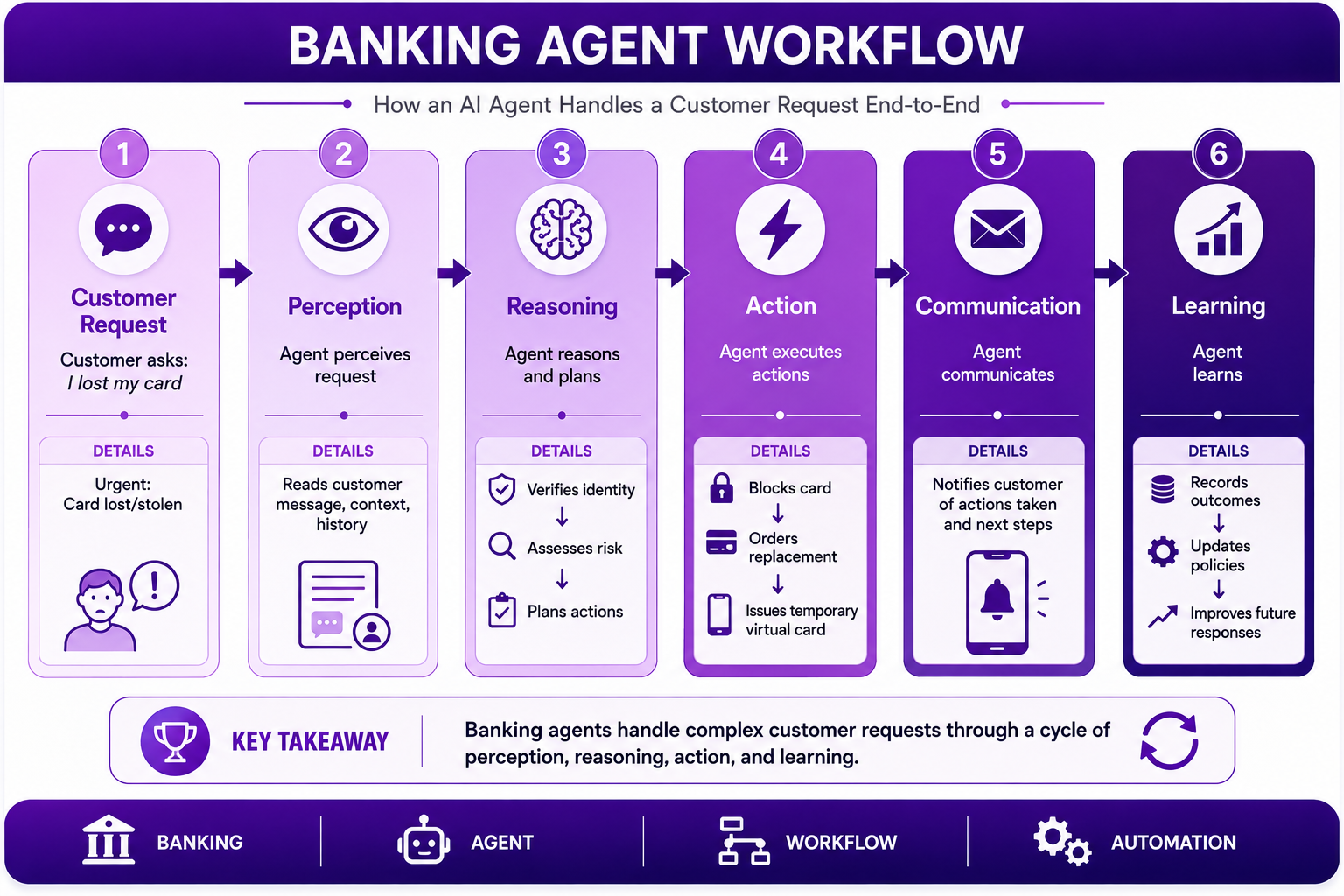
Diagram Placeholder 4: Banking Agent Workflow
Step 1: Customer Request
The customer initiates interaction.
Example: "I lost my card"
Details: Urgent: Card lost/stolen
The agent must quickly assess the urgency and proceed with appropriate actions.
Step 2: Perception
The agent perceives the request.
Actions: Reads customer message, context, and history
It also authenticates the customer, fetches their account details, and retrieves any recent interactions.
Step 3: Reasoning
The agent reasons and plans.
Actions: Verifies identity → Assesses risk → Plans actions
The agent decides whether to block the card immediately, issue a temporary virtual card, or order a physical replacement. It may also check if there are any pending transactions that need to be flagged.
Step 4: Action
The agent executes actions.
Actions: Blocks card → Orders replacement → Issues temporary virtual card
Each action involves calling multiple backend systems: core banking, card management, and notification services.
Step 5: Communication
The agent communicates with the customer.
Actions: Notifies customer of actions taken and next steps
It sends a clear, empathetic message explaining what has been done and what the customer should expect next (e.g., delivery timeline, temporary card details).
Step 6: Learning
The agent learns from the interaction.
Actions: Records outcomes → Updates policies → Improves future responses
It logs the entire interaction, notes any issues (e.g., delays in card replacement), and may adjust its workflow for similar future requests.
Customer Request
       ↓
   Perception
       ↓
   Reasoning
       ↓
    Action
       ↓
 Communication
       ↓
   Learning
Banking agents handle complex customer requests through a cycle of perception, reasoning, action, and learning.
AI Assistants, Copilots, and Agents – What's the Difference?
In the enterprise, you will encounter these terms. They are not interchangeable; they represent different levels of autonomy and capability.
AI Assistant
- Responds to user queries in natural language
- Typically single‑turn or limited context
- No persistent memory or proactive actions
- Example: A FAQ bot that answers account balance questions
An assistant is essentially a knowledgeable conversational interface. It can retrieve information and explain it, but it cannot perform actions or manage processes.
Copilot
- Works alongside a human, providing suggestions and completing partial tasks
- Uses context from the user's current activity
- Can perform actions with user approval
- Example: A copilot that helps a banker draft a loan offer letter by pulling data and suggesting clauses
Copilots enhance human productivity. They are interactive and collaborative, but they require human authorization for critical actions.
AI Agent
- Operates autonomously towards a goal
- Plans, uses tools, maintains memory, and adapts
- Can execute actions without explicit step‑by‑step instruction
- Example: An agent that processes incoming claims: it extracts data, checks policy terms, calculates payout, and submits for approval—all with minimal human involvement
Agents are the most powerful and autonomous. They can run entire workflows, make decisions, and take actions without waiting for human prompts, though they may still include human‑in‑the‑loop checkpoints for high‑stakes decisions.
Continuum
Assistant <-------- Copilot ---------> Agent
(Reactive)       (Collaborative)      (Autonomous)
Most enterprise deployments start with assistants and copilots, then evolve toward full agents. This gradual progression allows organizations to build trust, refine processes, and manage risk.
Banking Industry Use Cases for Agentic AI
Banking is a fertile ground for agentic AI due to its data‑intensive, process‑driven, and customer‑centric nature. Below are some of the most impactful applications.
1. Customer Service & Support
- Handle routine inquiries (balance, transaction history, card blocking)
- Resolve complaints by gathering context and escalating appropriately
- Proactively notify customers about fraud alerts or account changes
Agents can reduce call center volumes, improve resolution times, and free human agents for complex issues.
2. Fraud Detection & Prevention
- Monitor transactions in real time
- Trigger additional authentication or block transactions
- Collaborate with compliance agents to file suspicious activity reports
Agentic systems can go beyond simple rule‑based alerts by incorporating contextual intelligence—for example, linking a transaction to a customer's travel plans or spending patterns—and taking immediate action.
3. Loan & Credit Processing
- Collect and validate applicant documents
- Integrate with credit bureaus and internal scoring models
- Make preliminary approval decisions and route complex cases to underwriters
Agents can accelerate lending decisions, improve consistency, and reduce manual errors.
4. Wealth Management & Advisory
- Analyse market data and customer portfolios
- Generate personalised investment recommendations
- Rebalance portfolios based on risk appetite and market conditions
Agents can provide 24/7 advisory services, helping customers manage their investments with timely, data‑driven insights.
5. Regulatory Compliance (KYC/AML)
- Screen customer identities against watchlists
- Aggregate transaction data for reporting
- Flag anomalies and generate audit trails
Compliance agents can ensure that regulatory obligations are met continuously, reducing the risk of fines and reputational damage.
6. Operational Efficiency
- Automate back‑office reconciliation
- Manage document workflows (contracts, statements)
- Orchestrate multi‑step processes across legacy systems
Agents can act as the "digital workforce" that connects disparate systems and automates routine administrative work.
Enterprise AI Maturity Model
Organisations typically progress through stages of AI adoption. Understanding where you stand helps plan the journey toward agentic AI.
Level 1: Ad-hoc AI (isolated experiments, no strategy)
Level 2: Repeatable AI (standard tools, some governance)
Level 3: Defined AI (integrated with business processes)
Level 4: Managed AI (metrics, monitoring, active governance)
Level 5: Optimized AI (continuous improvement, autonomous agents)
Agentic AI typically emerges at Levels 4 and 5, where AI becomes a trusted partner in business operations. At these levels, organizations have robust data pipelines, clear governance, and a culture that embraces automation and intelligent decision‑making.
Challenges and Risks
While Agentic AI is powerful, it introduces new risks that must be addressed proactively.
Hallucination & Inaccurate Reasoning
Agents may generate plausible but incorrect outputs. This is critical in banking, where a wrong decision can have financial and legal consequences.
Mitigation: Guardrails, verification steps, human‑in‑the‑loop for high‑stakes decisions. Use factual retrieval and cross‑checking to minimize hallucinations.
Security & Privacy
Agents have broad access to systems and data. They can be exploited by malicious actors or inadvertently leak sensitive information.
Mitigation: Least‑privilege access, robust authentication, audit logs. Implement strict access controls and monitor agent activity continuously.
Loss of Human Oversight
Over‑autonomous agents may drift from business objectives or behave in unexpected ways.
Mitigation: Regular monitoring, clear escalation paths, fallback mechanisms. Design agents with "circuit breakers" that pause operations if anomalies are detected.
Regulatory Compliance
Agents must adhere to financial regulations (e.g., GDPR, Basel III, AML laws). Non‑compliance can result in heavy fines and reputational damage.
Mitigation: Embed compliance rules into agent reasoning, maintain explainability. Document every decision and maintain an audit trail.
Integration Complexity
Agents must interface with legacy systems, APIs, and data silos. This can be technically challenging and expensive.
Mitigation: Use standardised APIs, adapters, and incremental rollout. Start with simple integrations and expand gradually.
Best Practices for Adopting Agentic AI
✅ Start with well‑defined, low‑risk processes – Choose processes that are repetitive, rule‑based, and have clear success metrics.
✅ Design for human‑in‑the‑loop initially – Increase autonomy gradually as trust and performance improve.
✅ Build observability into every agent – Logs, traces, and metrics are essential for debugging, auditing, and improving agents.
✅ Test agents extensively – Simulate realistic scenarios and edge cases to uncover failure modes.
✅ Implement strong identity and access controls – Ensure agents can only perform actions they are authorized to do.
✅ Maintain a clear chain of reasoning – For compliance and trust, agents should be able to explain their decisions.
✅ Continuously evaluate performance and drift – Regularly assess agents against business outcomes and retrain or reconfigure as needed.
✅ Foster a culture of responsible AI – Establish ethical guidelines and involve stakeholders from legal, compliance, and business teams.
Common Mistakes
❌ Deploying agents without sufficient guardrails or testing – This leads to unpredictable behaviour and potential harm.
❌ Assuming agents understand business context without explicit instructions – Agents need clear prompts, policies, and constraints.
❌ Giving agents overly broad permissions – This increases risk; follow the principle of least privilege.
❌ Neglecting monitoring and feedback mechanisms – Without feedback, agents cannot improve and may degrade over time.
❌ Treating agent outputs as final without verification – Always have a human or automated check for critical decisions.
❌ Ignoring the need for explainability – Especially in regulated industries, "black box" agents are unacceptable.
Interview Questions
- What is Agentic AI and how does it differ from traditional AI?
- Explain the key characteristics of an AI agent.
- How would you design a customer service agent for a bank?
- What are the risks of deploying autonomous agents in financial services?
- Compare an AI assistant, a copilot, and an AI agent.
- What role does planning play in agentic systems?
- How do agents use tools? Give a banking example.
- Why is memory important for agents?
- How can you ensure compliance when using agentic AI?
- What are the main challenges in integrating agents with legacy systems?
Practice Exercises
- Identify three banking processes that could benefit from agentic automation. For each, describe the agent's perception, reasoning, and action steps.
- Draw a simple workflow for a loan‑processing agent that includes at least three external system calls (e.g., credit check, document storage, email).
- Compare a rule‑based system, a machine learning model, and an agentic system for fraud detection. List pros and cons of each.
- Design a high‑level architecture for a multi‑agent system that handles customer onboarding (KYC, account opening, welcome communication).
Key Takeaways
- Agentic AI represents a paradigm shift from reactive models to proactive, goal‑oriented systems
- Agents perceive, reason, plan, act, and learn—they are not just language models
- Banking and financial services are prime domains for agentic AI due to complex, multi‑step processes
- Enterprises must adopt a maturity model and gradually increase autonomy
- Responsible AI practices are non‑negotiable for trustworthy agentic systems
Chapter Summary
In this chapter, you learned:
- What Agentic AI is and why it exists
- The evolution from rule‑based systems to intelligent agents
- The four core components of AI agents: Perception, Reasoning, Action, and Learning
- How to differentiate assistants, copilots, and agents
- Banking industry use cases for agentic automation
- The challenges, risks, and best practices for adoption
You now have the conceptual foundation required to start designing enterprise‑grade agentic AI systems.