
Chapter 2: Enterprise AI Concepts
In the previous chapter, we introduced Agentic AI and explored its core characteristics, evolution, and banking use cases. We learned that AI agents are not isolated models but systems that perceive, reason, act, and learn. However, deploying Agentic AI in an enterprise—especially in a heavily regulated industry like banking—requires more than just building agents. It requires a holistic enterprise AI strategy that spans architecture, integration, data, governance, and maturity.
Agentic systems do not exist in a vacuum. They must integrate with existing banking infrastructure, comply with strict regulations, handle sensitive customer data, and deliver reliable, scalable services. This chapter provides the broader enterprise context that every AI practitioner must understand before designing or deploying agents at scale.
We will cover the typical layered architecture of an enterprise AI system, the integration patterns that connect AI to core banking processes, the maturity stages that organisations go through, and the cultural and organisational shifts needed for long‑term success. Throughout, we continue to use banking examples to make these concepts tangible and directly applicable.
🎯 Learning Objectives
By the end of this chapter, you will be able to:
- Describe the layers of an enterprise AI architecture in banking and explain how they interact
- Explain the importance of integration patterns for AI workloads and choose the right pattern for a given use case
- Differentiate between real‑time, batch, streaming, and agent‑collaboration patterns and their trade‑offs
- Understand the AI maturity model and assess where your organisation stands
- Identify the key components of an enterprise AI platform and their roles
- Recognise the organisational and cultural enablers that drive AI adoption
- Articulate the role of data governance, security, and compliance in enterprise AI
- Apply best practices to avoid common pitfalls when scaling AI in a bank
Enterprise AI Architecture in Banking
Modern banks operate complex, distributed ecosystems that include legacy core systems, modern microservices, multiple customer channels, and vast amounts of data. Adding AI agents into this mix requires a well‑structured architecture that enables scalability, reliability, and governance. Without a clear architecture, AI initiatives become siloed, difficult to maintain, and costly to integrate.
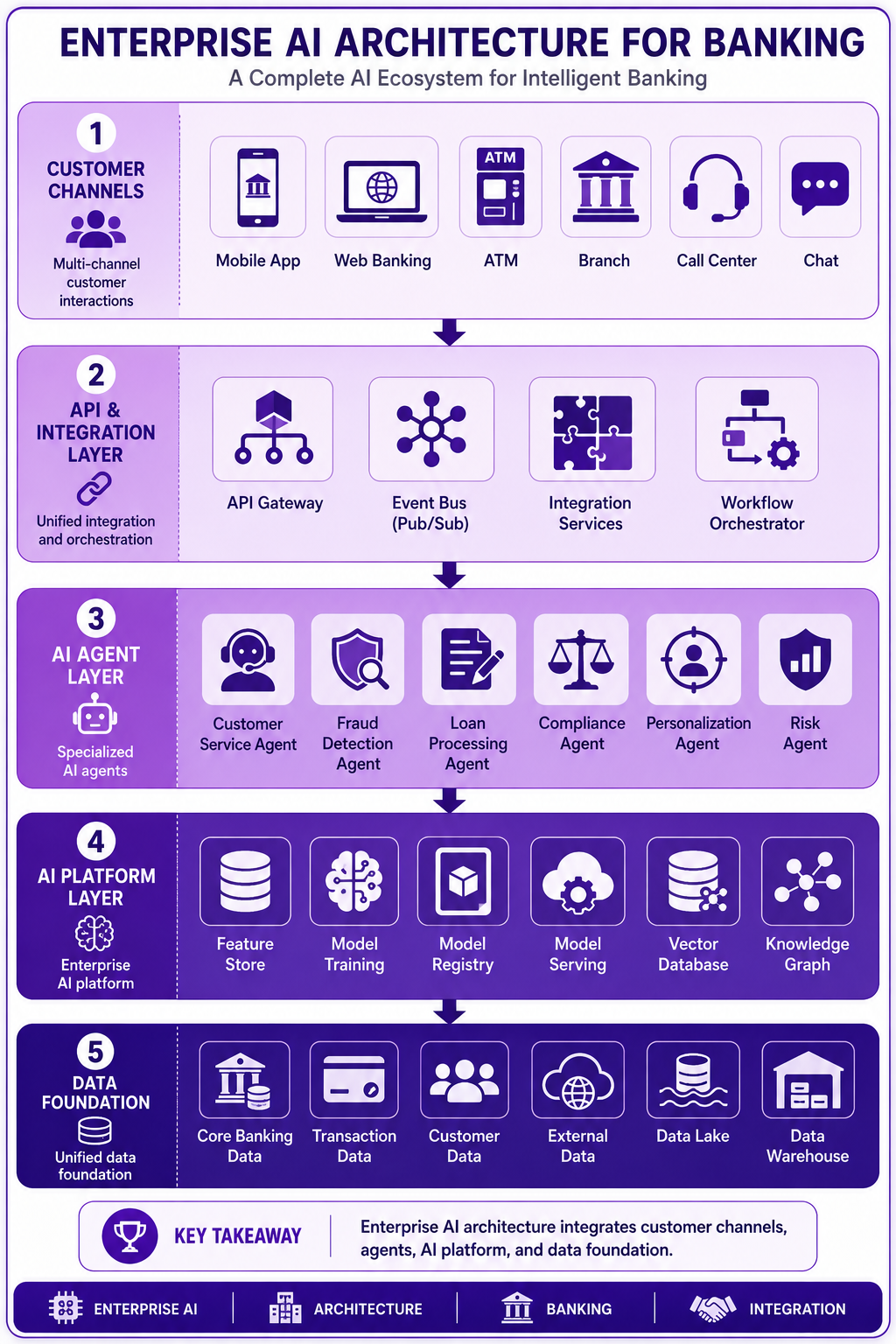
Diagram Placeholder 1: Enterprise AI Architecture in Banking
Layer 1: Customer Channels
The top layer represents all the touchpoints through which customers interact with the bank. These channels generate requests and data that flow into the AI ecosystem. Agents must be able to receive inputs from any channel and respond consistently, regardless of the source.
- Mobile App – Most customers now use mobile banking for everyday transactions, balance checks, and support. Agents integrated here must handle push notifications, in‑app messages, and secure authentication.
- Web Banking – The web portal offers richer functionality; agents can assist with loan applications, investment advice, and document uploads.
- ATM – Although ATMs have limited interfaces, they can trigger fraud alerts or prompt for additional verification based on agent decisions.
- Branch – In‑branch interactions may involve face‑to‑face conversations with staff, where agents can provide real‑time recommendations or automated note‑taking.
- Call Center – Voice and chat interactions are prime candidates for agentic support, including sentiment analysis, call summarisation, and automated case routing.
- Chat – Live chat on the website or within the app is often the first point of contact; agents can handle simple queries instantly and escalate complex ones.
The key architectural challenge is to ensure that agents receive the same context regardless of the channel, so that a customer switching from mobile to web gets a seamless experience.
Layer 2: API & Integration Layer
This layer provides the connective tissue that links channels to AI agents and backend systems. It abstracts the complexity of internal services and legacy systems, exposing a consistent interface for agents.
- API Gateway – Routes requests from channels to the appropriate agent or service. It handles authentication (OAuth2, JWT), rate limiting, request validation, and versioning. It also provides a single entry point for external partners.
- Event Bus (Pub/Sub) – Decouples producers (e.g., transaction systems) and consumers (e.g., fraud agents) enabling asynchronous communication. This is critical for event‑driven architectures where agents react to events like new transactions, customer profile updates, or market changes.
- Integration Services – Connects to core banking systems (often mainframe‑based), CRM, document management, and external partners (credit bureaus, payment networks). These services translate between modern APIs and legacy protocols (SOAP, XML, MQ).
- Workflow Orchestrator – Coordinates multi‑step processes across agents and systems. For example, an orchestrator might manage a loan application: it invokes a document‑collection agent, a credit‑scoring agent, a fraud agent, and finally a decision agent, ordering their execution based on dependencies.
This layer ensures that agents can access the data and services they need, while maintaining security, observability, and resilience. It also provides a natural place to implement service‑level agreements (SLAs) and circuit breakers.
Layer 3: AI Agent Layer
This is where the intelligent agents reside. Each agent is specialised for a particular business capability. They can operate independently or collaborate through the orchestration layer.
- Customer Service Agent – Handles inquiries, complaints, and proactive notifications. It can retrieve account details, transaction histories, and product information, and respond with natural language. It may also escalate to human agents for complex issues.
- Fraud Detection Agent – Monitors transactions, blocks suspicious activity, and files reports with compliance. It uses real‑time models and rule engines to score transactions and can trigger additional authentication.
- Loan Processing Agent – Collects and validates applicant documents, checks credit scores from bureaus, applies underwriting policies, and makes preliminary approval decisions. It can also generate offer letters and schedule meetings with human underwriters.
- Compliance Agent – Screens customers against sanctions lists, monitors transactions for anti‑money laundering (AML) and know‑your‑customer (KYC) compliance, and generates audit trails. It must be highly explainable to satisfy regulators.
- Personalization Agent – Analyses customer behaviour, spending patterns, and life events to offer tailored product recommendations, such as credit cards, savings plans, or investment products.
- Risk Agent – Assesses portfolio risk, market risk, and credit risk in real time, providing early warnings to risk managers and suggesting hedging strategies.
Each agent encapsulates a specific domain knowledge and can be developed, tested, and deployed independently, following microservices principles.
Layer 4: AI Platform Layer
This layer provides the infrastructure and tools to build, deploy, and manage AI models. It is the "engine room" that powers the agents.
- Feature Store – Centralised repository for storing, sharing, and managing features (input variables) used in model training and inference. It ensures consistency between training and serving, reduces duplication, and enables feature discovery.
- Model Training – Environment for developing and experimenting with models, including Jupyter notebooks, distributed training clusters, and hyperparameter optimisation tools.
- Model Registry – Version‑controlled catalogue of trained models with metadata (version, performance metrics, training data, lineage). It supports model lifecycle management (staging, production, archiving) and enables rollback.
- Model Serving – Infrastructure that hosts models for inference. Supports real‑time (REST/gRPC) and batch prediction. Must be scalable, low‑latency, and highly available.
- Vector Database – Stores embeddings (vector representations) for semantic search, similarity matching, and retrieval‑augmented generation (RAG). Essential for agents that need to retrieve relevant documents, policies, or past interactions from large knowledge bases.
- Knowledge Graph – A graph database representing entities (customers, accounts, products, transactions) and their relationships. Enables reasoning and contextual understanding for agents, allowing them to infer connections not explicitly stated.
This platform is essential for MLOps and enables continuous improvement of AI agents through experimentation, monitoring, and automated retraining.
Layer 5: Data Foundation
The bottom layer is the unified data foundation that fuels everything above. High‑quality, well‑governed data is the prerequisite for any AI system.
- Core Banking Data – Customer accounts, balances, transactions, loans, and deposits. This is the system of record.
- Transaction Data – Detailed records of all financial transactions, including timestamps, amounts, counterparties, and merchant codes.
- Customer Data – Profiles, demographics, preferences, interaction history, and contact details.
- External Data – Market data (stock prices, interest rates), credit bureau reports, social media feeds, regulatory watchlists, and economic indicators.
- Data Lake – Raw, unstructured data (e.g., PDFs, images, call transcripts) for exploration and experimentation.
- Data Warehouse – Structured, curated data for reporting, BI, and model training.
Data must be governed, secured, and made accessible to the AI platform with appropriate privacy controls (e.g., anonymisation, encryption, access logging). Data lineage and quality are critical for auditability.
Customer Channels
       ↓
API & Integration Layer
       ↓
AI Agent Layer
       ↓
AI Platform Layer
       ↓
Data Foundation
Enterprise AI architecture integrates customer channels, agents, AI platform, and data foundation. Each layer depends on the one below it, and the whole system is designed for flexibility, scalability, and governance.
Enterprise AI Integration Patterns
Different banking use cases require different integration patterns. The choice of pattern affects latency, throughput, scalability, and complexity. Using the wrong pattern can lead to poor performance, high costs, or missed business opportunities.
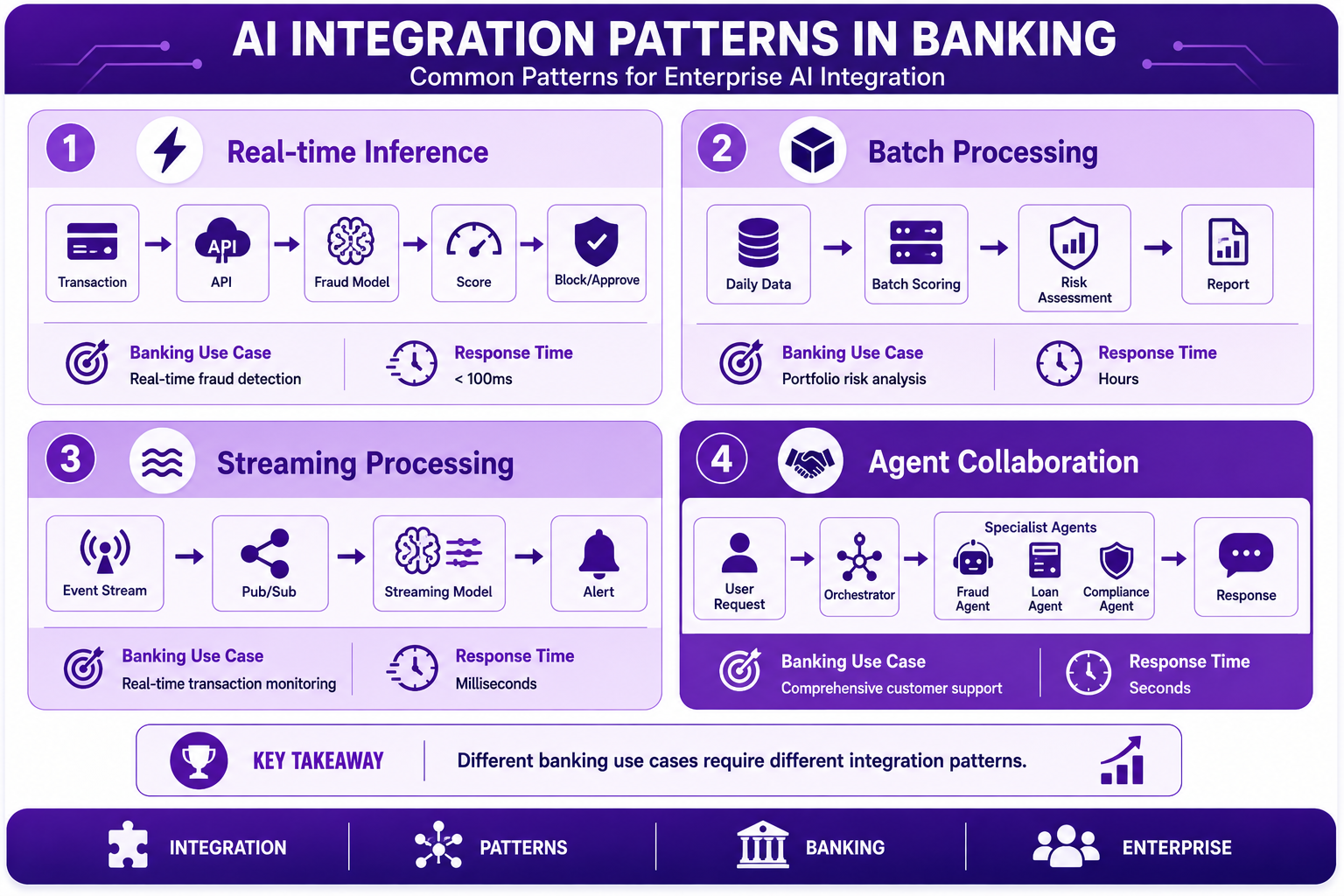
Diagram Placeholder 2: Enterprise AI Integration Patterns
Pattern 1: Real‑time Inference
Description: The AI model scores requests synchronously and returns an immediate decision. The request is typically triggered by a user action or a system event that requires a near‑instantaneous response.
Flow: Transaction → API → Fraud Model → Score → Block/Approve
Banking Use Case: Real‑time fraud detection on card transactions. When a customer makes a purchase, the transaction details are sent to the fraud model, which returns a risk score within milliseconds. Based on that score, the transaction is either approved, declined, or flagged for additional verification.
Response Time: < 100ms
Trade‑offs: This pattern provides the fastest decisions but requires highly optimised models, low‑latency serving infrastructure, and careful management of peak loads. It is also costly because you pay for compute per request. However, for fraud prevention, the benefit of blocking fraudulent transactions in real time far outweighs the cost.
Pattern 2: Batch Processing
Description: Large volumes of data are processed periodically (e.g., nightly, weekly) to generate insights that do not require immediate action.
Flow: Daily Data → Batch Scoring → Risk Assessment → Report
Banking Use Case: Portfolio risk analysis, where the bank evaluates the risk profile of all loans collectively to determine capital reserves, set interest rates, or identify concentration risks. The results are used for regulatory reporting and strategic planning.
Response Time: Hours
Trade‑offs: Batch processing is efficient for large datasets because you can optimise for throughput rather than latency. It is also cheaper, as you can use lower‑cost compute resources during off‑peak hours. However, it is not suitable for time‑sensitive decisions.
Pattern 3: Streaming Processing
Description: Continuous streams of events are processed as they arrive, with low latency, but without the overhead of per‑request synchronous calls. This is often implemented using message queues and stream processing frameworks (e.g., Kafka, Flink).
Flow: Event Stream → Pub/Sub → Streaming Model → Alert
Banking Use Case: Real‑time transaction monitoring for anti‑money laundering (AML). Instead of scoring each transaction individually in a synchronous request, the transaction events are published to a stream. The model consumes the stream, applies scoring, and generates alerts when suspicious patterns (e.g., multiple small deposits just below reporting thresholds) are detected.
Response Time: Milliseconds to seconds
Trade‑offs: Streaming provides near‑real‑time insights with high scalability and fault tolerance. It decouples producers and consumers, making the system more resilient. However, it introduces complexity in state management (windowing, aggregations) and requires careful handling of exactly‑once semantics.
Pattern 4: Agent Collaboration
Description: Multiple agents work together to complete a complex task, coordinated by an orchestrator. Each agent handles a specific sub‑task, and the orchestrator manages the conversation, dependencies, and result aggregation.
Flow: User Request → Orchestrator → Specialist Agents → Response
Banking Use Case: Comprehensive customer support where a customer asks a complex question: "I want to refinance my mortgage and also consolidate my credit card debt." The orchestrator invokes a mortgage agent, a credit card agent, and a risk agent, each providing their analysis, then synthesises a unified response.
Response Time: Seconds to minutes
Trade‑offs: This pattern enables flexibility and scalability by breaking down tasks into specialised components. Each agent can be developed and improved independently. However, coordination adds latency and requires careful management of state, conversations, and error handling.
Use Case                     Pattern
--------------------------   -----------------
Fraud detection              Real-time Inference
Portfolio risk analysis      Batch Processing
Transaction monitoring       Streaming Processing
Complex customer queries     Agent Collaboration
Different banking use cases require different integration patterns. Choosing the right one is critical for performance, cost, and user experience.
AI Maturity Model for Banking
Organisations do not become AI‑driven overnight. They progress through stages of maturity, each with its own characteristics, challenges, and opportunities. Understanding where your organisation stands helps you chart a realistic path forward.
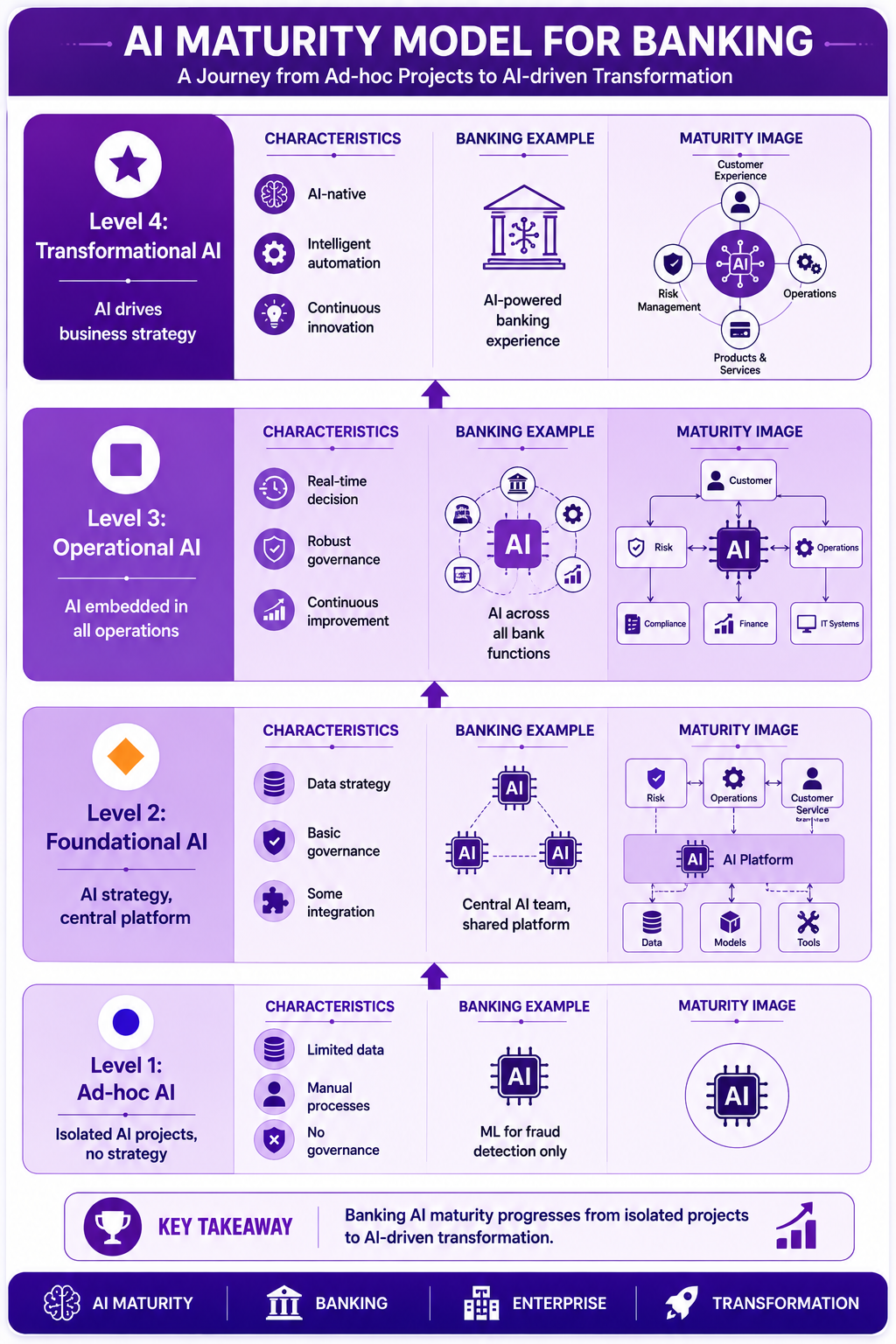
Diagram Placeholder 3: AI Maturity Model for Banking
Level 1: Ad‑hoc AI
Description: Isolated AI projects with no central strategy. Each business unit or team experiments independently, often using different tools and data sources.
Characteristics:
- Limited data access and quality issues
- Manual processes for model deployment
- No governance or standardisation
- Experiments are siloed and not shared
Banking Example: A single ML model used for fraud detection in the credit card division, but not integrated with other systems. The model is deployed as a one‑off JAR file, and updates require manual intervention.
Icon: 🔹
Challenges: Lack of reuse, high duplication of effort, and difficulty in scaling. There is no shared platform, so each project reinvents the wheel.
Next Steps: Establish a central AI team, define a common technology stack, and create a shared data infrastructure.
Level 2: Foundational AI
Description: An AI strategy is defined, and a central platform is established to support multiple projects.
Characteristics:
- Data strategy in place with defined data owners
- Basic governance (model registry, version control)
- Some integration across teams (shared feature store)
- Shared infrastructure (compute, storage)
Banking Example: A central AI team builds a shared feature store and model registry. The fraud detection team and the loan underwriting team both use the same platform, reusing features and models.
Icon: 🔸
Opportunities: Reduced duplication, faster project initiation, and better collaboration. However, governance is still light, and AI is not yet deeply embedded in business processes.
Next Steps: Move from experimentation to operationalisation, embedding AI into existing workflows and decision systems.
Level 3: Operational AI
Description: AI is embedded in all business operations and decision‑making processes. Models are deployed in production with robust monitoring and continuous improvement.
Characteristics:
- Real‑time decisions powered by AI
- Robust governance (monitoring, explainability, bias detection)
- Continuous improvement (MLOps with automated retraining)
- AI used across multiple functions (fraud, lending, marketing, service)
Banking Example: AI powers fraud detection, loan underwriting, customer service, and marketing simultaneously. Models are retrained weekly based on new data, and performance is tracked via dashboards. Compliance teams have access to explainability reports.
Icon: ⬜
Benefits: Significant efficiency gains, improved customer experience, and competitive advantage. The bank is now data‑driven and can react quickly to changes.
Next Steps: Move towards AI‑native innovation, where AI not only optimises existing processes but also creates new business models.
Level 4: Transformational AI
Description: AI drives business strategy and innovation at the highest level. The organisation is AI‑native, with AI at the core of every decision.
Characteristics:
- AI‑native culture; executives rely on AI insights
- Intelligent automation of complex, end‑to‑end workflows
- Continuous innovation through AI R&D
- AI is a competitive differentiator and brand asset
Banking Example: The bank offers an AI‑powered banking experience, where agents proactively manage finances, personalise advice, and automate nearly all routine processes. The bank's value proposition is built around AI‑enabled convenience and personalisation.
Icon: ⭐
Impact: The bank can enter new markets, launch new products faster, and achieve superior customer loyalty. However, maintaining this level requires significant investment in talent, infrastructure, and culture.
Next Steps: Continually push the boundaries of AI, explore new agentic capabilities, and ensure ethical and responsible use remains paramount.
Level 4: Transformational AI  <--- AI drives business strategy
Level 3: Operational AI       <--- AI embedded in operations
Level 2: Foundational AI      <--- Central platform and strategy
Level 1: Ad‑hoc AI            <--- Isolated projects
Banking AI maturity progresses from isolated projects to AI‑driven transformation. Each level builds on the previous one, and moving up requires investment in people, process, and technology.
Key Components of an Enterprise AI Platform
An enterprise AI platform is the technical foundation that enables organisations to build, deploy, and manage AI agents at scale. The following components are essential, and each plays a specific role in the lifecycle of AI models.
Feature Store
A central repository for storing, sharing, and managing features used in model training and inference. It ensures consistency between training and serving (avoiding training‑serving skew), enables feature reuse across teams, and provides versioning and lineage.
Banking example: Features like customer transaction frequency, average balance, credit score, recent loan applications, and number of late payments. These features are computed from raw data and stored in the feature store, so they are available for both training and real‑time scoring.
Key benefits: Reduces duplicated effort, improves data quality, and speeds up model development.
Model Training & Experimentation
Environments for data scientists and ML engineers to develop models, experiment with algorithms, and tune hyperparameters. This includes version control for code and data, experiment tracking (e.g., MLflow), and reproducibility.
Banking example: A data scientist explores multiple algorithms (logistic regression, random forest, XGBoost) for credit risk prediction. They track each experiment, compare metrics, and select the best model.
Model Registry
A catalog of trained models with metadata (version, performance metrics, training data, model parameters, and lineage). It supports model lifecycle management (staging, production, archiving) and enables rollback to previous versions.
Banking example: Before deploying a new fraud detection model, it is registered with validation metrics. The registry tracks which model is in production, and if performance degrades, the team can quickly revert to an older version.
Model Serving
Infrastructure that hosts models for inference. Supports real‑time (REST/gRPC) and batch prediction. Must be scalable, low‑latency, and highly available. Often includes features like auto‑scaling, load balancing, and canary deployments.
Banking example: A loan‑approval model is served via a REST API that receives customer data and returns a decision. The serving layer scales automatically during peak application periods.
Vector Database
Used to store and query embeddings for semantic search, similarity matching, and retrieval‑augmented generation (RAG). Essential for agents that need to retrieve context from knowledge bases, such as product documents, FAQ, or historical conversations.
Banking example: A customer service agent uses a vector database to find the most relevant policy documents based on a customer's query about mortgage refinancing, enriching its response with up‑to‑date information.
Knowledge Graph
A graph database representing entities (customers, accounts, products, transactions) and their relationships. Enables reasoning and contextual understanding for agents, allowing them to infer connections not explicitly stated.
Banking example: When a customer asks about their credit card rewards, the agent uses the knowledge graph to see that the customer also has a savings account and a mortgage, enabling a cross‑sell recommendation.
Monitoring & Observability
Tools to track model performance, drift (data and concept), latency, error rates, and resource usage. Provides dashboards, alerts, and logs to ensure reliability and compliance. This is a critical part of MLOps.
Banking example: A dashboard shows the daily average fraud detection score, the number of alerts, and the false‑positive rate. If the distribution of input features changes (data drift), an alert is triggered for review.
Governance & Compliance
Policies and tools to ensure that AI models are fair, explainable, secure, and compliant with regulations (e.g., GDPR, AI Act, Basel III). This includes audit trails, approval workflows, bias detection, and model validation.
Banking example: For a credit‑scoring model, the governance system tracks the model's training data, performance metrics, and decision‑making logic. It also runs fairness tests to check for disparate impact across demographic groups.
Organisational and Cultural Enablers
Technology alone is not sufficient. Successful enterprise AI adoption requires cultural and organisational shifts that embrace data‑driven decision‑making, experimentation, and collaboration.
Executive Sponsorship
AI initiatives must have support from top leadership to secure funding, remove barriers, and drive alignment. Without executive backing, AI projects often remain isolated and underfunded.
Banking example: The CEO champions the AI transformation, establishing a clear vision, allocating budget, and holding business unit heads accountable for AI adoption.
Cross‑functional Teams
AI projects require collaboration between data scientists, engineers, business analysts, legal/compliance, and operations. Breaking down silos and creating interdisciplinary teams accelerates delivery and ensures that solutions meet business needs.
Banking example: A fraud detection project includes data scientists, software engineers, fraud analysts, and compliance officers working together from the start.
Data‑Driven Mindset
Employees at all levels must be encouraged to make decisions based on data and insights, not just intuition. This requires training, accessible data tools, and a culture that rewards experimentation.
Banking example: Branch managers use AI‑generated insights to identify cross‑sell opportunities, and their performance is measured by data‑driven KPIs.
Continuous Learning Culture
AI evolves rapidly. Organisations must invest in upskilling employees, encouraging continuous learning, and staying current with research and industry trends. This includes formal training, conferences, and internal knowledge sharing.
Ethical AI Principles
Establishing clear principles for fairness, transparency, and accountability helps build trust with customers and regulators. These principles should guide all AI development and deployment.
Banking example: The bank publishes an AI ethics charter that commits to avoiding bias, ensuring explainability, and protecting customer privacy.
Governance and Risk Management
Banking is heavily regulated, and AI introduces new risks. Governance frameworks must address data, model, operational, and regulatory aspects.
Data Governance
- Data quality – Ensuring accuracy, completeness, and timeliness of data used by AI.
- Data lineage – Tracking the origin and transformations of data for auditability.
- Privacy and consent – Managing customer consent for data use and ensuring compliance with regulations.
- Access controls and encryption – Protecting sensitive data from unauthorised access.
Example: The bank maintains a data catalogue that documents the sources, transformations, and owners of all data used in AI models.
Model Governance
- Model validation and approval – Independent review of models before deployment.
- Performance monitoring and retraining – Tracking metrics and triggering retraining when drift is detected.
- Explainability and interpretability – Ensuring that model decisions can be understood and justified.
Example: A loan‑approval model undergoes a validation process where its fairness and accuracy are assessed against a holdout dataset before it is approved for production.
Operational Governance
- Incident management and escalation – Procedures for handling model failures or unexpected behaviour.
- Business continuity and fallback – Having manual or rule‑based fallback mechanisms when AI is unavailable.
- Vendor management – Assessing and monitoring third‑party AI services for security and compliance.
Example: If the fraud detection service goes down, the bank automatically switches to a rule‑based fallback to continue processing transactions.
Regulatory Compliance
- Adherence to local and global regulations (GDPR, Basel III, AML/KYC, AI Act).
- Regular audits and reporting.
- Documentation and transparency to satisfy regulatory inspections.
Example: The bank maintains detailed logs of all AI decisions, including input features, model versions, and outputs, to provide a complete audit trail.
Best Practices for Enterprise AI
✅ Start with a clear business case and measurable KPIs – Define success in terms of business outcomes (e.g., reduced fraud losses, faster loan approvals). This ensures alignment and justifies investment.
✅ Build a cross‑functional AI governance council – Include representatives from business, technology, legal, and compliance to oversee AI strategy, priorities, and risks.
✅ Adopt MLOps practices for continuous delivery and monitoring – Treat AI models as software with version control, CI/CD, automated testing, and monitoring. This reduces time‑to‑market and improves reliability.
✅ Invest in data infrastructure and data quality – High‑quality data is the foundation of AI. Invest in data pipelines, cleansing, and governance from the start.
✅ Design AI systems with privacy and security by design – Embed privacy and security into the architecture, not as an afterthought. Use encryption, anonymisation, and access controls.
✅ Prioritise explainability, especially in customer‑facing applications – Customers and regulators need to understand why decisions are made. Use interpretable models or provide post‑hoc explanations.
✅ Foster a culture of responsible AI and ethical awareness – Train employees on AI ethics, encourage reporting of concerns, and establish clear accountability.
✅ Pilot AI in low‑risk areas, then scale gradually – Validate AI in controlled environments before expanding to mission‑critical systems. Learn from pilots and refine processes.
Common Mistakes
❌ Treating AI as a one‑time project rather than a continuous journey – AI models degrade over time; continuous monitoring and retraining are essential.
❌ Ignoring data quality and governance until late in the process – Poor data leads to poor models; governance must be established early.
❌ Building AI in isolation without integration with existing systems – AI that cannot access production data or trigger actions is useless.
❌ Overlooking the need for explainability and auditability – In banking, decisions must be justified; lack of explainability leads to regulatory issues.
❌ Underestimating the cultural and organisational changes required – AI adoption changes roles and processes; resistance must be managed.
❌ Failing to monitor models in production for drift and performance degradation – Without monitoring, models become outdated and harmful.
Interview Questions
-
Describe the five layers of an enterprise AI architecture in banking and explain how they interact.
-
What are the key differences between real‑time inference, batch processing, and streaming processing? When would you use each in a banking context?
-
Explain the AI maturity model. Where do most banks start, and what does it take to reach Level 4?
-
What components are essential in an enterprise AI platform? Why is each important?
-
How do you ensure governance and compliance in an AI system in banking? Provide concrete examples.
-
What role does a feature store play in enterprise AI, and how does it help avoid training‑serving skew?
-
Why is a vector database important for AI agents, especially in customer service?
-
How can an organisation foster a culture that supports AI adoption? What are the key cultural enablers?
-
What are the common pitfalls when scaling AI in a bank, and how can they be avoided?
-
How would you approach building a fraud detection system using the right integration patterns? Justify your choices.
Practice Exercises
-
Draw a high‑level enterprise AI architecture for a mid‑sized bank. Label the five layers and indicate which components are critical for a customer service agent. Explain the data flow from a customer query to the agent's response.
-
For each integration pattern (real‑time, batch, streaming, agent collaboration), identify a banking use case not mentioned in the chapter and explain why that pattern is appropriate, including trade‑offs.
-
Assess your organisation's (or a hypothetical bank's) AI maturity using the four levels. What steps would you take to move to the next level? Identify specific initiatives and timelines.
-
Design a governance framework for an AI agent that handles loan approvals. Include data governance, model validation, monitoring, and compliance aspects. Define roles and responsibilities.
Key Takeaways
- Enterprise AI requires a layered architecture that integrates customer channels, APIs, agents, AI platform, and data foundation. Each layer has distinct responsibilities and must be designed for scalability and governance.
- Different use cases demand different integration patterns: real‑time for immediate decisions, batch for large‑scale analytics, streaming for continuous event processing, and agent collaboration for complex workflows.
- AI maturity progresses from ad‑hoc experiments to transformational, AI‑driven business strategy. Organisations must invest in people, processes, and platforms to advance.
- An enterprise AI platform includes feature stores, model registries, vector databases, and governance tools—all essential for production‑grade AI.
- Success depends not only on technology but also on organisational culture, executive support, cross‑functional collaboration, and a commitment to responsible AI.
Chapter Summary
In this chapter, you learned:
- The layers of an enterprise AI architecture in banking and how they support agentic systems
- Four key integration patterns (real‑time, batch, streaming, agent collaboration) and when to apply them
- The AI maturity model and how organisations evolve from ad‑hoc to transformational AI
- Essential components of an enterprise AI platform and their roles
- Governance, compliance, and cultural enablers that are crucial for AI success in banking
You now understand the broader enterprise context in which AI agents operate. This foundation prepares you to design agents that are not only intelligent but also integrated, governed, and aligned with business strategy. In the next chapter, we will dive deep into the architecture of an individual AI agent, exploring its internal components and how they work together to perceive, reason, act, and learn.