
Chapter 3: Agent Architecture
In the previous chapters, we explored the fundamentals of Agentic AI and the enterprise context in which agents operate. We learned that agents are not just language models—they are autonomous systems that perceive, reason, act, and learn. However, understanding the external behaviour is not enough; to build, debug, and scale agents effectively, we must open the black box and examine their internal structure.
Now it is time to open the black box and examine the internal architecture of an AI agent. Understanding how agents are built is essential for designing, implementing, and scaling them effectively in enterprise environments. A well‑designed architecture not only ensures functional correctness but also enables maintainability, observability, and graceful evolution as requirements change.
In this chapter, we will dissect the architecture of an AI agent, exploring its core modules, their interactions, and the different architectural patterns used in banking applications. We will also examine the agent lifecycle and how agents maintain state and memory—topics that are often overlooked but are critical for delivering consistent, context‑aware experiences.
Throughout this chapter, we continue to use the banking domain to ground our examples, ensuring that the concepts are practical and applicable to real‑world financial institutions.
🎯 Learning Objectives
By the end of this chapter, you will be able to:
- Describe the complete lifecycle of an AI agent and explain how each stage contributes to autonomous behaviour
- Identify and explain the five core modules of agent architecture and their interactions
- Understand the role of different memory types in agent systems and when to use each
- Differentiate between reactive, deliberative, and hybrid architectures and select the appropriate one for a given banking use case
- Apply appropriate architecture patterns for specific business functions like customer service, fraud detection, and loan processing
- Design the internal structure of an agent for a specific business function, considering modularity and scalability
- Understand how agents maintain state and context across interactions, including handling long‑running processes
What is Agent Architecture?
Agent architecture refers to the internal structure and organisation of an AI agent. It defines:
- What modules the agent contains and their responsibilities
- How these modules interact and communicate with each other
- How data flows through the system from perception to action
- How the agent makes decisions and executes actions
- How the agent maintains state, memory, and learning over time
A well‑designed architecture is critical for building agents that are reliable, scalable, and maintainable. In banking, where agents handle sensitive customer data and regulatory obligations, architecture choices directly impact security, compliance, and customer trust. Moreover, a clear architecture allows teams to develop, test, and deploy modules independently, accelerating delivery and reducing risk.
Just as a building needs a solid blueprint, an AI agent needs a well‑defined architecture to function effectively. Without it, the agent becomes a fragile, unmaintainable monolith.
The architecture must also accommodate the fact that agents operate in dynamic environments—customer needs change, market conditions shift, and regulations evolve. A modular, loosely coupled architecture allows the agent to adapt without requiring a complete rewrite.
Agent Lifecycle
Agents operate in a continuous cycle of perception, reasoning, and action, combined with learning over time. Understanding this lifecycle is the foundation for designing agent systems. Each stage feeds into the next, and learning is the only stage that can happen asynchronously, often in the background, to continuously improve the agent.
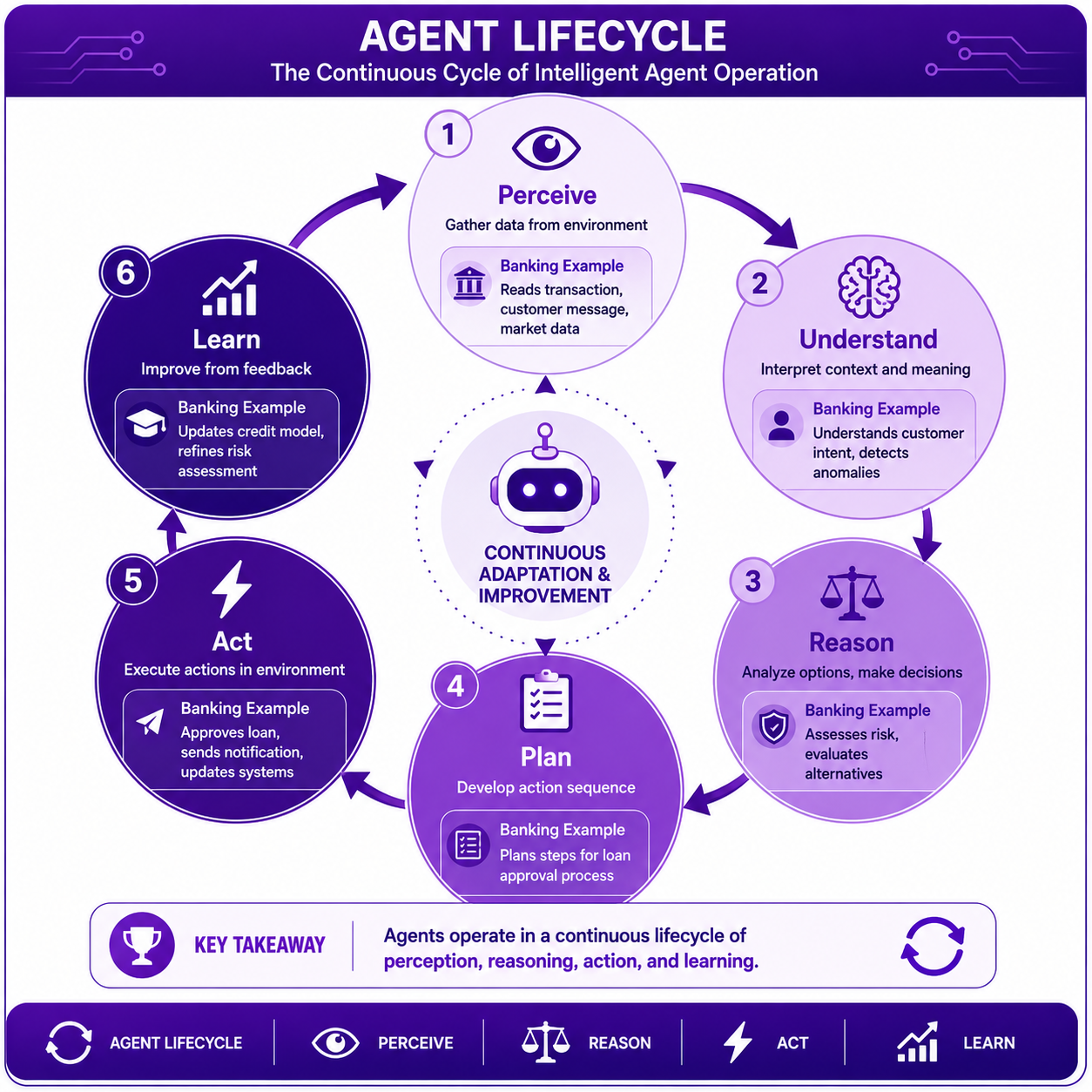
Diagram Placeholder 1: Agent Lifecycle
Step 1: Perceive
The agent gathers data from its environment. This is the input stage where raw data is collected from various sources—both structured (e.g., transaction logs, account balances) and unstructured (e.g., customer messages, call transcripts). The perception module must handle different data formats, perform necessary parsing, and prepare the data for further processing.
Banking Example: Reads transaction data, customer messages, and market feeds. For instance, when a customer sends a message via chat, the perception module captures the text, the customer ID, the session ID, and any attachments.
Key Activities:
- Collecting structured and unstructured data
- Receiving user inputs and API calls
- Monitoring event streams and system changes
- Data validation and cleansing (e.g., removing personally identifiable information if not needed)
- Transforming data into a common internal format
Considerations: Perception must be robust to noisy or incomplete data. In banking, data may come from disparate systems with different schemas; the perception module should normalise these into a unified representation.
Step 2: Understand
The agent interprets the context and meaning of the perceived data. This goes beyond mere parsing; it involves natural language understanding (NLU) for text, entity recognition, intent classification, and contextual interpretation. The agent builds a mental model of the current situation, including the user's goal, the state of any ongoing processes, and relevant historical context.
Banking Example: Understands customer intent (e.g., "I want to check my loan status" vs. "I want to apply for a loan"), detects anomalies (e.g., unusual transaction patterns), and identifies key entities (e.g., account numbers, dates, amounts).
Key Activities:
- Natural language understanding (NLU)
- Contextual interpretation (e.g., resolving pronouns, maintaining dialogue state)
- Entity recognition and extraction (e.g., names, account IDs, transaction amounts)
- Anomaly detection and pattern recognition
- Sentiment analysis (e.g., detecting frustration to escalate)
Considerations: Understanding must be accurate and fast. Misinterpreting a customer's intent can lead to incorrect actions. In regulated environments, the understanding stage must also capture enough information to provide explainability later.
Step 3: Reason
The agent analyzes options and makes decisions based on its understanding. This is the "thinking" part of the agent, where it evaluates possible courses of action, weighs trade‑offs, and chooses the best one. Reasoning can be rule‑based, probabilistic, or based on learned models (e.g., reinforcement learning). It may involve simulation, what‑if analysis, or optimisation.
Banking Example: Assesses risk for a loan application by combining credit score, income, debt‑to‑income ratio, and other factors. It evaluates whether to approve, reject, or request more information. For fraud detection, it determines if a transaction is legitimate, suspicious, or fraudulent.
Key Activities:
- Logical reasoning and inference (e.g., applying business rules)
- Risk assessment and scoring (e.g., credit scoring, fraud scoring)
- Option evaluation and selection (e.g., which product to recommend)
- Trade‑off analysis (e.g., balancing customer satisfaction vs. risk)
- Constraint checking (e.g., regulatory caps on loan amounts)
Considerations: The reasoning module is often the most computationally intensive. It may involve multiple models, rule engines, and external data calls. It must produce decisions that are consistent, transparent, and auditable, especially in banking.
Step 4: Plan
The agent develops a sequence of actions to achieve its goal. Unlike simple decision‑making, planning involves breaking down a high‑level objective into a series of concrete steps, considering dependencies, ordering, and alternative paths. In complex banking processes, planning is essential for orchestrating multiple subtasks across different systems and human touchpoints.
Banking Example: Plans the steps for a loan approval process, including document verification, credit check, underwriting, and final approval. It may also include contingencies (e.g., if documents are missing, request them from the customer).
Key Activities:
- Decomposing goals into sub‑tasks
- Sequencing actions (what to do first, second, etc.)
- Handling dependencies and constraints (e.g., credit check must happen after identity verification)
- Contingency planning (e.g., fallback if a service is unavailable)
- Resource allocation (e.g., assigning tasks to specific sub‑agents or systems)
Considerations: Planning must be dynamic—if a step fails or new information arrives, the plan may need to be revised. In banking, plans often involve multiple systems and may take minutes or hours to complete.
Step 5: Act
The agent executes actions in the environment. This is the output stage where the agent's decisions are translated into real‑world operations. Actions can be digital (API calls, database updates, generating messages) or physical (e.g., controlling ATMs or branch devices). In banking, actions often involve updating core systems, notifying customers, or triggering workflows.
Banking Example: Approves a loan, sends a notification to the customer, updates the loan management system, and schedules a follow‑up call. For fraud, it blocks a card and sends an alert.
Key Activities:
- Calling APIs and services (internal and external)
- Generating responses (text, email, push notification)
- Updating databases (e.g., change status, record outcomes)
- Sending notifications and alerts
- Triggering downstream processes (e.g., payment disbursement)
Considerations: Actions must be idempotent (i.e., repeating the action should not have unintended side effects) and atomic where possible to avoid partial updates. Security and audit logging are critical—every action should be traceable to the agent's decision.
Step 6: Learn
The agent improves from feedback and experience over time. Learning can happen online (adjusting decisions in real time) or offline (periodic retraining of models). The agent collects outcomes (e.g., whether a fraud alert was correct, whether a loan was repaid) and uses this to refine its models, rules, and knowledge base.
Banking Example: Updates credit models based on loan repayment data, refines risk assessment algorithms, and adapts to new fraud patterns as they emerge. It may also learn from customer feedback (e.g., satisfaction scores) to improve its communication style.
Key Activities:
- Collecting outcomes and feedback (e.g., success/failure, user ratings)
- Updating models and knowledge (e.g., retraining ML models)
- Refining decision rules (e.g., adjusting thresholds)
- Adapting to changing conditions (e.g., new fraud techniques)
- Logging and analysing performance metrics
Considerations: Learning must be safe and controlled. In banking, retraining models must be validated to avoid introducing bias or regression. Learning should also be interpretable so that any changes can be explained.
Perceive → Understand → Reason → Plan → Act → Learn
Agents operate in a continuous lifecycle of perception, reasoning, action, and learning. While the cycle is sequential, learning often occurs asynchronously, using accumulated data to improve future cycles.
Agent Internal Architecture
Now let's examine the internal modules that make up an agent. Each module plays a specific role and interacts with others to enable intelligent behaviour. A modular design allows for independent development, testing, and replacement of components, which is essential for large‑scale enterprise deployments.

Diagram Placeholder 2: Agent Internal Architecture
Perception Module
The perception module is the agent's interface to the outside world. It collects and processes data from various sources, transforming raw data into a structured internal representation that other modules can consume. It is responsible for data validation, normalisation, and feature extraction.
Inputs:
- APIs
- Data streams
- User input
- Databases
- External services (e.g., market feeds, credit bureaus)
Outputs:
- Structured data (e.g., JSON objects, feature vectors)
- Context (e.g., session ID, user context)
- Features (e.g., transaction amount, customer age)
Banking Example: Reads transaction streams from the payment gateway, parses customer messages using NLP, and extracts entities like account numbers, dates, and transaction amounts. It also captures metadata (e.g., timestamp, source IP) for security and audit.
Key Considerations: The perception module must handle high‑volume, high‑velocity data with low latency. In banking, data quality and security are paramount—invalid or malicious data must be filtered out. The module should also be resilient to missing or partial data.
Reasoning Module
The reasoning module is the "brain" of the agent. It analyzes information and makes decisions based on the current state, historical context, and domain knowledge. It encapsulates the agent's intelligence and is often the most complex module, combining rule‑based logic, machine learning models, and optimisation algorithms.
Inputs:
- Perceived data (structured context)
- Memory (short‑term, long‑term, working)
- Knowledge (domain rules, regulations)
Outputs:
- Decisions (e.g., approve/decline, fraud/no‑fraud)
- Plans (e.g., sequence of actions)
- Recommendations (e.g., product suggestions)
Banking Example: Performs risk assessment for a loan application, analyzing credit history, income, employment status, and other factors. It may use a credit scoring model, apply regulatory caps, and consider the customer's relationship with the bank (e.g., tenure, existing products) to make a balanced decision.
Key Considerations: The reasoning module must be transparent and explainable, especially in regulated applications. It should also be efficient—complex reasoning may need to be offloaded to dedicated services or performed asynchronously when latency is not critical.
Action Module
The action module executes decisions and interacts with the environment. It translates the agent's decisions and plans into concrete operations, ensuring that they are performed reliably and with proper error handling.
Inputs:
- Decisions (e.g., approved, risk score)
- Plans (e.g., sequence of API calls)
Outputs:
- API calls (e.g., updating a CRM, calling a payment service)
- Responses (e.g., customer‑facing messages)
- System updates (e.g., status changes in databases)
- Notifications (e.g., emails, push notifications, SMS)
Banking Example: Blocks a suspicious card, sends an alert to the customer via SMS and push notification, logs the incident in the fraud management system, and triggers a case for manual review.
Key Considerations: The action module must handle failures gracefully, implementing retries, circuit breakers, and fallback mechanisms. Actions should be idempotent to avoid duplicates. Security is critical—actions that modify systems must be authenticated and authorised.
Memory Module
The memory module stores and retrieves information over time. It is essential for maintaining context, personalising interactions, and enabling learning. Memory is often divided into multiple types based on duration and purpose.
Types of Memory:
| Memory Type | Description | Banking Example |
|---|---|---|
| Short‑term | Current session context; cleared when the session ends | Conversation history in a customer service chat; current transaction being processed |
| Long‑term | Persistent knowledge about the user and the domain | Customer profile (name, address, preferences), transaction history, past interactions, product holdings |
| Working | Immediate reasoning context; holds data actively being processed | Current loan application details (income, assets, debts) while assessing risk |
| Knowledge | Domain facts and rules; often static or slowly evolving | Regulatory requirements (e.g., AML rules, KYC guidelines), product information, fee schedules |
Banking Example: A customer service agent uses short‑term memory to remember the current chat context, long‑term memory to pull the customer's profile and recent transactions, and knowledge memory to retrieve product details and policy terms.
Key Considerations: Memory must be secure—sensitive data (e.g., PII, account numbers) should be encrypted and access controlled. Memory storage must be scalable and fast, especially for short‑term and working memory. Expiration policies should be defined to avoid stale data.
Learning Module
The learning module enables the agent to improve over time through feedback and experience. It is responsible for updating the agent's models, rules, and knowledge base based on observed outcomes, user feedback, and changing conditions.
Inputs:
- Outcomes (e.g., loan repayment status, fraud detection correctness)
- Feedback (e.g., customer ratings, human reviewer decisions)
- Performance metrics (e.g., accuracy, latency, cost)
Outputs:
- Updated models (e.g., retrained fraud detection model)
- Improved knowledge (e.g., new fraud patterns added to rules)
- Refined rules (e.g., adjusted thresholds for risk acceptance)
Banking Example: Retrains fraud detection models with new transaction patterns, refining the risk assessment algorithm to catch emerging fraud techniques while reducing false positives.
Key Considerations: Learning must be governed to prevent unintended drift. Models should be validated before deployment, and A/B testing can be used to compare performance. Learning also requires a feedback loop—without reliable feedback, the agent cannot improve.
Module Interactions
The modules work together in a coordinated manner, forming a pipeline that processes inputs and produces outputs while continuously learning.
- Perception ↔ Memory: Perceived data is stored in memory for later use (e.g., storing conversation history).
- Perception → Reasoning: Processed data is sent to the reasoning module for decision‑making.
- Reasoning → Action: Decisions from reasoning trigger actions.
- Reasoning ↔ Memory: Reasoning uses memory (e.g., retrieving customer profile) and updates it (e.g., storing the current decision context).
- Learning → All Modules: Learning updates models (perception features, reasoning algorithms), knowledge bases, and even action parameters over time.
This interaction pattern ensures that the agent is both responsive and adaptive, capable of handling immediate tasks while improving over the long term.
Memory in Agent Systems
Memory is one of the most critical components of an agent. Without memory, agents cannot maintain context, personalise interactions, or learn from experience. In banking, where customers expect seamless, continuous service across channels and sessions, memory is indispensable.
Short‑term Memory
- Stores information for the duration of a single session or interaction.
- Provides context for current conversation or transaction.
- Cleared when the session ends or after a timeout.
Banking Example: A customer service agent remembers the customer's current query ("I want to check my loan status") and the previous responses within the same chat session, so the dialogue flows naturally.
Implementation: Often stored in memory caches (e.g., Redis) or in the session state of the application. Expiry policies ensure that stale data is automatically purged.
Long‑term Memory
- Stores information persistently across sessions.
- Enables personalisation and continuity.
- Updated with new information over time (e.g., new transactions, changed preferences).
Banking Example: A wealth management agent remembers a customer's investment preferences, risk tolerance, and past portfolio performance across multiple interactions, allowing it to provide tailored advice even if the customer doesn't repeat the context.
Implementation: Stored in persistent databases (relational or NoSQL) with appropriate indexing for fast retrieval. Data governance policies must be applied to protect privacy.
Working Memory
- Holds information being actively processed.
- Temporary storage for reasoning and planning.
- Similar to human short‑term memory, but for the agent's internal computations.
Banking Example: A loan processing agent holds the current application data (income, assets, debts, credit score) while it runs risk assessment models and computes the decision.
Implementation: Typically kept in memory during the reasoning process and discarded after the decision is made. It may be part of the reasoning module's state.
Knowledge Memory
- Stores domain knowledge, rules, and facts.
- Usually static or slowly evolving (updated through governance processes).
- Provides the foundation for reasoning and planning.
Banking Example: A compliance agent stores regulatory requirements (e.g., AML reporting thresholds, KYC document types), internal policies, and product parameters.
Implementation: Stored in knowledge bases (e.g., graph databases, rule engines, or vector databases for unstructured knowledge). Updates are managed through a change management process to ensure accuracy.
Agent Architecture Patterns
Different banking use cases require different agent architecture patterns. Understanding these patterns helps in selecting the right approach for each scenario, balancing trade‑offs between latency, complexity, and flexibility.
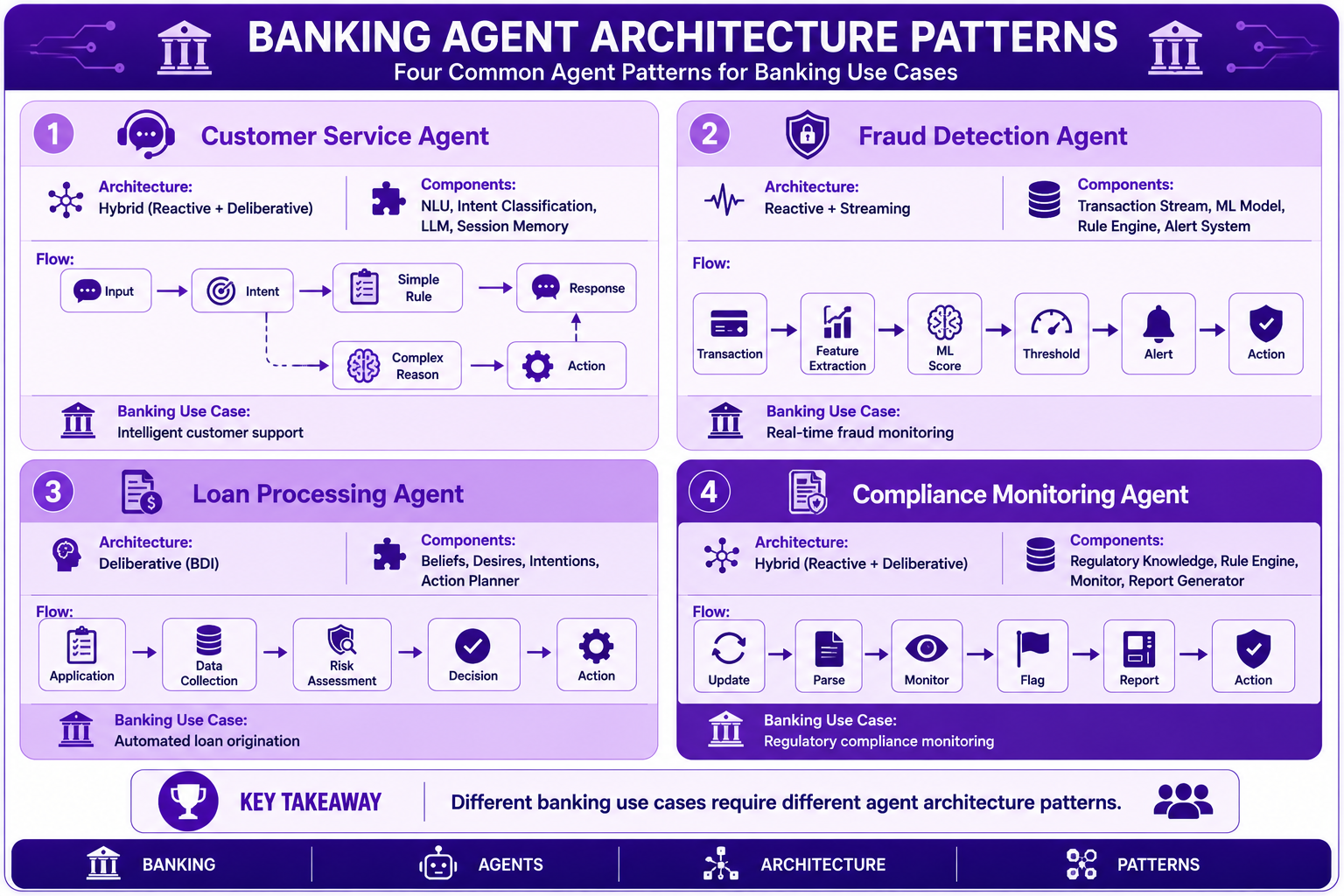
Diagram Placeholder 3: Banking Agent Architecture Patterns
Pattern 1: Customer Service Agent (Hybrid - Reactive + Deliberative)
Architecture: Combines immediate responses (reactive) with planning and reasoning (deliberative). Simple queries (e.g., balance check) are handled reactively with minimal delay, while complex queries (e.g., dispute a transaction) trigger deeper reasoning and planning.
Components:
- Natural Language Understanding (NLU) – to parse customer intent and entities
- Intent Classification – to route queries to the appropriate handler
- Large Language Model (LLM) – for generating human‑like responses and handling complex reasoning
- Session Memory – to maintain dialogue context
Flow:
Input → Intent → Simple → Rule → Response
                → Complex → Reason → Action
Use Case: Intelligent customer support that can handle simple FAQs and complex queries requiring planning (e.g., "I want to close my account" – which involves checking balances, transferring funds, etc.).
Benefits: Provides fast responses for routine questions while retaining the ability to handle complex issues without manual intervention.
Pattern 2: Fraud Detection Agent (Reactive + Streaming)
Architecture: Reacts to events in real time with minimal delay, using streaming data and machine learning models. The agent is event‑driven: it consumes a stream of transactions and applies scoring and rules as each event arrives.
Components:
- Transaction Stream (e.g., Kafka topic)
- Feature Extraction – computes features from each transaction
- ML Model – scores each transaction for fraud likelihood
- Rule Engine – applies business rules (e.g., velocity checks, country restrictions)
- Alert System – triggers alerts when score exceeds threshold
Flow:
Transaction → Feature Extraction → ML Score → Threshold → Alert → Action
Use Case: Real‑time fraud monitoring where low latency is critical. Every transaction must be scored within milliseconds to decide whether to block or approve.
Benefits: Low latency, high throughput, and ability to scale with transaction volume. The agent can be stateless, making it easy to horizontally scale.
Pattern 3: Loan Processing Agent (Deliberative - BDI)
Architecture: Belief‑Desire‑Intention (BDI) model with explicit goals and plans. The agent has beliefs (knowledge about the world), desires (goals to achieve), and intentions (commitments to action). It plans actions to achieve its desires, monitoring progress and adapting as needed.
Components:
- Beliefs – e.g., customer data, credit policies
- Desires – e.g., "approve loan" or "reject loan" goals
- Intentions – e.g., "collect documents", "perform credit check"
- Action Planner – generates sequences of actions and handles contingencies
Flow:
Application → Data Collection → Risk Assessment → Decision → Action
Use Case: Automated loan origination where complex planning and reasoning are required, often spanning minutes or hours and involving multiple subsystems (document management, credit bureaus, underwriting).
Benefits: The agent can handle long‑running processes, maintain state, and adjust plans based on intermediate outcomes (e.g., if documents are missing, request them before proceeding).
Pattern 4: Compliance Monitoring Agent (Hybrid - Reactive + Deliberative)
Architecture: Combines reactive monitoring with deliberative analysis and reporting. The agent continuously monitors events (e.g., transactions, customer profile changes) and reacts in real time to flag violations, while also performing periodic, deep‑dive analysis for regulatory reporting.
Components:
- Regulatory Knowledge – stored rules and compliance requirements
- Rule Engine – applies rules to incoming events
- Monitor – listens to event streams and applies rules
- Report Generator – produces compliance reports (e.g., SAR filings)
Flow:
Update → Parse → Monitor → Flag → Report → Action
Use Case: Regulatory compliance monitoring where both real‑time flagging (e.g., suspicious transactions) and periodic reporting (e.g., AML reports) are needed.
Benefits: The agent can both react to immediate threats and provide structured reports for audits, reducing manual effort and improving accuracy.
Reactive vs. Deliberative Architectures
Understanding the distinction between reactive and deliberative architectures is fundamental to agent design. The choice affects the agent's behaviour, performance, and complexity.
Reactive Architecture
- Simple – Uses stimulus‑response rules (e.g., if‑then rules, simple classifiers).
- Fast – Low latency, immediate responses, suitable for time‑critical applications.
- No Planning – Does not consider future consequences; decisions are based solely on the current input.
- Limited – Cannot handle complex tasks that require multi‑step reasoning or adaptation.
Banking Example: A simple chatbot that answers FAQs using pattern matching. It does not remember previous interactions or plan next steps.
Pros: Easy to build and maintain; very fast; predictable behaviour. Cons: Cannot handle novel situations; no learning or adaptation; limited to simple tasks.
Deliberative Architecture
- Complex – Uses reasoning and planning (e.g., BDI, hierarchical planning).
- Slower – Requires computation time for reasoning and planning.
- Goal‑oriented – Works towards objectives; considers long‑term consequences.
- Flexible – Handles novel situations by generating new plans.
Banking Example: A loan underwriting agent that collects data, evaluates risk, and plans steps. It can adapt if new information arrives (e.g., a better credit score from another bureau).
Pros: Can handle complex tasks; adaptive and flexible; can learn and improve. Cons: Slower; more complex to design and debug; may require more computational resources.
Hybrid Architecture
- Combines both – Best of both worlds: reactive for speed, deliberative for depth.
- Balanced – Fast for simple tasks, reasoning for complex ones.
- Practical – Most common in enterprise AI, where agents must handle a mix of simple and complex requests.
Banking Example: A customer service agent that answers simple queries immediately (reactive) and escalates complex ones to a reasoning module (deliberative). This provides a seamless experience without sacrificing performance.
Design Pattern: Often implemented with a fast‑path (rule‑based) and a slow‑path (model‑based) that the agent chooses based on complexity.
State Management in Agents
Agents must maintain state to provide coherent, context‑aware interactions. State management involves tracking various types of information across the agent's lifecycle.
Conversational State
- Tracks the current conversation context.
- Includes user intent, session variables, and dialogue history.
- Essential for multi‑turn interactions where the agent needs to remember what was said earlier.
Banking Example: A customer says, "I want to transfer money." The agent replies, "To which account?" The customer says, "To my savings account." The conversational state stores the intent and the account type to complete the transaction.
Implementation: Typically stored in short‑term memory and updated with each turn.
Business State
- Tracks the progress of business processes.
- Includes application status, workflow stage, and pending actions.
- Essential for long‑running tasks that span multiple sessions or involve multiple steps.
Banking Example: A loan application that goes through stages: application submitted → documents pending → underwriting → approval/rejection. The business state tracks which stage the application is in and what actions are needed next.
Implementation: Stored in a persistent database, often with a state machine to enforce valid transitions.
Agent State
- Tracks the agent's internal condition.
- Includes current goal, plan, active memory, and any active sub‑tasks.
- Essential for autonomous operation, especially in deliberative agents.
Banking Example: A wealth management agent has a goal to "rebalance portfolio by 5 PM". It has a plan with steps (evaluate current allocation, select trades, execute). The agent state tracks its progress through these steps.
Implementation: Stored in working memory and updated as the agent executes its plan.
Best Practices for Agent Architecture
✅ Design for modularity—each module should be independently maintainable, testable, and replaceable. This allows teams to work on different parts of the agent concurrently and reduces the risk of regressions.
✅ Use appropriate memory types for different storage needs—short‑term for session context, long‑term for persistent data, working for active reasoning, and knowledge for domain facts. Mixing them up leads to performance and consistency issues.
✅ Choose the right architecture pattern for each use case—don't force a deliberative pattern on a simple FAQ bot, and don't use a reactive pattern for complex loan underwriting.
✅ Implement observability across all modules—logs, metrics, and traces for debugging, monitoring, and auditing. In banking, audit trails are non‑negotiable.
✅ Plan for state persistence across sessions, especially for long‑running processes. Agents should be able to resume where they left off after a restart or failure.
✅ Design for graceful degradation and fallback—when an external service is unavailable, the agent should have a plan B (e.g., escalate to human or use a simpler rule).
✅ Build in security and privacy from the start—encrypt sensitive data in memory and storage, enforce least‑privilege access, and log all actions for compliance.
✅ Test the agent's architecture with realistic scenarios, including edge cases, partial data, and high load, to ensure it behaves correctly under stress.
Common Mistakes
❌ Over‑engineering simple use cases with complex architectures that add unnecessary overhead and maintenance cost.
❌ Under‑engineering complex use cases with reactive architectures that cannot handle the required planning and reasoning.
❌ Ignoring memory and state management, leading to agents that are forgetful, inconsistent, or unable to handle multi‑turn conversations.
❌ Building monolithic agents without modular separation, making them hard to debug, test, or extend.
❌ Neglecting observability and debugging capabilities, which makes it nearly impossible to understand why an agent made a certain decision—a critical issue in regulated banking.
❌ Assuming agents have perfect information—in reality, data is often incomplete, noisy, or delayed. Agents must be designed to handle uncertainty.
❌ Deploying agents without fallback mechanisms, leaving the system broken when a model or external service fails.
Interview Questions
-
Describe the six steps of the agent lifecycle and explain how they interrelate.
-
What are the five core modules of an agent's internal architecture? Give a banking example for each.
-
Explain the different types of memory in an agent system, including when each is used and how they are implemented.
-
Compare reactive, deliberative, and hybrid architectures. When would you use each in a banking context?
-
How would you design a customer service agent architecture for a bank, including the choice of pattern?
-
What role does the reasoning module play in an agent? How does it differ from the planning module?
-
How do the perception and memory modules interact in a typical agent? Provide a concrete example.
-
What is the BDI model and when is it appropriate to use in banking applications?
-
How do you handle state management in long‑running agent tasks (e.g., a loan application that takes days)?
-
What are the trade‑offs between reactive and deliberative architectures in terms of latency, flexibility, and maintainability?
Practice Exercises
-
Draw the lifecycle of a fraud detection agent, labelling each step with specific banking activities. Include how learning would occur after each transaction.
-
Design the internal architecture of a loan processing agent. Label all modules and their interactions. Indicate which memory types would be used for what data.
-
For each of the four banking agent patterns (Customer Service, Fraud Detection, Loan Processing, Compliance Monitoring), identify a specific use case and explain why that pattern is appropriate, including potential trade‑offs.
-
Implement a simple state management design for a customer service agent that handles multi‑turn conversations. Describe how you would store conversational state, business state, and agent state, and how they would be updated.
Key Takeaways
- Agents operate in a continuous lifecycle: Perceive → Understand → Reason → Plan → Act → Learn. Each stage is essential for autonomous behaviour.
- The internal architecture consists of five core modules: Perception, Reasoning, Action, Memory, and Learning. These modules interact to process inputs and produce outputs.
- Memory is critical for maintaining context, personalisation, and continuity. Different types of memory (short‑term, long‑term, working, knowledge) serve different purposes.
- Different banking use cases require different architecture patterns, ranging from reactive (fraud detection) to deliberative (loan processing) to hybrid (customer service).
- The choice between reactive, deliberative, and hybrid architectures depends on the complexity, latency requirements, and need for planning and adaptation.
- State management is essential for coherent, context‑aware interactions, and must handle conversational, business, and agent state.
Chapter Summary
In this chapter, you learned:
- The complete lifecycle of an AI agent and how each stage contributes to autonomous decision‑making
- The five core modules of agent architecture and their interactions, with a focus on modularity and maintainability
- The different types of memory and their roles in enabling context, personalisation, and learning
- Common architecture patterns for banking agents, including reactive, deliberative, and hybrid approaches
- How to choose between reactive, deliberative, and hybrid architectures based on use case requirements
- Best practices and common pitfalls in agent design, with an emphasis on observability, security, and graceful degradation
You now understand the internal structure of AI agents and are ready to design agents for specific business functions. This architectural knowledge is crucial for building agents that are not only intelligent but also reliable, scalable, and compliant. In the next chapter, we will explore workflow thinking and how to design agentic workflows for complex business processes, enabling agents to orchestrate multi‑step, multi‑system interactions seamlessly.