
Chapter 7: Responsible AI
In the previous chapter, we explored agent design patterns—reusable templates for structuring agent behaviour, reasoning, and interaction with tools. We learned how patterns like ReAct, Plan‑and‑Execute, and Hierarchical Agents can help build robust, efficient, and maintainable agents for banking applications.
However, building agents that are effective is only one part of the equation. In banking and financial services, agents must also be responsible—they must be fair, transparent, privacy‑preserving, safe, and aligned with regulatory requirements. An agent that makes accurate but biased decisions, or that cannot explain its reasoning, is not suitable for production in a regulated environment.
Responsible AI is the practice of designing, developing, and deploying AI systems that are ethical, trustworthy, and compliant with laws and regulations. It encompasses a broad range of concerns: bias and fairness, explainability and transparency, privacy and data protection, safety and robustness, and governance and accountability.
In this chapter, we will explore the key dimensions of Responsible AI as they apply to agentic systems in banking. We will discuss the risks and challenges, the regulatory landscape, and the practical techniques for building responsible agents. By the end, you will understand how to embed responsibility into every stage of the agent lifecycle—from design and development to deployment and monitoring.
🎯 Learning Objectives
By the end of this chapter, you will be able to:
- Define Responsible AI and understand its importance in banking
- Identify the key dimensions of Responsible AI: fairness, transparency, privacy, safety, and governance
- Recognise common biases in AI systems and how they manifest in banking
- Apply techniques for bias detection and mitigation in agentic systems
- Implement explainability and transparency mechanisms for agent decisions
- Understand privacy and data protection requirements (GDPR, CCPA, etc.)
- Design safety guardrails and controls to prevent harmful agent behaviour
- Establish governance frameworks for responsible AI in banking
- Apply best practices and avoid common pitfalls in Responsible AI
- Prepare for regulatory compliance and audits
What is Responsible AI?
Responsible AI refers to the practice of developing and deploying artificial intelligence systems in a manner that is ethical, transparent, fair, and accountable. It ensures that AI systems respect human rights, promote fairness, and do not cause harm.
In the context of banking, Responsible AI is not just a nice‑to‑have—it is a business imperative. Banks handle sensitive customer data, make decisions that profoundly affect people's lives (e.g., loan approvals, credit scoring), and operate under strict regulatory oversight. An AI system that discriminates, violates privacy, or cannot explain its decisions exposes the bank to legal liability, regulatory fines, and reputational damage.
Why Responsible AI Matters in Banking:
- Customer Trust – Customers must trust that AI agents are acting in their best interests and treating them fairly.
- Regulatory Compliance – Regulations like GDPR, the EU AI Act, and fair lending laws mandate transparency, fairness, and accountability.
- Risk Management – Unchecked AI can introduce operational, financial, and reputational risks.
- Competitive Advantage – Banks that demonstrate responsible AI practices can differentiate themselves and attract conscientious customers.
- Ethical Imperative – Beyond compliance, it is the right thing to do.
The Five Pillars of Responsible AI
Responsible AI can be understood through five key pillars. Each pillar addresses a specific concern and requires concrete practices and techniques.
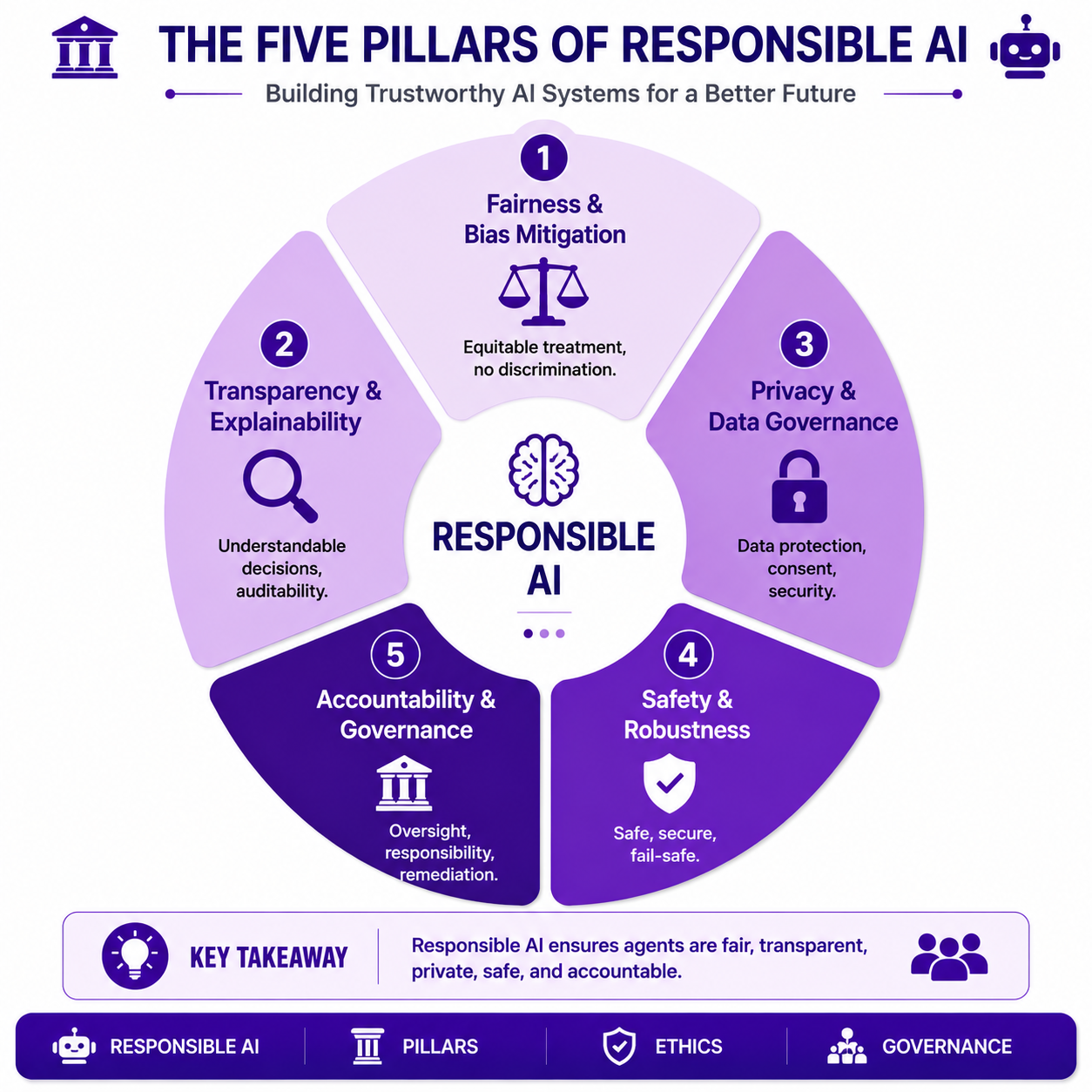
Diagram Placeholder 1: Five Pillars of Responsible AI
Pillar 1: Fairness and Bias Mitigation
Definition: AI systems should treat all individuals and groups equitably, without discriminating based on protected characteristics such as race, gender, age, religion, or socioeconomic status.
Key Concerns:
- Algorithmic Bias – Models that systematically produce unfair outcomes for certain groups.
- Data Bias – Training data that reflects historical inequalities or underrepresents certain groups.
- Feedback Loops – Biased outputs that reinforce biases in future data.
Banking Example: A credit scoring agent that systematically approves loans for one demographic group while denying equally qualified applicants from another group.
Pillar 2: Transparency and Explainability
Definition: AI systems should be transparent about their capabilities, limitations, and decision‑making processes. Their decisions should be explainable in human‑understandable terms.
Key Concerns:
- Black Box Models – Complex models (e.g., deep neural networks) that are difficult to interpret.
- Opacity – Users and regulators cannot understand why a decision was made.
- Lack of Auditability – Without explainability, it is impossible to audit or improve the system.
Banking Example: A loan denial agent that cannot explain why an application was rejected, making it impossible for the applicant to appeal or for the bank to identify bias.
Pillar 3: Privacy and Data Governance
Definition: AI systems must protect the privacy and confidentiality of personal data, ensuring that data is collected, used, and stored in compliance with privacy laws and user consent.
Key Concerns:
- Data Leakage – Sensitive information being exposed or inferred.
- Unauthorised Access – Data being accessed by unauthorised parties.
- Non‑compliance – Violating GDPR, CCPA, or other privacy regulations.
Banking Example: A customer service agent that inadvertently reveals another customer's account details during a conversation.
Pillar 4: Safety and Robustness
Definition: AI systems must be safe, secure, and robust against adversarial attacks, errors, and unexpected inputs. They should fail gracefully and not cause harm.
Key Concerns:
- Adversarial Attacks – Malicious inputs designed to fool or manipulate the agent.
- Hallucinations – Agents generating plausible but incorrect information.
- Unintended Actions – Agents taking actions with negative consequences.
Banking Example: A fraud detection agent that is tricked into approving a fraudulent transaction by a carefully crafted adversarial input.
Pillar 5: Accountability and Governance
Definition: Organisations must take responsibility for their AI systems, establishing clear governance structures, policies, and procedures for oversight, audit, and remediation.
Key Concerns:
- No Clear Ownership – No one is accountable for AI failures.
- Lack of Oversight – AI systems operate without review or monitoring.
- No Remediation Process – No mechanism for addressing issues when they arise.
Banking Example: A bank deploys an AI agent for loan underwriting, but when issues are discovered, there is no clear process for investigating or correcting them.
Fairness and Bias in Agentic AI
Bias in AI is not a new problem, but it takes on particular significance in agentic systems because agents make autonomous decisions that can have far‑reaching consequences.
Sources of Bias
1. Data Bias
Training data may reflect historical inequalities or be unrepresentative of certain groups.
Banking Example: If a credit scoring model is trained primarily on data from applicants who were historically approved for loans, it may learn to favour the characteristics of that group, even if those characteristics are not predictive of creditworthiness.
2. Algorithmic Bias
The model itself may introduce bias through its design or optimisation objectives.
Banking Example: A model that optimises for overall accuracy may perform well on the majority group but poorly on minority groups if they are underrepresented in the training data.
3. Interaction Bias
Agents may exhibit bias in how they interact with different users, even if the underlying model is fair.
Banking Example: A customer service agent may use different language or tone when interacting with customers based on demographic signals (e.g., name, location).
4. Feedback Loop Bias
Biased outputs can influence future data, creating a self‑reinforcing loop.
Banking Example: If a loan agent denies loans to a certain group, those individuals are excluded from the dataset used to train future models, perpetuating the bias.
Bias Detection Techniques
1. Disparate Impact Analysis
Measure whether different groups receive different outcomes at significantly different rates.
Statistical Test: The 80% rule—if the selection rate for one group is less than 80% of the selection rate for the most favoured group, there may be disparate impact.
2. Equal Opportunity Analysis
Check whether the model has equal true positive rates across groups.
Banking Example: If the loan agent approves 90% of qualified male applicants but only 70% of qualified female applicants, there is a fairness issue.
3. Calibration Analysis
Ensure that predicted probabilities are well‑calibrated across groups.
Banking Example: If the agent predicts a 30% default rate for one group, but the actual default rate is 40%, the predictions are miscalibrated.
4. Individual Fairness
Similar individuals should receive similar outcomes.
Banking Example: Two applicants with identical credit profiles should receive the same loan decision, regardless of race or gender.
Bias Mitigation Techniques
| Technique | Description | Banking Example |
|---|---|---|
| Pre‑processing | Adjust training data to reduce bias (e.g., reweighting, oversampling, undersampling) | Over‑sampling underrepresented groups in credit scoring data |
| In‑processing | Incorporate fairness constraints into model training (e.g., fairness‑aware learning) | Training a loan approval model with a constraint that false positive rates be equal across groups |
| Post‑processing | Adjust model outputs to improve fairness (e.g., threshold adjustment) | Adjusting approval thresholds for different groups to achieve equal opportunity |
| Human‑in‑the‑Loop | Have humans review decisions for potentially biased cases | Flagging loan applications where the agent's decision deviates from a baseline for human review |
Transparency and Explainability
Explainability is critical in banking because customers and regulators need to understand why decisions were made—especially negative decisions like loan denials, fraud flags, or account closures.
Levels of Explainability
1. Global Explainability
Understanding how the model works overall—what features are important, how the model behaves on average.
Banking Example: A report showing that credit score and debt‑to‑income ratio are the most important factors in the loan approval model.
2. Local Explainability
Understanding why a specific decision was made for a particular instance.
Banking Example: For a denied loan application, explaining that the denial was due to a low credit score and high debt‑to‑income ratio.
3. Interactive Explainability
Allowing users to ask "what‑if" questions and explore alternative scenarios.
Banking Example: A customer asks, "If I paid off my credit card, would I be approved?" and the agent provides an updated assessment.
Explainability Techniques
| Technique | Description | Use Case |
|---|---|---|
| LIME (Local Interpretable Model‑agnostic Explanations) | Approximates the model locally with an interpretable model | Explaining individual loan decisions |
| SHAP (SHapley Additive exPlanations) | Uses game theory to assign feature importance values | Global and local explanations for credit scoring |
| Chain‑of‑Thought (CoT) | The agent reveals its reasoning steps | Investment advice, loan underwriting |
| Counterfactual Explanations | Shows what would have needed to change for a different outcome | "If your credit score were 50 points higher, your loan would be approved." |
Banking Example: A mortgage agent uses SHAP to explain to a customer why their application was denied: "Your application was denied because your credit score (650) is below our threshold (680). This contributed 60% to the decision. Your debt‑to‑income ratio (42%) was also above our limit (36%), contributing 30%."
Explainability in Agentic Systems
In agentic systems, explainability goes beyond the model—it also includes the agent's reasoning, planning, and actions.
What to Explain:
- Why the agent chose a particular action
- What information the agent used to make its decision
- What alternatives the agent considered
- How the agent's confidence level affects the decision
Banking Example: A fraud investigation agent provides a detailed log of its investigation: "I checked transactions, found three unusual patterns, queried geolocation data, and detected a mismatch. Based on this, I blocked the transaction."
Privacy and Data Protection
Agents in banking handle highly sensitive personal and financial data. Protecting this data is a legal and ethical obligation.
Key Privacy Principles
1. Data Minimisation
Collect and use only the data necessary for the task.
Banking Example: A credit scoring agent should not collect data about a customer's health or religion, even if such data is available, unless it is explicitly needed and legally permissible.
2. Purpose Limitation
Data should only be used for the purpose for which it was collected.
Banking Example: Customer data collected for loan processing should not be used for marketing without explicit consent.
3. Consent and Transparency
Users must be informed about how their data is used and give explicit consent.
Banking Example: A customer onboarding agent explains what data it collects, why, and how it will be used, and obtains consent.
4. Security and Confidentiality
Data must be protected from unauthorised access, loss, or theft.
Banking Example: All customer data processed by agents must be encrypted, both at rest and in transit.
5. Right to Access and Erasure
Users have the right to access their data and request its deletion.
Banking Example: A customer can request a copy of all personal data held by the bank's AI systems, and can ask for it to be deleted.
Privacy‑Enhancing Techniques
| Technique | Description | Banking Example |
|---|---|---|
| Anonymisation | Remove personally identifiable information (PII) from data | Removing names and addresses from training data |
| Pseudonymisation | Replace identifiers with pseudonyms | Using customer IDs instead of names |
| Differential Privacy | Add noise to data to prevent individual identification | Training models on aggregated data with noise |
| Federated Learning | Train models on decentralised data without centralising it | Training fraud detection models across branches without sharing raw data |
| Secure Multi‑Party Computation | Compute functions across data sources without revealing raw data | Multiple banks jointly train a fraud model without sharing customer data |
Safety and Robustness
Agents must be safe—they must not cause harm, whether through errors, adversarial attacks, or unintended behaviour.
Safety Concerns in Banking Agents
1. Hallucinations
Agents generating false or misleading information.
Mitigation: Fact‑checking, retrieval‑augmented generation (RAG), human review.
2. Adversarial Attacks
Malicious actors crafting inputs to fool or manipulate the agent.
Mitigation: Input validation, adversarial training, anomaly detection.
3. Unintended Actions
Agents taking actions with negative consequences.
Mitigation: Action guardrails, simulation and testing, human‑in‑the‑loop.
4. Prompt Injection
Malicious prompts that bypass safety controls.
Mitigation: Input sanitisation, prompt filtering, role‑based restrictions.
5. Over‑Automation
Agents acting autonomously in situations where human judgement is required.
Mitigation: Clear escalation policies, fallback mechanisms.
Safety Techniques
| Technique | Description | Banking Example |
|---|---|---|
| Guardrails | Rules and filters that constrain agent behaviour | A loan agent cannot approve amounts over $1M without human review |
| Reinforcement Learning from Human Feedback (RLHF) | Training agents to prefer safe behaviours | Fine‑tuning a customer service agent to avoid offensive or biased language |
| Adversarial Testing | Testing agents with adversarial inputs | Attempting to trick a fraud agent into approving a fraudulent transaction |
| Fail‑Safe Mechanisms | Automatic fallbacks when the agent is uncertain | If confidence is below 80%, escalate to human |
| Monitoring and Alerting | Real‑time detection of unsafe behaviour | Alerts when a loan agent approves an unusually high number of applications |
Governance and Accountability
Responsible AI requires a governance framework that defines roles, responsibilities, policies, and processes.
Key Governance Elements
1. AI Policy and Principles
A documented set of principles and policies that guide AI development and deployment.
Banking Example: A bank's AI Ethics Charter, including commitments to fairness, transparency, and privacy.
2. Roles and Responsibilities
Clear assignment of accountability for AI systems.
| Role | Responsibility |
|---|---|
| AI Ethics Committee | Oversee policy and principles |
| AI Product Owner | Business accountability for the agent |
| AI Developer | Technical implementation |
| AI Tester | Quality assurance, bias testing |
| Compliance Officer | Regulatory compliance |
| Data Protection Officer | Privacy compliance |
3. Risk Assessment
Assessing and managing risks associated with AI systems.
Banking Example: A risk assessment for a loan approval agent that evaluates fairness, explainability, and robustness risks.
4. Audit and Monitoring
Regular audits of AI systems and continuous monitoring of performance and behaviour.
Banking Example: Quarterly fairness audits for credit scoring models; real‑time monitoring for drift.
5. Incident Management
Processes for identifying, reporting, and remediating AI incidents.
Banking Example: If a customer service agent reveals sensitive information, the incident is logged, investigated, and the agent is updated.
Regulatory Landscape
Banks operate under a complex web of regulations that impact AI systems.
Key Regulations Affecting AI in Banking
| Regulation | Key Requirements | Impact on Agents |
|---|---|---|
| GDPR (Europe) | Data protection, right to explanation, consent | Agents must explain decisions, respect data rights |
| CCPA/CPRA (California) | Consumer privacy, access, deletion | Agents must handle data requests |
| EU AI Act | Risk‑based classification; high‑risk systems require conformity assessments | Loan underwriting agents are high‑risk; require strict oversight |
| Fair Lending Laws (US) | Prohibition of discriminatory lending practices | Agents must not discriminate; require fairness testing |
| Basel III | Risk management and governance | AI risk management must be integrated into bank governance |
| SR 11‑7 (US) | Model risk management | AI models must be validated, monitored, and governed |
Responsible AI in the Agent Lifecycle
Responsible AI must be embedded throughout the entire lifecycle of an agent.
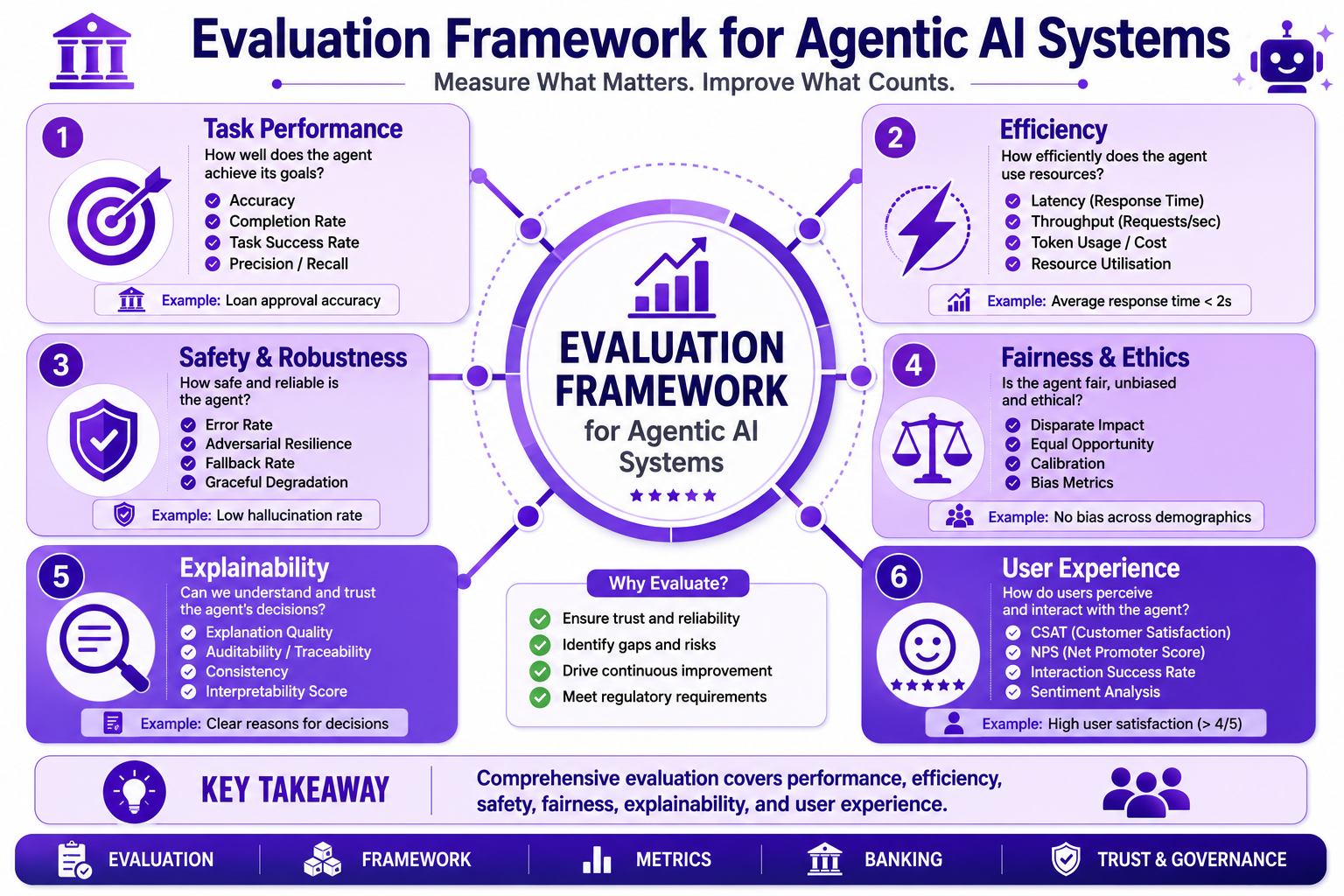
Diagram Placeholder 3: Responsible AI Lifecycle
1. Design Phase
- Define ethical principles and requirements
- Assess potential risks and impact
- Involve diverse stakeholders (legal, compliance, ethics)
2. Development Phase
- Use representative, unbiased data
- Implement fairness and explainability techniques
- Conduct adversarial testing
- Document all design decisions
3. Deployment Phase
- Validate model against fairness criteria
- Establish monitoring and alerting
- Implement human‑in‑the‑loop for high‑risk decisions
- Provide user‑facing explanations
4. Operation Phase
- Continuously monitor for bias and drift
- Collect and act on feedback
- Conduct regular audits
- Update models and policies
5. Retire Phase
- Ensure data is handled appropriately
- Document the retirement decision
- Conduct a post‑retirement review
Responsible AI in Banking Agents: A Practical Framework
A practical framework for implementing Responsible AI in banking agents:
- Assess – Identify the risks and regulatory requirements.
- Design – Incorporate responsible AI principles into the architecture.
- Develop – Implement fairness, explainability, privacy, and safety measures.
- Test – Validate with diverse datasets, adversarial tests, and human review.
- Deploy – Roll out with monitoring and human‑in‑the‑loop.
- Monitor – Continuously track performance, bias, and drift.
- Govern – Maintain oversight, audit, and remediation processes.
Best Practices for Responsible AI
✅ Start with a clear ethical framework – Define principles that reflect your organisation's values.
✅ Involve diverse stakeholders – Include legal, compliance, ethics, and affected communities.
✅ Document everything – Document data sources, model decisions, and validation results for auditability.
✅ Test with diverse data – Ensure your test data reflects the full diversity of your user base.
✅ Provide explanations – Make sure your agents can explain their decisions in plain language.
✅ Implement guardrails – Constrain agent behaviour to prevent harm.
✅ Monitor continuously – Track bias, drift, and performance in production.
✅ Have an incident response plan – Be prepared to handle issues when they arise.
✅ Engage with regulators – Proactively discuss your AI practices with regulators.
✅ Foster a culture of responsibility – Encourage all team members to prioritise Responsible AI.
Common Mistakes
❌ Treating Responsible AI as a checkbox – It must be embedded in the entire lifecycle, not just a one‑time activity.
❌ Ignoring bias until after deployment – Bias is much harder to fix once the system is live.
❌ Assuming that "statistical fairness" is enough – Fairness is not just about numbers; it's about lived experiences.
❌ Over‑relying on explainability tools – Tools like SHAP can be misused; they do not guarantee true understanding.
❌ Neglecting privacy in agent interactions – Agents may inadvertently reveal sensitive information in conversations.
❌ Underestimating the importance of human oversight – Agents should not be fully autonomous in high‑risk decisions.
❌ Failing to update governance as the system evolves – Governance must evolve with the agent.
Interview Questions
-
What is Responsible AI and why is it important in banking?
-
Explain the five pillars of Responsible AI. Provide a banking example for each.
-
What are the main sources of bias in AI systems? How can they be mitigated?
-
Describe three techniques for detecting bias in a loan approval agent.
-
What is the difference between global and local explainability? Provide examples.
-
How would you implement privacy protection in a customer service agent?
-
What are safety guardrails and why are they important for agentic systems?
-
What regulations affect AI in banking? How do they impact agent design?
-
How would you set up governance for a multi‑agent system in a bank?
-
Describe the Responsible AI lifecycle from design to retirement.
Practice Exercises
-
Identify potential biases in a credit scoring agent. Describe the data, algorithm, and interaction biases that could occur.
-
Design an explainability strategy for a loan underwriting agent. Include global, local, and interactive explanations.
-
Create a privacy‑preserving design for a customer service agent that handles account information.
-
Design a set of safety guardrails for a fraud detection agent that can block transactions.
-
Develop a governance framework for an AI‑powered investment advisory agent, including roles, policies, and monitoring.
Key Takeaways
- Responsible AI is the practice of building AI systems that are fair, transparent, privacy‑preserving, safe, and accountable.
- The five pillars of Responsible AI are Fairness, Transparency, Privacy, Safety, and Governance.
- Bias can arise from data, algorithms, interactions, and feedback loops.
- Explainability is critical in banking; agents should be able to explain their decisions in plain language.
- Privacy must be protected through data minimisation, consent, security, and privacy‑enhancing technologies.
- Safety guardrails prevent harmful agent behaviour and ensure fail‑safe operation.
- Governance provides oversight, accountability, and a framework for continuous improvement.
- Regulations like GDPR, the EU AI Act, and fair lending laws mandate responsible AI practices.
- Responsible AI must be embedded throughout the entire agent lifecycle.
Chapter Summary
In this chapter, you learned:
- The definition and importance of Responsible AI in banking
- The five pillars: Fairness and Bias Mitigation, Transparency and Explainability, Privacy and Data Governance, Safety and Robustness, and Accountability and Governance
- Sources of bias and techniques for detection and mitigation
- Explainability techniques, including LIME, SHAP, and Chain‑of‑Thought
- Privacy principles and privacy‑enhancing techniques
- Safety concerns and mitigation strategies, including guardrails and adversarial testing
- Governance frameworks, roles, and responsibilities
- The regulatory landscape affecting AI in banking
- The Responsible AI lifecycle from design to retirement
- Best practices and common mistakes
You now understand the principles and practices of Responsible AI and how to embed them into your agentic systems. This knowledge is essential for building agents that are not only powerful but also trustworthy and compliant.
In the next and final chapter, we will explore AI Evaluation and Monitoring—how to measure, track, and improve your agents' performance in production.