
Chapter 3: Inheritance, Polymorphism & Abstraction
Introduction
As enterprise applications grow, developers often encounter duplicate code across multiple classes.
Consider the IPMS application.
Entities such as:
- Student
- Company
- Placement Drive
- Interview Panel Member
- Administrator
share several common characteristics.
Instead of duplicating code, Object-Oriented Programming provides powerful mechanisms for code reuse and extensibility.
In this chapter, we will learn:
- Inheritance
- Polymorphism
- Abstraction
These concepts are fundamental for designing scalable enterprise applications.
What You Will Learn
By the end of this chapter, you will:
- Understand Inheritance
- Create Parent and Child Classes
- Use Method Overriding
- Understand IS-A Relationships
- Learn Runtime Polymorphism
- Learn Compile-Time Polymorphism
- Create Abstract Classes
- Implement Abstract Methods
- Apply Inheritance in IPMS
- Build Reusable Class Hierarchies
Understanding Inheritance
Inheritance allows one class to acquire the properties and behaviors of another class.
Benefits of Inheritance
- Code Reuse
- Maintainability
- Extensibility
- Reduced Duplication
- Better Design
Real World Example
Consider:
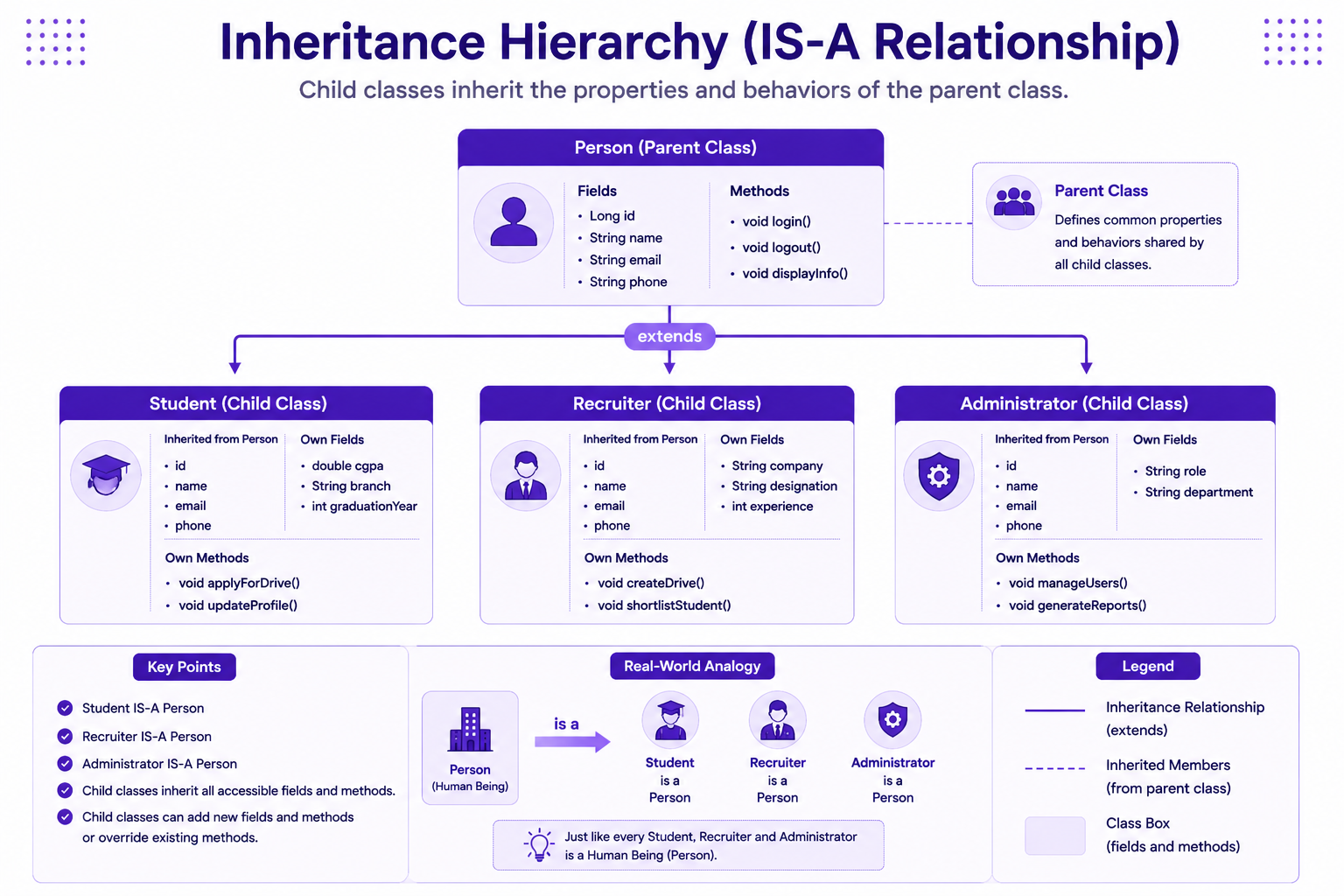
Person
│
├── Student
│
├── Administrator
│
└── Recruiter
All entities share:
- Name
- Phone Number
Parent Class
public class Person {

    protected String name;

    protected String email;

    protected String phone;
}
Child Class
public class Student extends Person {

    private double cgpa;
}
Understanding extends
extends
creates an inheritance relationship.
Inheritance Hierarchy
Creating Parent Class
package com.ipms.person;

public class Person {

    protected Long id;

    protected String name;

    protected String email;
}
Creating Student Class
package com.ipms.student;

import com.ipms.person.Person;

public class Student extends Person {

    private double cgpa;
}
Creating Recruiter Class
package com.ipms.recruiter;

import com.ipms.person.Person;

public class Recruiter extends Person {

    private String designation;
}
Accessing Parent Members
Student student = new Student();

student.name = "John Doe";
Understanding IS-A Relationship
Inheritance represents:
IS-A
Examples:
Student IS-A Person

Recruiter IS-A Person

Admin IS-A Person
Example
public class Employee {

}
public class Manager extends Employee {

}
Invalid Example
Company IS-A Student
Invalid relationship.
Constructor Inheritance
Parent constructors execute before child constructors.
Parent Constructor
public Person() {

    System.out.println("Person Constructor");
}
Child Constructor
public Student() {

    System.out.println("Student Constructor");
}
Output
Person Constructor

Student Constructor
Understanding super Keyword
Used to access parent members.
Calling Parent Constructor
public Student() {

    super();
}
Parent Parameterized Constructor
public Person(
        String name,
        String email) {

    this.name = name;

    this.email = email;
}
Child Constructor
public Student(
        String name,
        String email,
        double cgpa) {

    super(name, email);

    this.cgpa = cgpa;
}
Accessing Parent Method
super.displayInfo();
Method Overriding
A child class can redefine parent behavior.
Parent Method
public void displayRole() {

    System.out.println("Person");
}
Child Method
@Override
public void displayRole() {

    System.out.println("Student");
}
Example
public class Person {

    public void displayRole() {

        System.out.println("Person");
    }
}
public class Student extends Person {

    @Override
    public void displayRole() {

        System.out.println("Student");
    }
}
Executing
Student student = new Student();

student.displayRole();
Output
Student
Rules for Overriding
- Same method name
- Same parameters
- Same return type
- Cannot reduce visibility
Understanding Polymorphism
Polymorphism means:
Many Forms
Types of Polymorphism
- Compile-Time Polymorphism
- Runtime Polymorphism
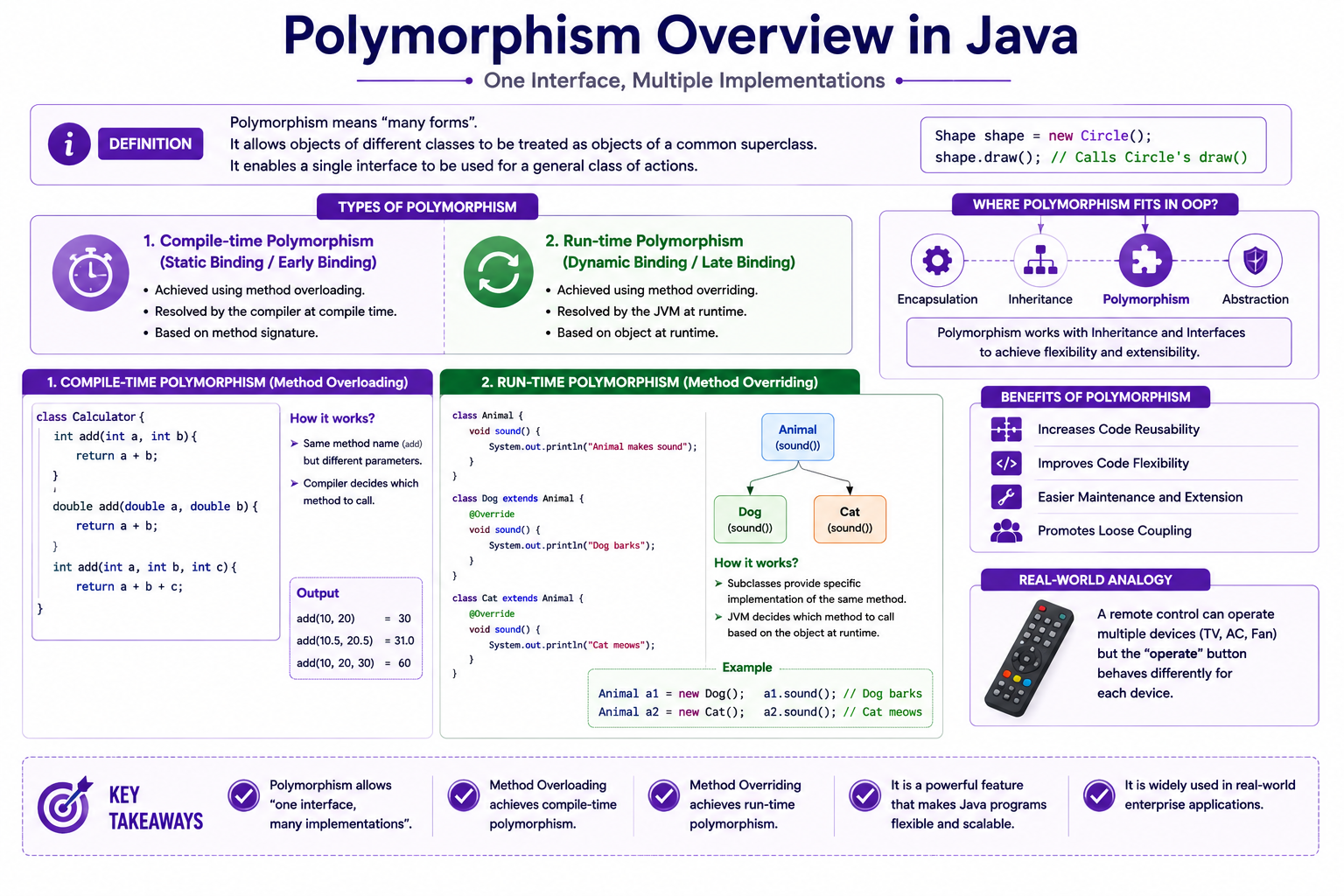
Compile-Time Polymorphism
Achieved using:
Method Overloading
Example
public class Calculator {

    public int add(
            int a,
            int b) {

        return a + b;
    }

    public int add(
            int a,
            int b,
            int c) {

        return a + b + c;
    }
}
Using Overloaded Methods
Calculator calculator =
        new Calculator();

calculator.add(10, 20);

calculator.add(10, 20, 30);
Runtime Polymorphism
Achieved using:
Method Overriding
Example
Person person =
        new Student();
Dynamic Method Dispatch
person.displayRole();
calls:
Student.displayRole()
Polymorphism Overview
Example
public class Person {

    public void login() {

        System.out.println("Person Login");
    }
}
public class Student extends Person {

    @Override
    public void login() {

        System.out.println("Student Login");
    }
}
public class Recruiter extends Person {

    @Override
    public void login() {

        System.out.println("Recruiter Login");
    }
}
Runtime Execution
Person person;

person = new Student();

person.login();

person = new Recruiter();

person.login();
Output
Student Login

Recruiter Login
Understanding Abstraction
Abstraction focuses on:
What an object does
instead of
How it does it
Benefits
- Simplifies Design
- Improves Maintainability
- Supports Extensibility
- Reduces Complexity
Abstract Classes
An abstract class cannot be instantiated.
Example
public abstract class Person {

}
Invalid
Person person =
        new Person();
Abstract Method
public abstract void login();
Abstract Class Example
public abstract class Person {

    protected String name;

    public abstract void login();
}
Student Implementation
public class Student extends Person {

    @Override
    public void login() {

        System.out.println(
                "Student Login");
    }
}
Recruiter Implementation
public class Recruiter extends Person {

    @Override
    public void login() {

        System.out.println(
                "Recruiter Login");
    }
}
Using Abstract Classes
Person person =
        new Student();

person.login();
Output
Student Login
Abstract Class with Concrete Methods
public abstract class Person {

    public void displayInfo() {

        System.out.println("Person");
    }

    public abstract void login();
}
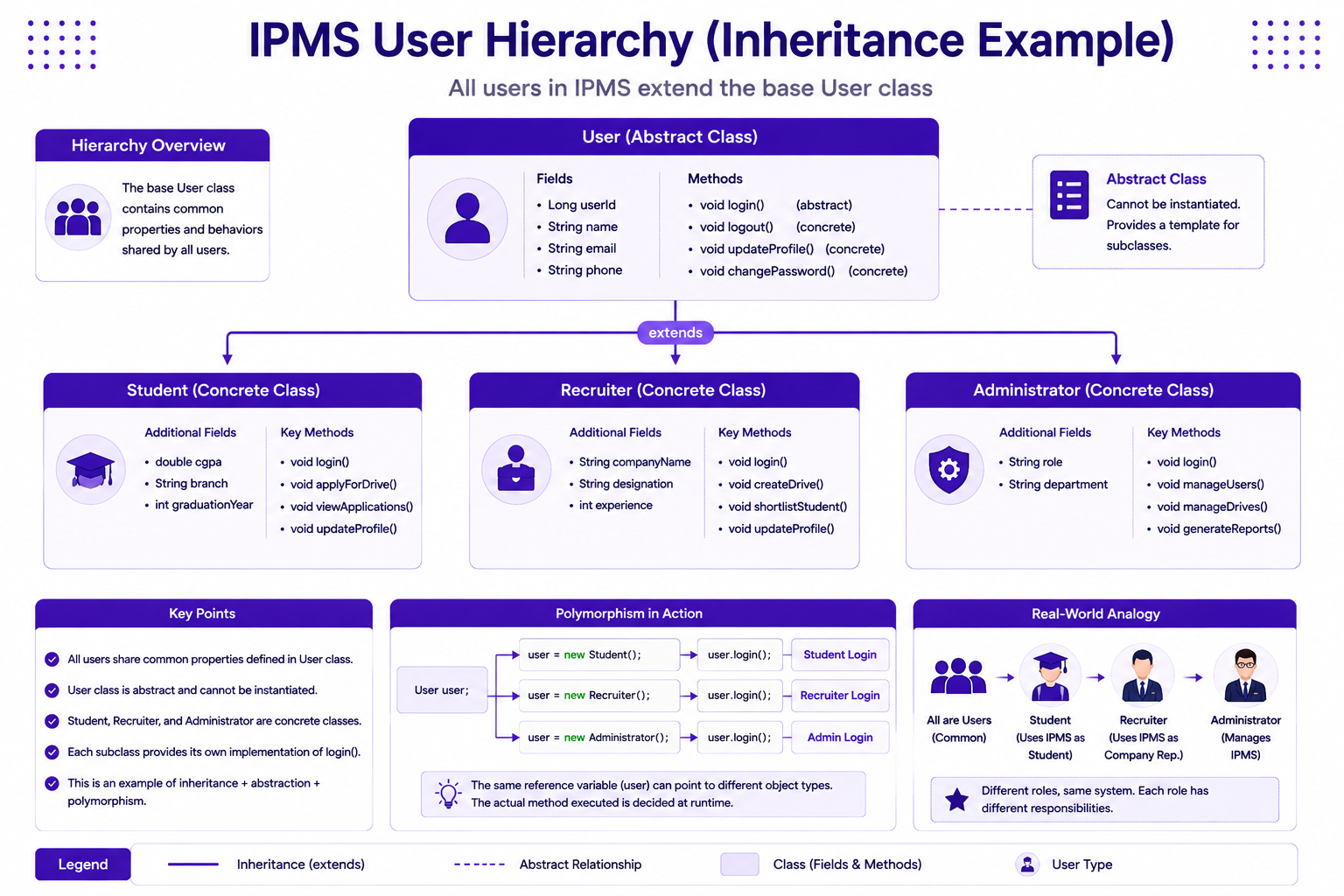
Enterprise Example
Person
│
├── Student
│
├── Recruiter
│
└── Administrator
IPMS User Hierarchy
Creating Base User
public abstract class User {

    protected Long userId;

    protected String name;

    protected String email;

    public abstract void login();
}
Student User
public class Student
        extends User {

    private double cgpa;

    @Override
    public void login() {

        System.out.println(
                "Student Login");
    }
}
Recruiter User
public class Recruiter
        extends User {

    private String company;

    @Override
    public void login() {

        System.out.println(
                "Recruiter Login");
    }
}
Administrator User
public class Administrator
        extends User {

    @Override
    public void login() {

        System.out.println(
                "Admin Login");
    }
}
Testing Polymorphism
User user;

user = new Student();

user.login();

user = new Recruiter();

user.login();

user = new Administrator();

user.login();
Output
Student Login

Recruiter Login

Admin Login
Mini Project
Create User Management Module.
Requirements:
- Create abstract User class
- Create Student class
- Create Recruiter class
- Create Administrator class
- Override login()
- Demonstrate runtime polymorphism
Best Practices
- Favor inheritance for IS-A relationships
- Keep inheritance hierarchies shallow
- Use @Override annotation
- Use abstraction for common behavior
- Avoid duplicate code
- Follow single responsibility principle
Common Beginner Mistakes
| Mistake | Correct Approach |
|---|---|
| Deep inheritance chains | Keep hierarchy simple |
| Forgetting @Override | Always use annotation |
| Instantiating abstract class | Create child object |
| Wrong IS-A relationship | Use proper hierarchy |
| Duplicate methods | Use inheritance |
Practice Exercises
- Create Employee and Manager classes.
- Create Vehicle hierarchy.
- Implement method overriding.
- Create abstract Payment class.
- Implement CreditCardPayment.
- Implement UPIPayment.
- Demonstrate runtime polymorphism.
Chapter Summary
In this chapter, you learned:
- Inheritance
- Parent and Child Classes
- IS-A Relationships
- Constructor Chaining
- super Keyword
- Method Overriding
- Compile-Time Polymorphism
- Runtime Polymorphism
- Abstract Classes
- Abstract Methods
- Enterprise Class Hierarchies
In the next chapter, we will learn:
- Interfaces
- Collections Framework
- Generics
These concepts form the foundation of enterprise Java application development.