
Chapter 9: Capstone Project – Institute Placement Management System (IPMS)
Introduction
Throughout this tutorial, we have learned:
- Java Fundamentals
- Object-Oriented Programming
- Inheritance
- Polymorphism
- Abstraction
- Interfaces
- Collections
- Generics
- Exception Handling
- File Handling
- Functional Programming
- Stream API
- Multithreading
- SOLID Principles
- Design Patterns
In this final chapter, we will apply all these concepts to build a complete enterprise-style application called:
Institute Placement Management System (IPMS)
This capstone project demonstrates how Java is used in real-world enterprise software development.
Project Overview
IPMS helps educational institutions manage placement activities.
Business Objectives
The system should:
- Register Students
- Manage Companies
- Manage Placement Drives
- Process Applications
- Track Interviews
- Generate Reports
- Send Notifications
- Provide Analytics
Stakeholders
| Stakeholder | Responsibilities |
|---|---|
| Student | Apply for Jobs |
| Recruiter | Conduct Hiring |
| TPO | Manage Placements |
| Administrator | Manage System |
System Features
Student Management
- Student Registration
- Profile Management
- Resume Upload
- Skills Management
- Academic Records
Company Management
- Company Registration
- Job Posting
- Hiring Criteria
- Drive Scheduling
Placement Drive Management
- Create Drive
- Publish Drive
- Accept Applications
- Schedule Interviews
Reports
- Student Reports
- Placement Reports
- Company Reports
- Analytics Reports
System Architecture Overview
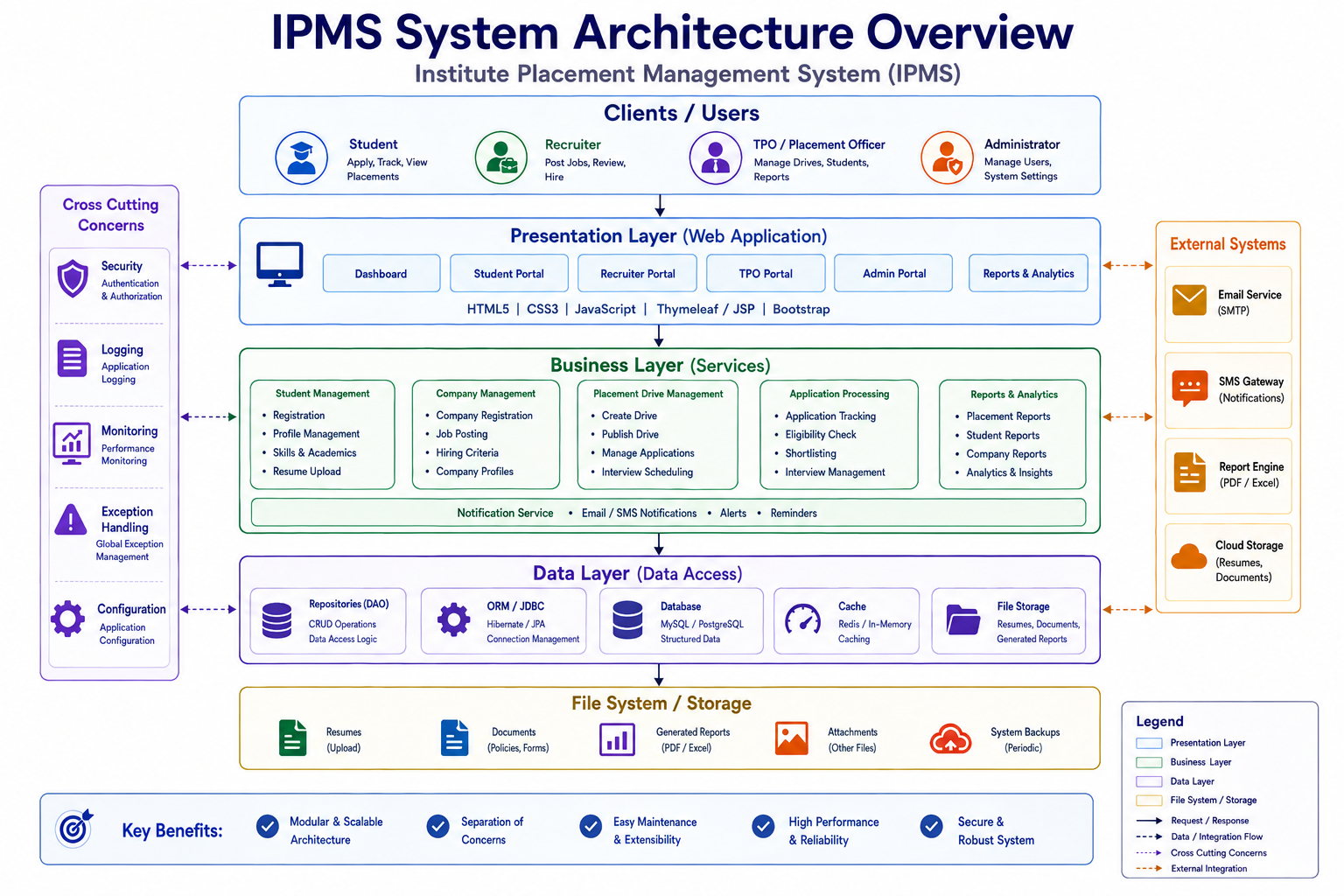
High Level Architecture
Presentation Layer

Business Layer

Data Layer

File System
Technology Stack
| Component | Technology |
|---|---|
| Language | Java 17 |
| IDE | IntelliJ IDEA |
| Build Tool | Maven |
| Database | MySQL/PostgreSQL |
| Reporting | Java APIs |
| Concurrency | Executor Framework |
Project Structure
ipms
│
├── controller
│
├── service
│
├── repository
│
├── model
│
├── dto
│
├── util
│
├── exception
│
└── report
Domain Model
The domain model represents core business entities.
Core Entities
- Student
- Company
- PlacementDrive
- Application
- Interview
- User
Domain Model Diagram
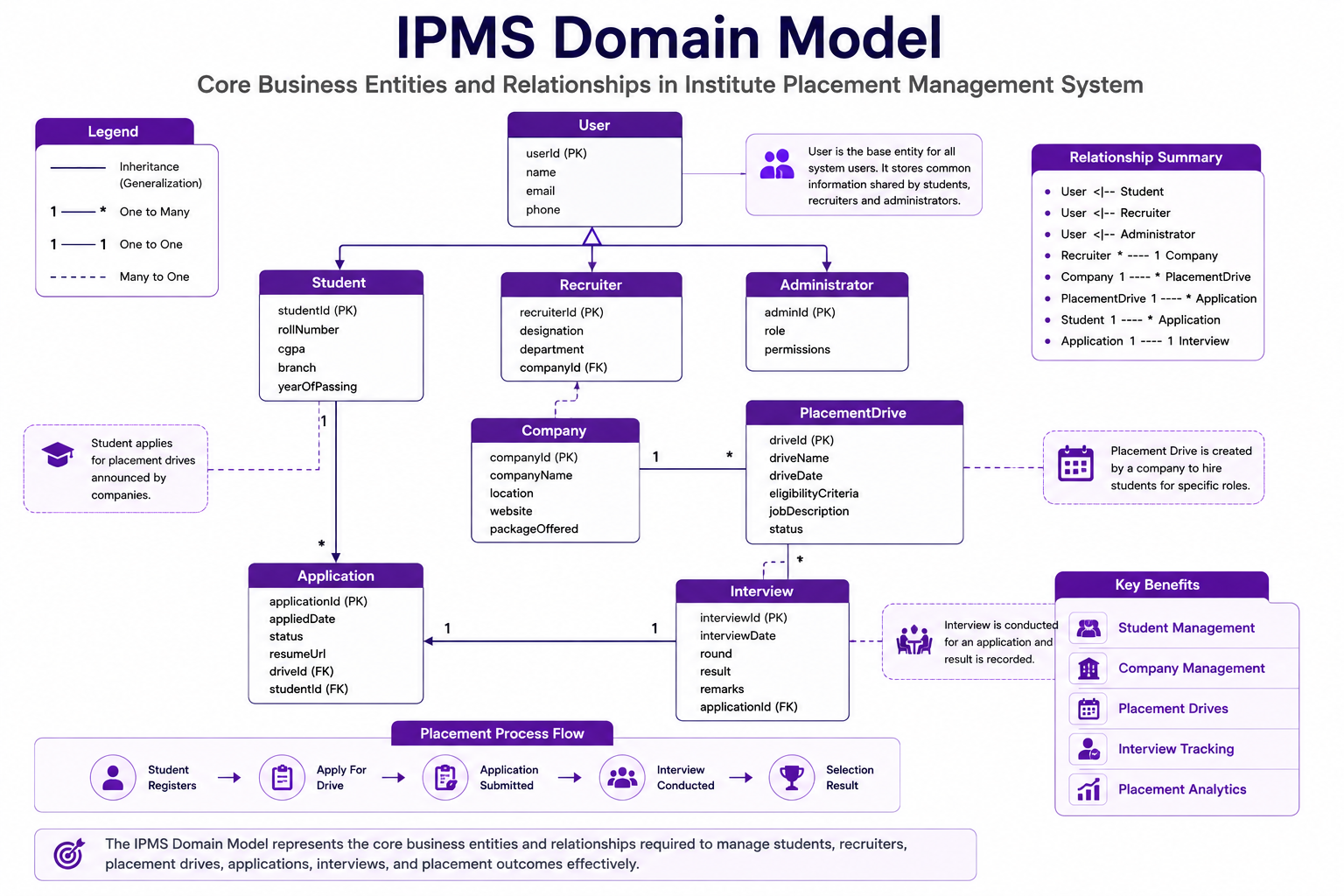
Student Entity
public class Student {

    private Long studentId;

    private String name;

    private String email;

    private double cgpa;

    private String branch;
}
Example Student
Student student =
        new Student();

student.setStudentId(101L);

student.setName(
        "John Doe");

student.setCgpa(8.75);
Another Student
Student student2 =
        new Student();

student2.setStudentId(102L);

student2.setName(
        "Sara Elise");

student2.setCgpa(9.20);
Company Entity
public class Company {

    private Long companyId;

    private String companyName;

    private String location;
}
Example
Company company =
        new Company();

company.setCompanyName(
        "TechNova Solutions");
Placement Drive Entity
public class PlacementDrive {

    private Long driveId;

    private String driveName;

    private LocalDate driveDate;
}
Application Entity
public class Application {

    private Long applicationId;

    private Student student;

    private PlacementDrive drive;
}
User Hierarchy
Using Inheritance.
public abstract class User {

    protected String name;

    protected String email;
}
Student User
public class Student
        extends User {

}
Recruiter User
public class Recruiter
        extends User {

}
Administrator User
public class Administrator
        extends User {

}
Applying Interfaces
Notification Interface
public interface NotificationService {

    void send(
            String message);
}
Email Notification
public class EmailService
        implements NotificationService {

    @Override
    public void send(
            String message) {

        System.out.println(message);
    }
}
SMS Notification
public class SmsService
        implements NotificationService {

    @Override
    public void send(
            String message) {

        System.out.println(message);
    }
}
Repository Layer
Repository handles data access.
Student Repository
public interface StudentRepository {

    void save(
            Student student);

    Student findById(
            Long id);
}
Implementation
public class StudentRepositoryImpl
        implements StudentRepository {

}
Service Layer
Business Logic Layer.
Student Service
public class StudentService {

    private StudentRepository
            repository;
}
Register Student
public void registerStudent(
        Student student) {

    repository.save(student);
}
Controller Layer
Handles requests.
Student Controller
public class StudentController {

    private StudentService
            service;
}
Create Student
public void createStudent(
        Student student) {

    service.registerStudent(
            student);
}
Layered Architecture
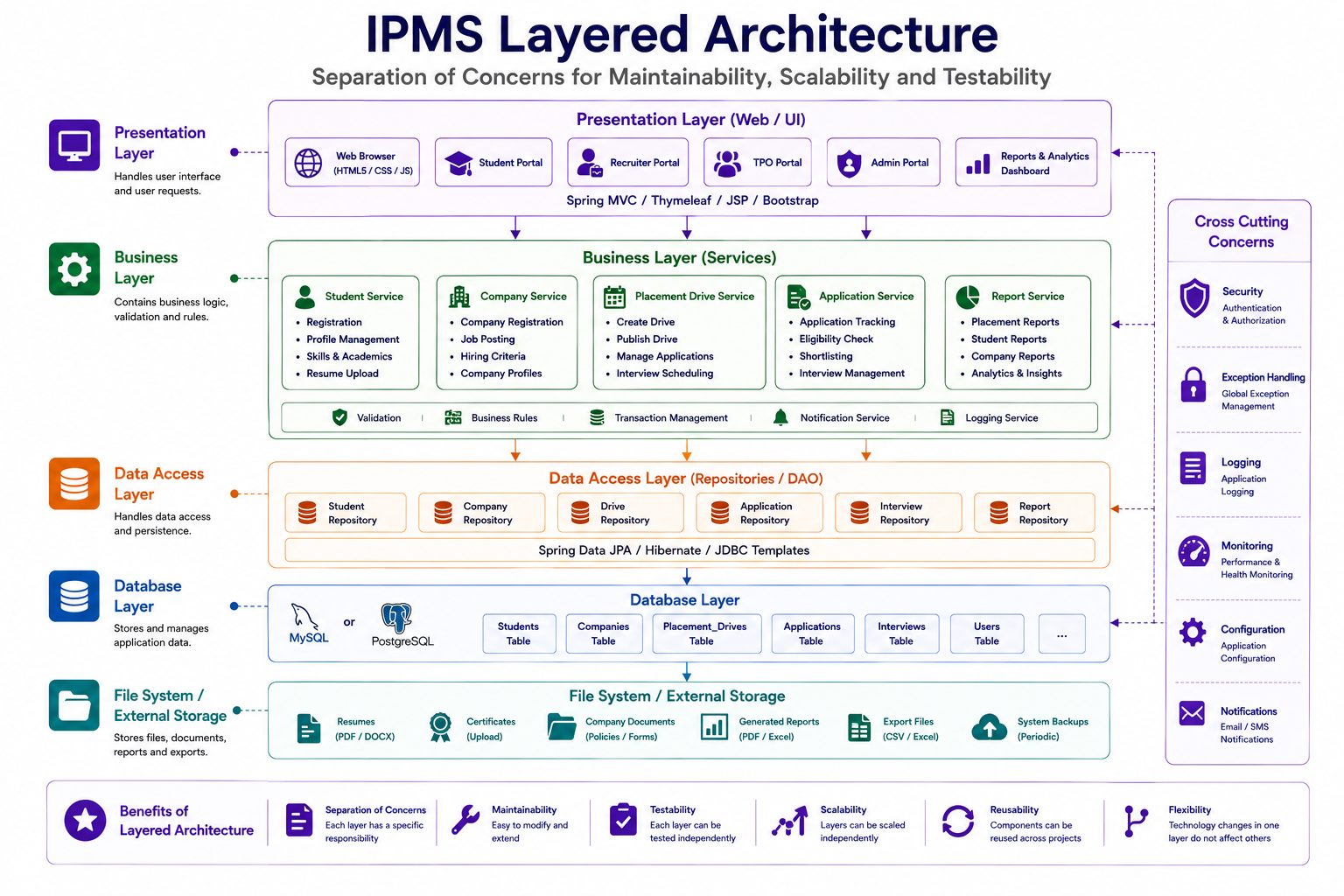
Applying Collections
Student List
List<Student> students =
        new ArrayList<>();
Company List
List<Company> companies =
        new ArrayList<>();
Skill Set
Set<String> skills =
        new HashSet<>();
Company Map
Map<Long, Company> companies =
        new HashMap<>();
Applying Generics
public interface Repository<T> {

    void save(T entity);

    T findById(Long id);
}
Student Repository
public class StudentRepository
        implements Repository<Student> {

}
Exception Handling
Custom Exception
public class InvalidCgpaException
        extends Exception {

    public InvalidCgpaException(
            String message) {

        super(message);
    }
}
Validation
if(student.getCgpa() < 0 ||
        student.getCgpa() > 10) {

    throw new InvalidCgpaException(
            "Invalid CGPA");
}
File Export
Generate reports.
CSV Export
BufferedWriter writer =
        new BufferedWriter(
                new FileWriter(
                        "students.csv"));
Write Student
writer.write(
        "101,John Doe,8.75");
Analytics using Stream API
Eligible Students
students.stream()
        .filter(
                student ->
                        student.getCgpa() >= 7)
        .forEach(
                System.out::println);
Top Students
students.stream()
        .sorted(
                Comparator.comparing(
                        Student::getCgpa)
                        .reversed());
Average CGPA
double average =
        students.stream()
                .mapToDouble(
                        Student::getCgpa)
                .average()
                .orElse(0);
Placement Analytics
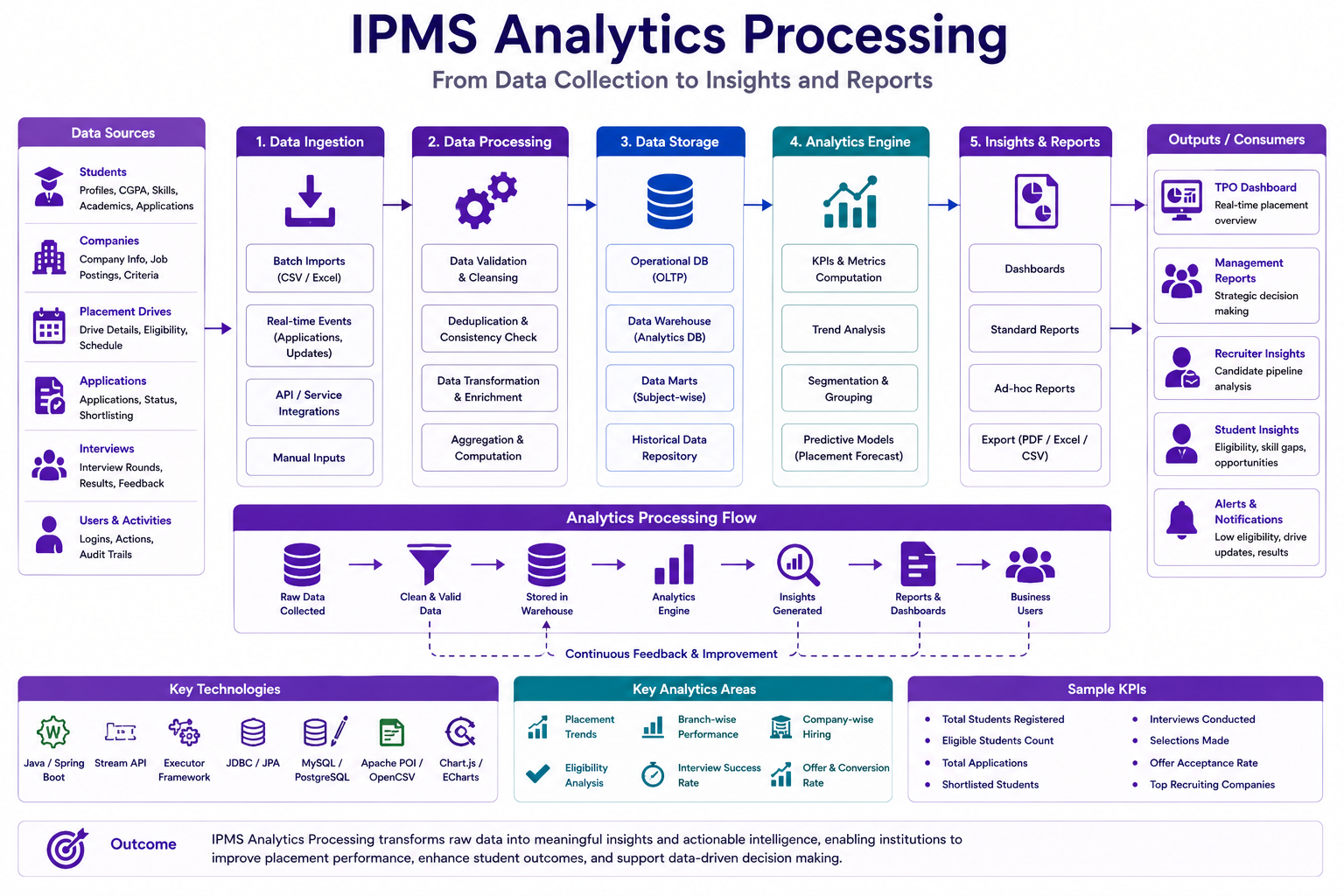
Applying Multithreading
Notification Task
Runnable notificationTask =
        () ->
                System.out.println(
                        "Email Sent");
Executor Service
ExecutorService executor =
        Executors.newFixedThreadPool(5);
Execute Task
executor.submit(
        notificationTask);
Generate Report
Callable<String> reportTask =
        () -> "Report Generated";
Future Result
Future<String> result =
        executor.submit(
                reportTask);
Applying SOLID Principles
SRP
StudentService

CompanyService

ReportService
OCP
ReportGenerator
Extended by:
PdfReportGenerator

ExcelReportGenerator
DIP
StudentService
depends upon:
StudentRepository
Applying Design Patterns
Singleton
ConfigurationManager
Factory
NotificationFactory
Builder
StudentBuilder
Strategy
EligibilityStrategy
Notification Factory
NotificationService service =
        NotificationFactory
                .create("EMAIL");
Student Builder
Student student =
        new StudentBuilder()
                .name("John Doe")
                .cgpa(8.75)
                .build();
Eligibility Strategy
EligibilityStrategy strategy =
        new CgpaStrategy();
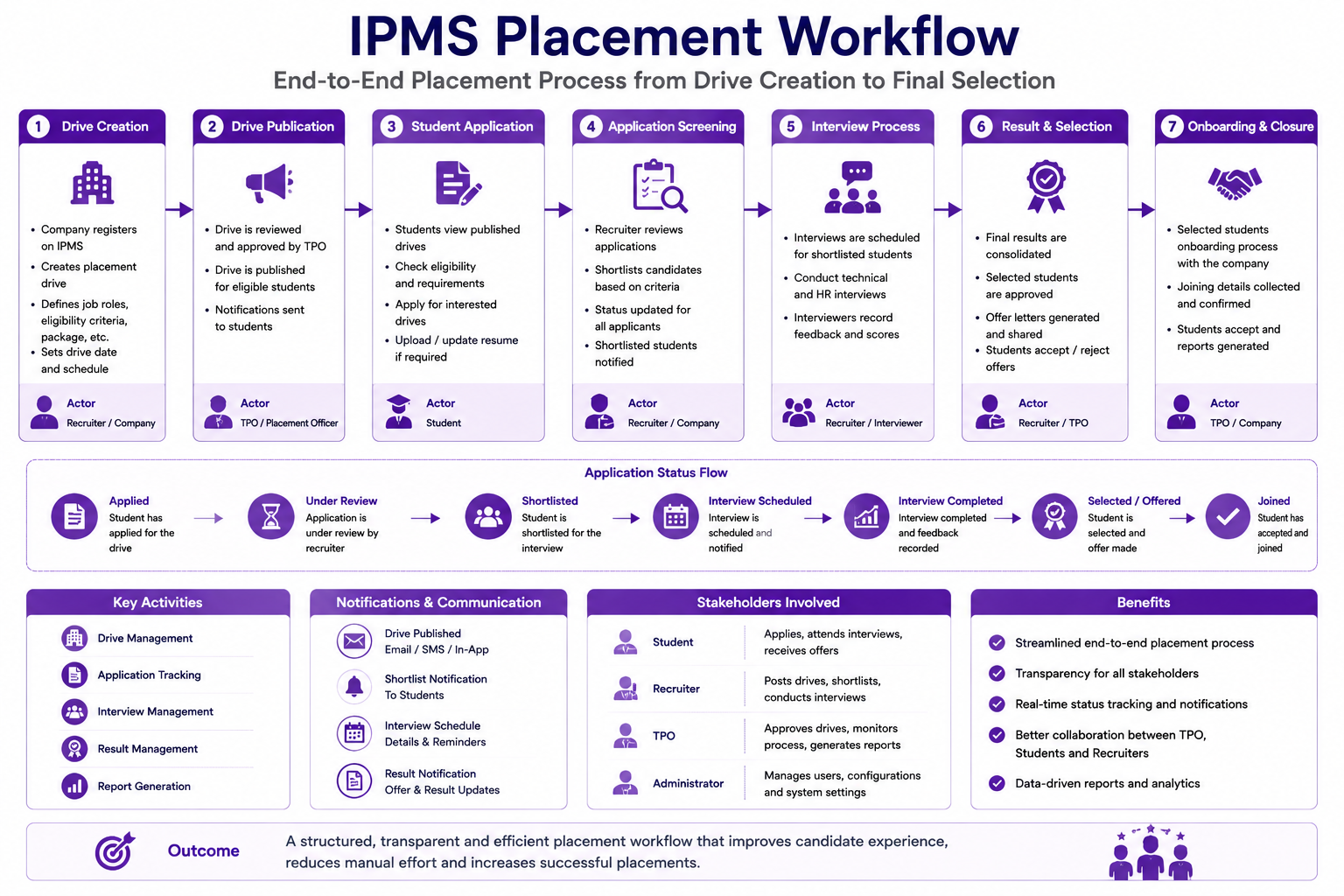
Placement Workflow
Sample Data
Students
| ID | Name | CGPA |
|---|---|---|
| 101 | John Doe | 8.75 |
| 102 | Sara Elise | 9.20 |
| 103 | Michael Brown | 7.85 |
| 104 | Emily Carter | 8.10 |
Companies
| ID | Company |
|---|---|
| 1 | TechNova Solutions |
| 2 | GlobalSoft Systems |
| 3 | FutureTech Labs |
Placement Eligibility Logic
public boolean eligible(
        Student student) {

    return student.getCgpa() >= 7;
}
Sample Execution Flow
Student Registers
        ↓

Profile Validation
        ↓

Placement Drive Published
        ↓

Student Applies
        ↓

Eligibility Check
        ↓

Interview Scheduled
        ↓

Result Declared
Future Enhancements
- Spring Boot REST APIs
- MySQL Integration
- Hibernate ORM
- JWT Security
- Docker Deployment
- Microservices
- Kafka Integration
- Cloud Deployment
Mini Project Deliverables
Students should implement:
- Student Module
- Company Module
- Placement Drive Module
- Report Module
- Notification Module
- Analytics Module
Best Practices
- Follow SOLID Principles
- Use Design Patterns
- Validate Inputs
- Handle Exceptions
- Use Collections Effectively
- Apply Generics
- Use Streams for Analytics
- Use Executor Framework for Background Tasks
Learning Outcomes
After completing IPMS, students will be able to:
- Design Enterprise Applications
- Implement OOP Concepts
- Use Collections and Generics
- Handle Exceptions
- Process Data using Streams
- Build Concurrent Applications
- Apply SOLID Principles
- Apply Design Patterns
Course Summary
Congratulations!
You have successfully completed:
- Java Fundamentals
- OOP
- Collections
- Generics
- Exception Handling
- File Handling
- Functional Programming
- Stream API
- Multithreading
- SOLID Principles
- Design Patterns
and applied them to build a complete enterprise-grade project:
Institute Placement Management System (IPMS)
This project serves as a strong foundation before learning:
- JDBC
- Spring Framework
- Spring Boot
- Hibernate
- Microservices
- Cloud-Native Java Development
Keep building, experimenting, and coding every day.