
Chapter 02: Git Setup, Configuration and Essential Commands
Practical focus: Prepare a safe local workspace and understand Git's basic vocabulary.
Learning objectives
By the end of this chapter, you should be able to:
- Verify Git installation and configure commit identity.
- Explain working tree, staging area, commit and remote.
- Use basic Git inspection commands safely.
1. Why this topic matters
Git records repository history through commits. Before collaborating, verify installation and configure the author identity used in commits.
2. Core concepts
Install and verify
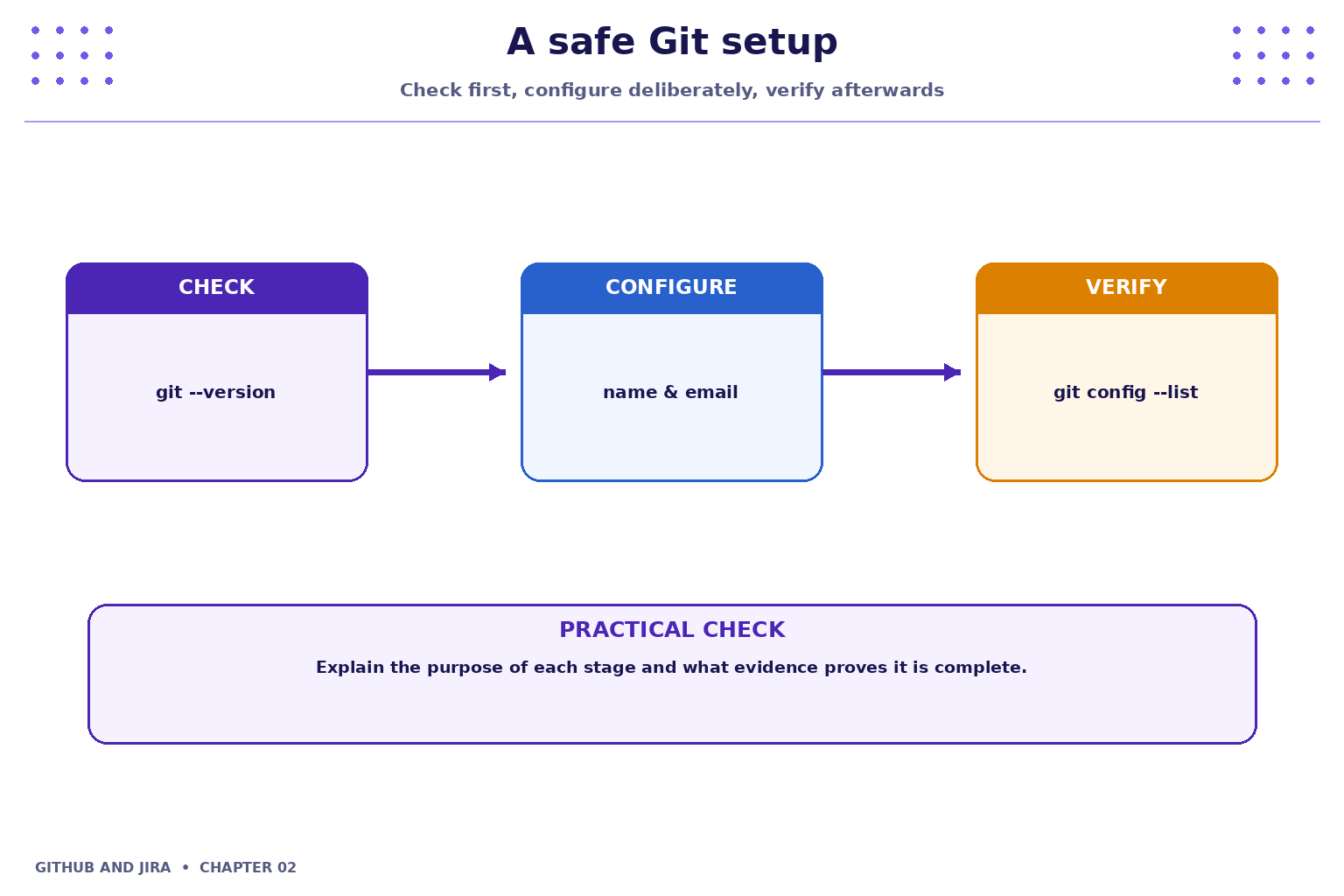
Use an approved Git installer for your operating system. Verify the installation with git --version. Installation steps differ by OS and organisational policy.
Configure identity
Git commit metadata commonly includes a name and email. Configure a suitable identity with git config --global user.name and git config --global user.email. Use the identity policy required by your team; do not share private configuration output blindly.
3. Practical model
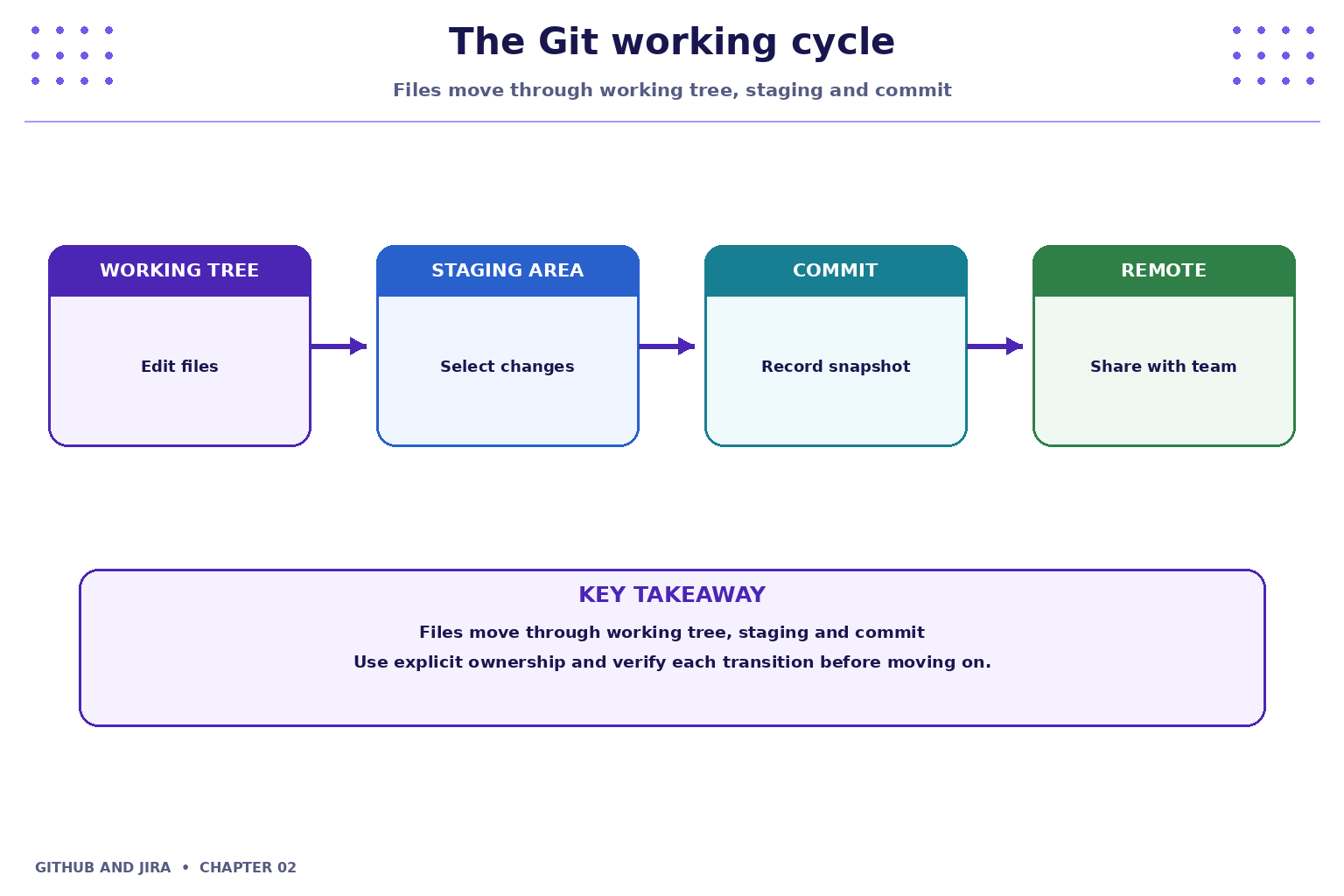
The working tree contains current files. The staging area selects changes for the next commit. A commit records a snapshot in repository history. A remote is another repository location used for collaboration.
4. Industry scenario
Scenario: a team is delivering a small feature for a fictional Student Task Tracker. Git records repository history through commits. Before collaborating, verify installation and configure the author identity used in commits.
5. Hands-on lab
Use only your own practice repository and the approved Jira project. Do not use production code, credentials or personal data.
- Run
git --version. If Git is not installed, follow the approved installation guide. - Set
user.nameanduser.emailusing your course-approved identity, then inspect only those values. - Create a practice folder and initialise a repository with
git init; rungit status.
Lab evidence to record
- What you changed or inspected.
- The command or UI action used.
- What you observed and how you verified it.
- Any limitation, blocker or follow-up action.
6. Command and action reference
| Command / action | Purpose / safe note |
|---|---|
git --version |
Show installed Git version |
git config --global user.name "Your Name" |
Set commit author name; replace placeholder |
git config --global user.email "you@example.com" |
Set commit author email; replace placeholder |
git init |
Create repository metadata in the current directory |
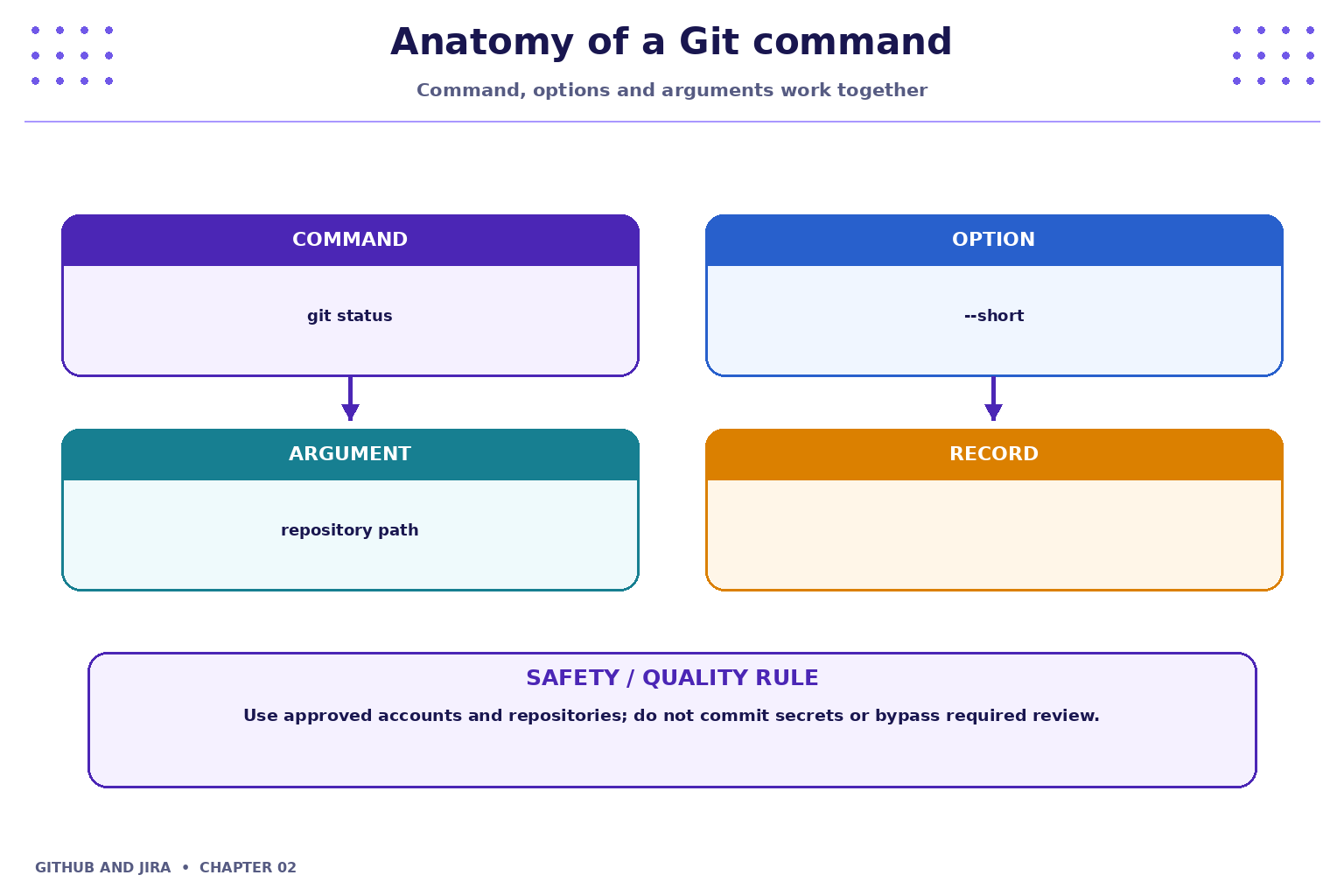
git status |
Show current repository state |
git help status |
Open help for a command |
Safety note: Command-line examples are illustrative. Replace placeholders with values from your own approved practice environment. Do not paste tokens, passwords, private keys or confidential data into commits, tickets or screenshots.
7. Common mistakes and troubleshooting
- Wrong repository or project: verify the repository URL, current directory, project name and work-item key before changing anything.
- Permission denied / action unavailable: check account access and project or repository permissions; request the appropriate access rather than sharing credentials or bypassing controls.
- Unexpected Git state: stop and inspect
git status, the diff and recent history before trying another command. - Missing integration activity: verify configuration, permissions, repository connection and the team's linking convention; do not assume the integration supports every event.
8. Quick-fire knowledge check
1. What does git init do?
Show answer
Initialises a Git repository2. What is the staging area for?
Show answer
Selecting changes for the next commit3. Does git status normally modify files?
Show answer
No, it inspects repository stateKey takeaways
- Git records repository history through commits. Before collaborating, verify installation and configure the author identity used in commits.
- Keep changes small, status accurate and evidence easy for teammates to inspect.
- Follow approved access, review and security policies.
Practice extension
Ask a teammate to review your work or inspect a sample project. Identify one improvement to clarity, traceability, test evidence or workflow consistency.
Next chapter
Chapter 3 — Repositories, Cloning and Remote Synchronisation