
Chapter 2: REST Architecture and API Design Principles
In the previous chapter, we explored the modern API landscape and learned why APIs have become the backbone of digital transformation initiatives.
In this chapter, we will focus on designing high-quality REST APIs using industry-standard best practices.
Before writing any code, it is important to understand how APIs should be structured, how resources should be modeled, and how consumers interact with APIs.
Using our Insurance Policy Management System (IPMS), we will design enterprise-grade REST APIs that are scalable, maintainable, and easy to consume.
🎯 Learning Objectives
By the end of this chapter, you will be able to:
- Understand REST architectural principles
- Design resource-oriented APIs
- Create meaningful URI structures
- Use HTTP methods correctly
- Select appropriate HTTP status codes
- Understand idempotency
- Design pagination, filtering, and sorting
- Implement API versioning strategies
- Model business resources effectively
What is REST?
REST stands for:
Representational State Transfer
REST is an architectural style introduced by Roy Fielding in his doctoral dissertation.
REST is not a protocol.
REST is a set of architectural constraints that help create scalable distributed systems.
Most modern enterprise APIs are REST-based because REST is:
- Simple
- Lightweight
- Scalable
- Language agnostic
- Platform independent
REST Architectural Constraints
A RESTful API follows several architectural constraints.
Client-Server Architecture
The client and server remain independent.
Example:
Mobile App
      ↓
 REST API
      ↓
 Policy Service
Benefits:
- Independent evolution
- Better scalability
- Separation of concerns
Stateless Communication
Each request must contain all information required to process it.
Example:
GET /api/policies/LIFE-100001
Authorization: Bearer token
The server should not depend on previous requests.
Benefits:
- Scalability
- Reliability
- Easier load balancing
Uniform Interface
REST APIs should expose a consistent interface.
Examples:
GET /policies
GET /policies/{policyNumber}
POST /policies
PUT /policies/{policyNumber}
DELETE /policies/{policyNumber}
Consumers should be able to predict API behavior.
Resource-Oriented Design
REST focuses on resources rather than operations.
Bad Design:
/createPolicy
/updatePolicy
/deletePolicy
Good Design:
POST /policies
PUT /policies/{policyNumber}
DELETE /policies/{policyNumber}
Resource Modeling
Resource modeling is one of the most important API design activities.
Before designing APIs, identify business entities.
For our Insurance Policy Management System:
PolicyHolder
Policy
Coverage
Claim
PremiumPayment
Agent
Beneficiary
Insurance Domain Model
Before designing APIs, architects must understand the business domain.
In our Insurance Policy Management System, the core business entities and their relationships drive API design.
A well-designed API reflects the business domain rather than the underlying database schema.
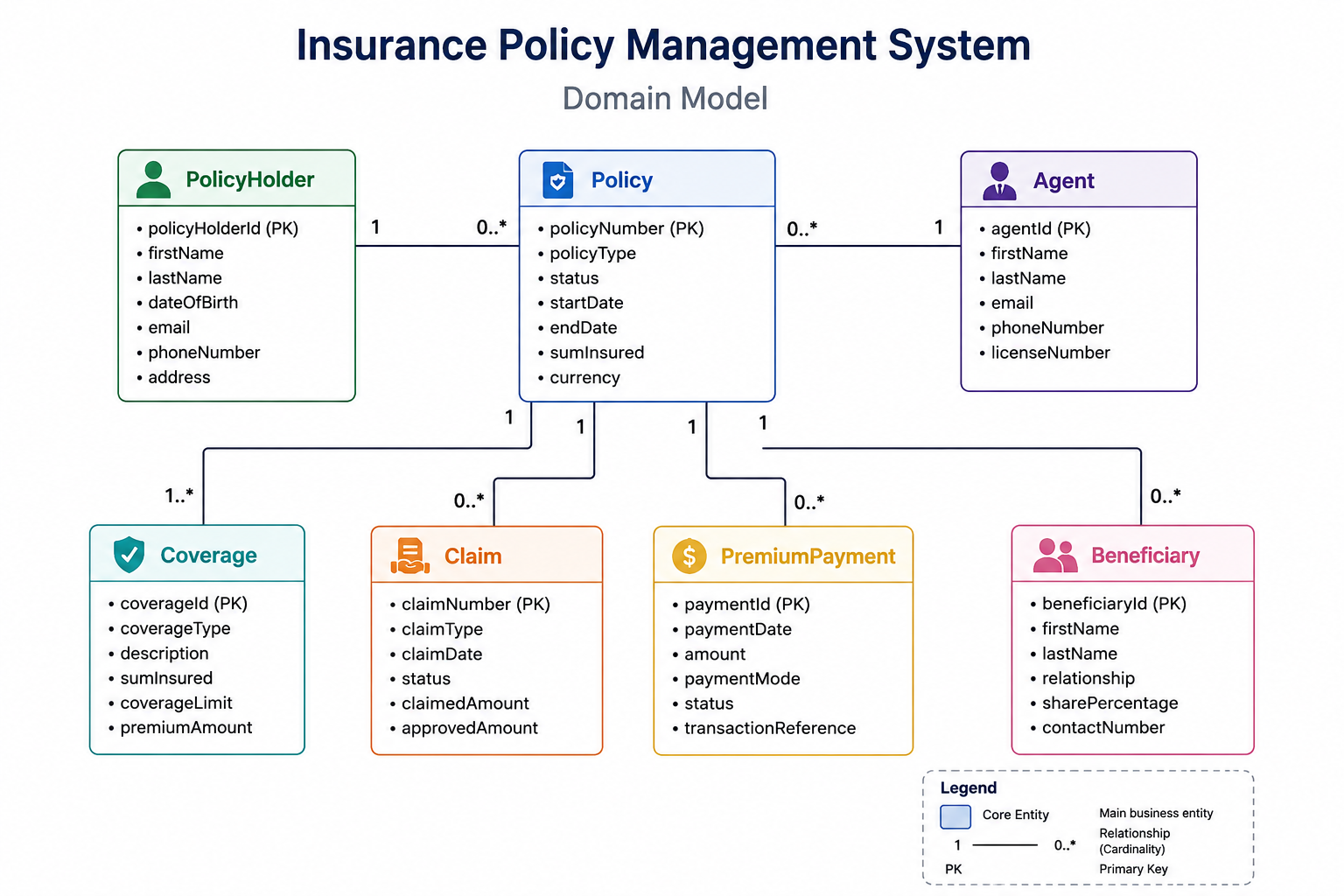
The domain model identifies major business entities and their relationships.
Resource Naming Guidelines
Use:
- Nouns
- Plural names
- Consistent naming
Examples:
/policies
/policy-holders
/claims
/payments
/agents
Avoid:
/getPolicies
/createPolicy
/deletePolicy
Resources represent data.
HTTP methods represent actions.
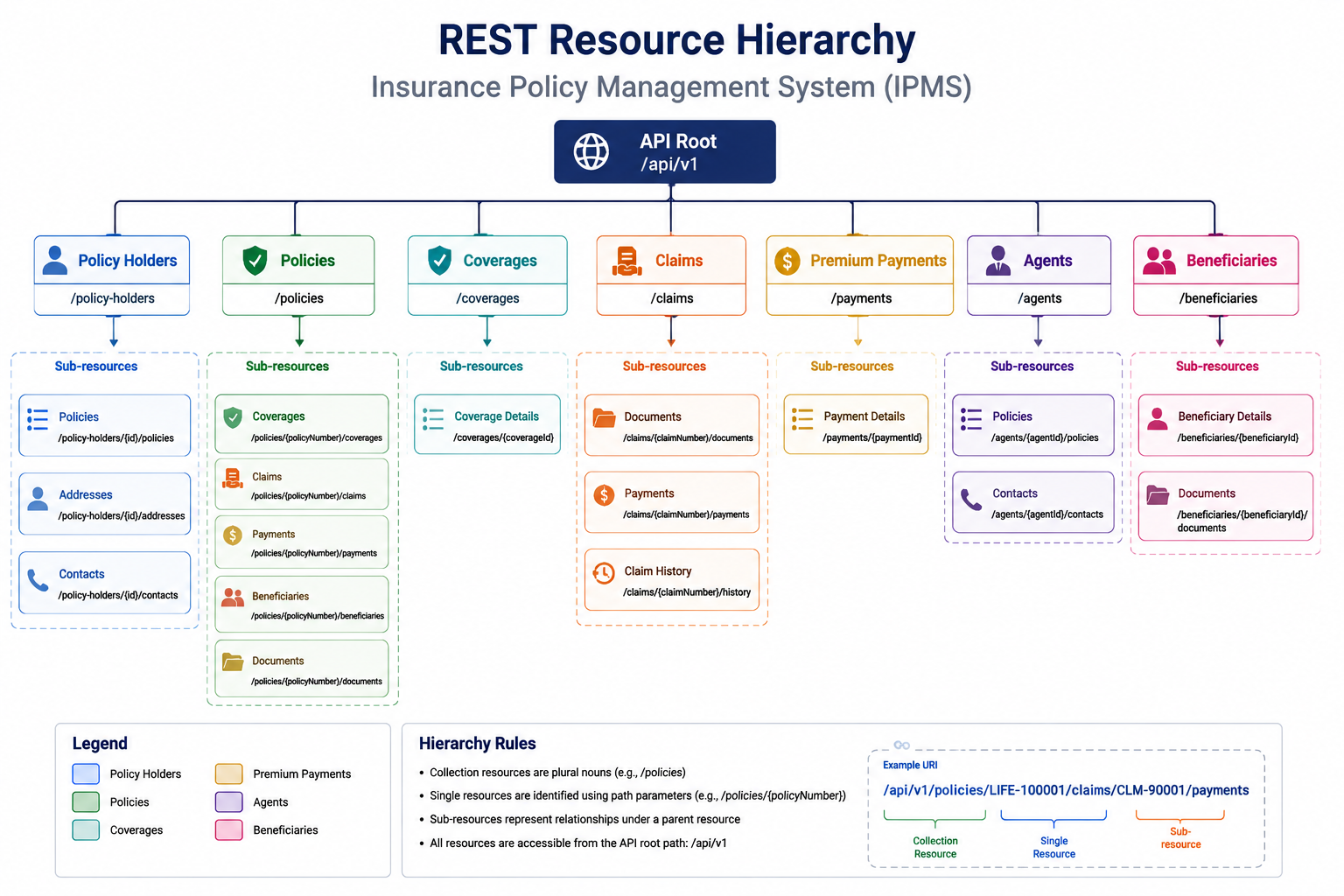
URI Design Principles
Good URI design is essential for API usability.
Collection Resource
Retrieve all policies:
GET /policies
Single Resource
Retrieve a specific policy:
GET /policies/LIFE-100001
Sub Resources
Retrieve claims for a policy:
GET /policies/LIFE-100001/claims
Retrieve beneficiaries:
GET /policies/LIFE-100001/beneficiaries
URI Hierarchy
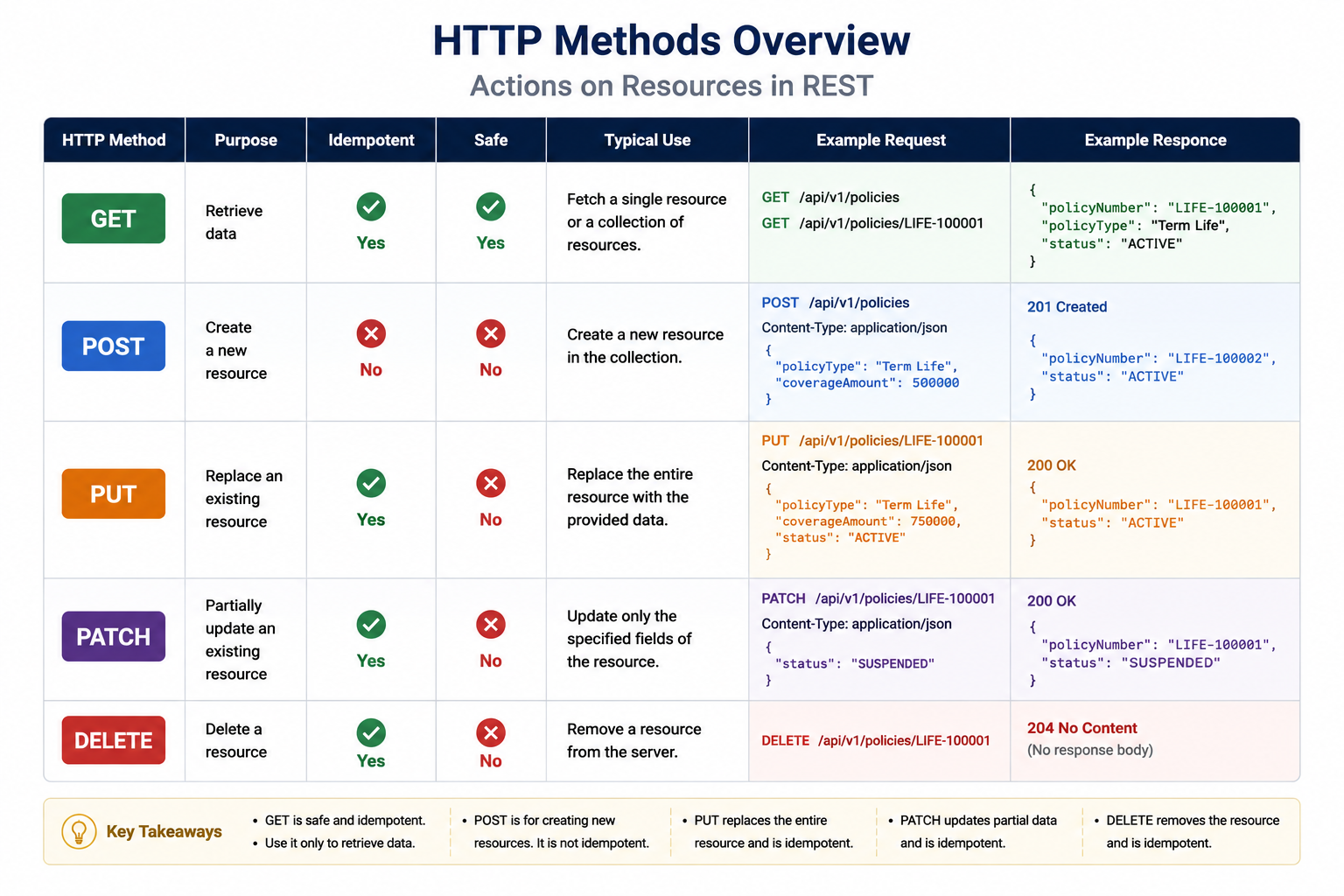
HTTP Methods
HTTP methods define the action performed on a resource.
GET
Retrieve data.
GET /policies
GET /policies/LIFE-100001
POST
Create a new resource.
POST /policies
Request:
{
  "policyType": "Term Life",
  "coverageAmount": 500000
}
PUT
Replace an existing resource.
PUT /policies/LIFE-100001
PATCH
Partially update a resource.
PATCH /policies/LIFE-100001
Example:
{
  "status": "SUSPENDED"
}
DELETE
Delete a resource.
DELETE /policies/LIFE-100001
HTTP Method Summary
HTTP Status Codes
Status codes communicate request outcomes.
2xx Success
200 OK
201 Created
204 No Content
4xx Client Errors
400 Bad Request
401 Unauthorized
403 Forbidden
404 Not Found
409 Conflict
5xx Server Errors
500 Internal Server Error
503 Service Unavailable
Status Code Decision Tree
Understanding Idempotency
Idempotency means:
Multiple identical requests
produce the same result.
Idempotent Methods
GET
PUT
DELETE
Example:
DELETE /policies/LIFE-100001
DELETE /policies/LIFE-100001
DELETE /policies/LIFE-100001
Result remains the same.
Non-Idempotent Methods
POST
Example:
POST /policies
POST /policies
POST /policies
Each request creates a new resource.
Idempotency Visualization
Pagination
Large datasets should not be returned in a single response.
Bad:
GET /policies
Returns:
2 million records
Good:
GET /policies?page=1&size=20
Pagination Example
GET /policies?page=2&size=10
Response:
{
  "page": 2,
  "size": 10,
  "totalPages": 150,
  "totalRecords": 1500
}
Filtering
Filtering reduces returned data.
Example:
GET /policies?status=ACTIVE
GET /policies?policyType=TERM
GET /claims?status=APPROVED
Sorting
Sorting organizes returned data.
Example:
GET /policies?sort=startDate
Descending:
GET /policies?sort=startDate,desc
Search, Filter and Sort Flow
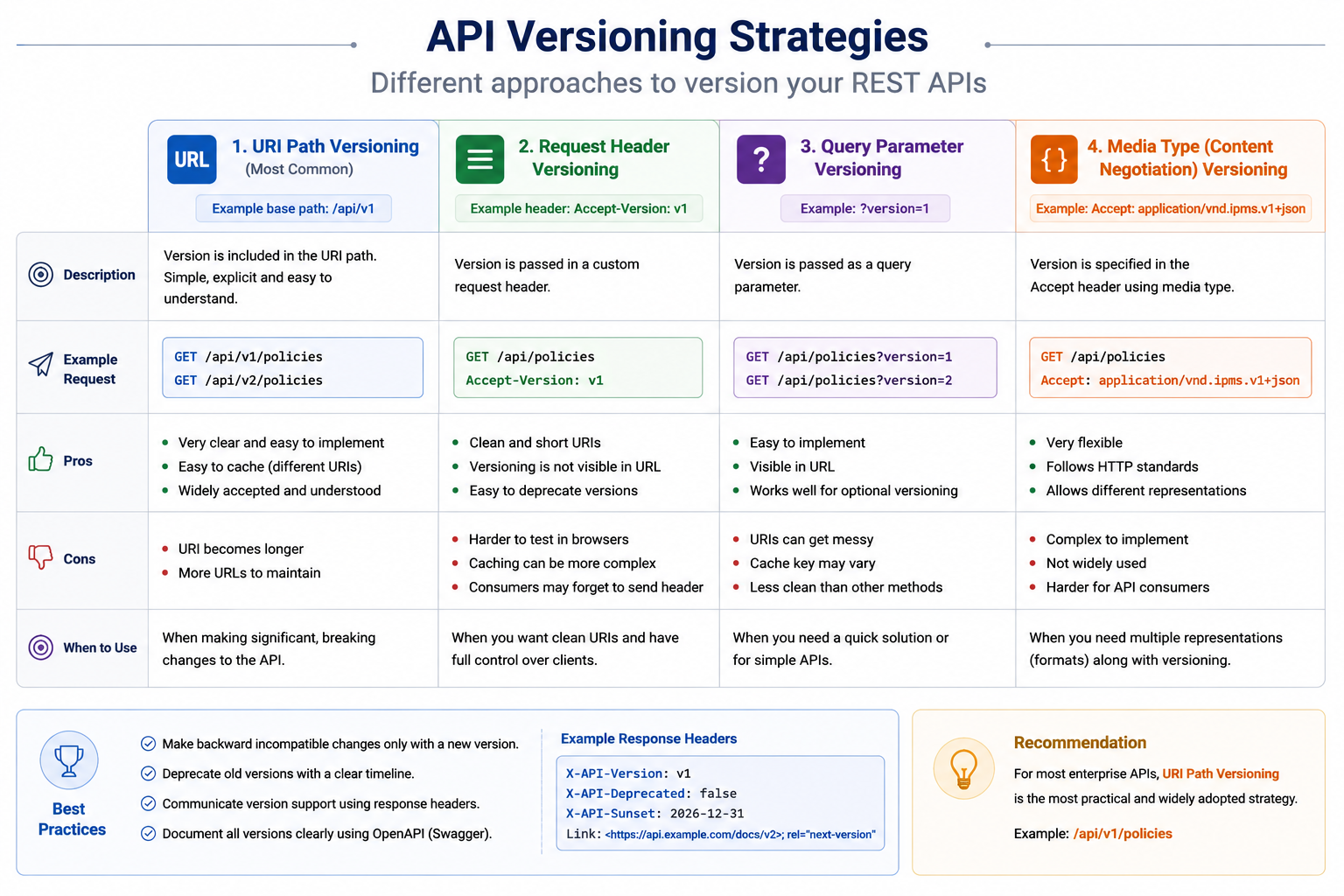
API Versioning
APIs evolve over time.
Versioning prevents breaking existing consumers.
URI Versioning
/api/v1/policies
/api/v2/policies
Header Versioning
Accept-Version: v2
Versioning Strategy Comparison
Designing Our First Insurance APIs
Using everything learned so far, we can design the primary resources for IPMS.
Policy Holder APIs
GET    /policy-holders

GET    /policy-holders/{id}

POST   /policy-holders

PUT    /policy-holders/{id}

DELETE /policy-holders/{id}
Policy APIs
GET    /policies

GET    /policies/{policyNumber}

POST   /policies

PUT    /policies/{policyNumber}

DELETE /policies/{policyNumber}
Claims APIs
GET    /claims

GET    /claims/{claimNumber}

POST   /claims

PUT    /claims/{claimNumber}

DELETE /claims/{claimNumber}
Premium Payment APIs
GET    /payments

GET    /payments/{paymentId}

POST   /payments
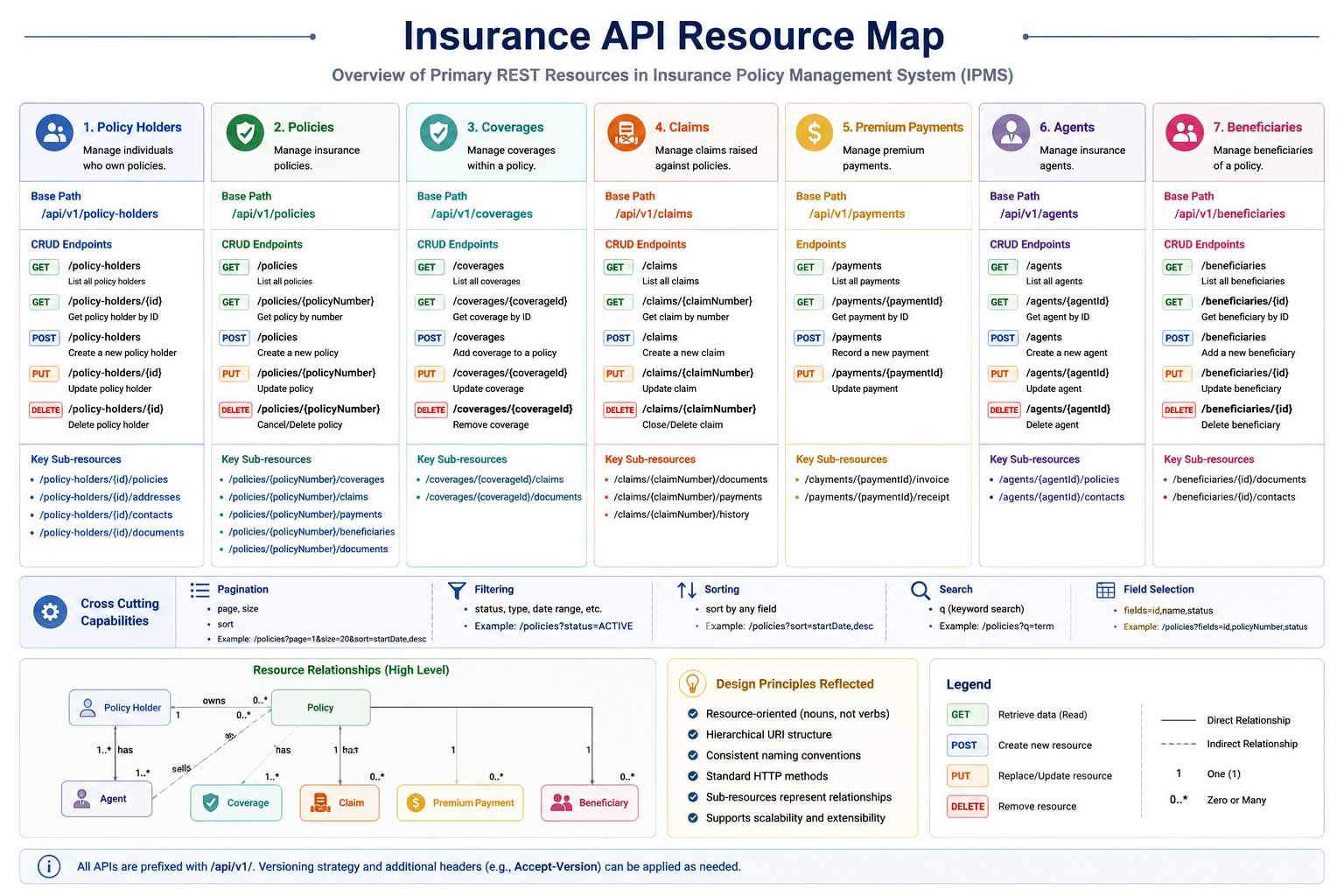
Insurance API Resource Map
The following diagram summarizes all major REST resources that we have identified in the Insurance Policy Management System.
These resources will gradually evolve into OpenAPI specifications, Spring Boot controllers, DTOs, JPA entities, and eventually microservices.
Best Practices
✅ Design APIs around business resources
✅ Use nouns, not verbs
✅ Use standard HTTP methods
✅ Return appropriate status codes
✅ Support pagination
✅ Use consistent naming conventions
✅ Plan versioning early
Common Mistakes
❌ Designing APIs around database tables
❌ Using verbs in URIs
❌ Returning incorrect status codes
❌ Ignoring pagination
❌ Breaking backward compatibility
❌ Exposing internal implementation details
Interview Questions
-
What are REST architectural constraints?
-
What is statelessness?
-
Explain idempotency.
-
Difference between PUT and PATCH?
-
Difference between POST and PUT?
-
Why should URIs use nouns instead of verbs?
-
What are common API versioning strategies?
-
Why is pagination important?
-
When should 201 Created be returned?
-
What makes a REST API consumer-friendly?
Practice Exercises
-
Design REST APIs for Agent Management.
-
Design REST APIs for Beneficiary Management.
-
Create URIs for:
- Policy Search
- Claim Search
- Premium History
-
Identify which APIs should support pagination.
-
Identify idempotent and non-idempotent operations.
Key Takeaways
- REST is an architectural style.
- Resources are the foundation of REST APIs.
- URIs should represent business entities.
- HTTP methods represent actions.
- Status codes communicate outcomes.
- Idempotency improves reliability.
- Pagination improves scalability.
- Versioning protects consumers.
- Good API design simplifies future development.
Chapter Summary
In this chapter, you learned:
- REST architectural principles
- Resource modeling
- URI design
- HTTP methods
- HTTP status codes
- Idempotency
- Pagination
- Filtering
- Sorting
- API versioning
You have now designed the APIs for our Insurance Policy Management System and are ready to formally define API contracts in the next chapter.