
Chapter 14: Event-Driven APIs with Kafka
In the previous chapter, we transformed our Insurance Policy Management System (IPMS) into a Microservices Architecture.
Our system now has:
- Independent Services
- API Gateway
- Service Discovery
- Database per Service
- Bounded Contexts
However, a new challenge emerges.
How should microservices communicate?
Should every service call every other service using REST APIs?
As the number of services grows, synchronous communication creates tight coupling and reduces resilience.
Modern enterprise systems solve this problem using:
Event-Driven Architecture
In this chapter, we will learn how Apache Kafka enables scalable event-driven communication between microservices.
🎯 Learning Objectives
By the end of this chapter, you will be able to:
- Understand Event-Driven Architecture
- Understand Apache Kafka
- Understand Producers and Consumers
- Understand Topics and Partitions
- Design Event Contracts
- Implement Event-Driven Communication
- Understand Consumer Groups
- Understand Event Sourcing Concepts
- Understand CQRS Fundamentals
- Design Insurance Event Flows
Why Event-Driven Architecture?
Consider the following process.
Policy Created
      ↓
Generate Payment Schedule
      ↓
Notify Customer
      ↓
Update Analytics
      ↓
Audit Logging
Using synchronous APIs:
Policy Service
      ↓
Payment Service
      ↓
Notification Service
      ↓
Analytics Service
Each service depends on the next.
Problems:
Tight Coupling

Cascading Failures

Slow Response Times

Difficult Scalability
What is Event-Driven Architecture?
In Event-Driven Architecture (EDA):
Service Produces Event
      ↓
Event Broker
      ↓
Interested Services Consume Event
Services do not directly call each other.
Event-Driven Architecture Overview
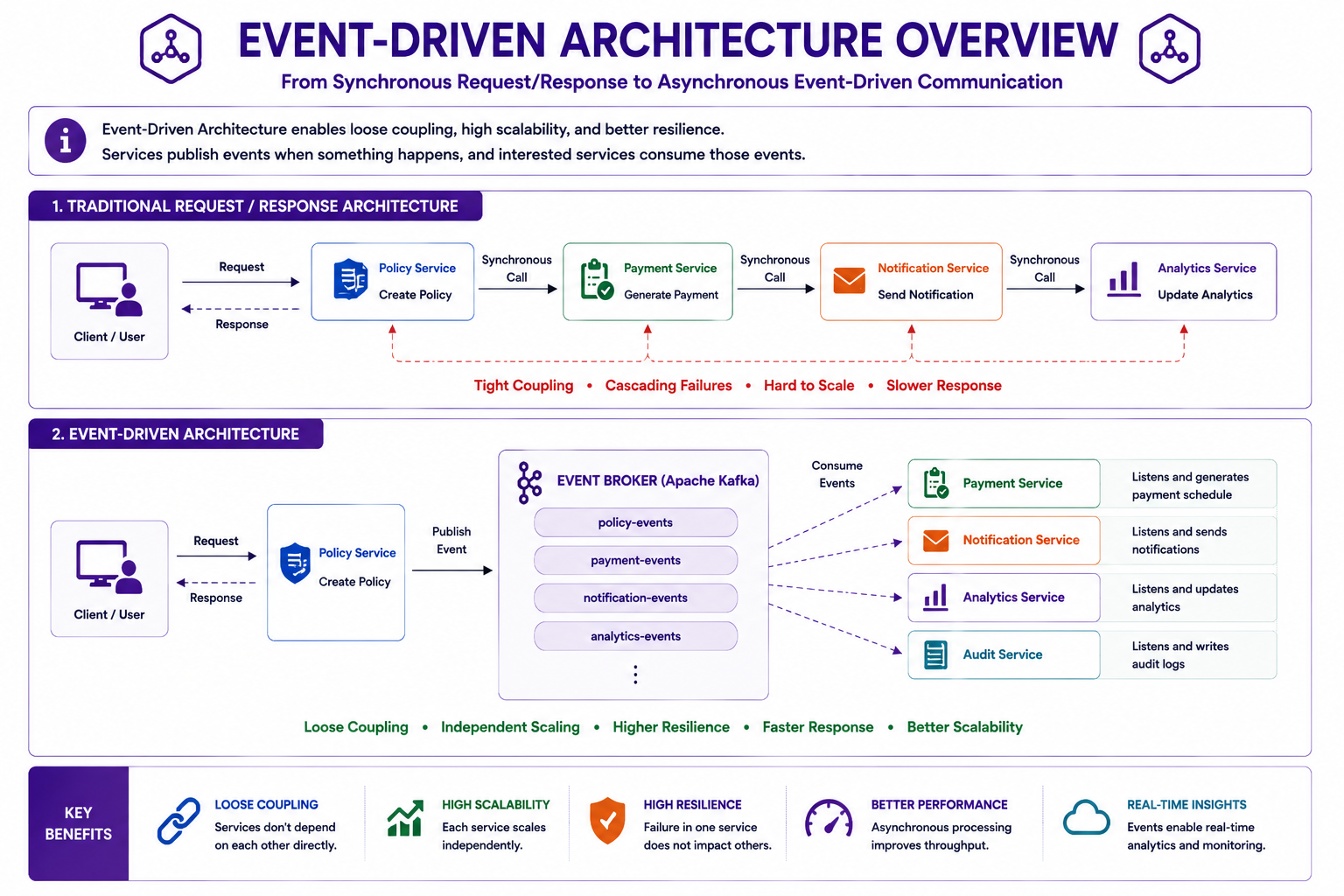
Events enable loose coupling between services.
What is an Event?
An event represents something that happened.
Examples:
Policy Created

Policy Updated

Claim Submitted

Claim Approved

Premium Paid

Customer Registered
Events describe facts.
Event Examples
{
  "eventType": "POLICY_CREATED",

  "policyNumber": "LIFE-100001",

  "policyType": "TERM"
}
What is Apache Kafka?
Apache Kafka is a distributed event streaming platform.
Kafka provides:
High Throughput

Scalability

Fault Tolerance

Event Streaming

Durability
Why Kafka?
Kafka is widely used because it supports:
Millions of Events

Distributed Processing

Replayability

High Availability
Kafka Core Components
Kafka consists of:
Producer

Topic

Partition

Broker

Consumer

Consumer Group
Kafka Architecture
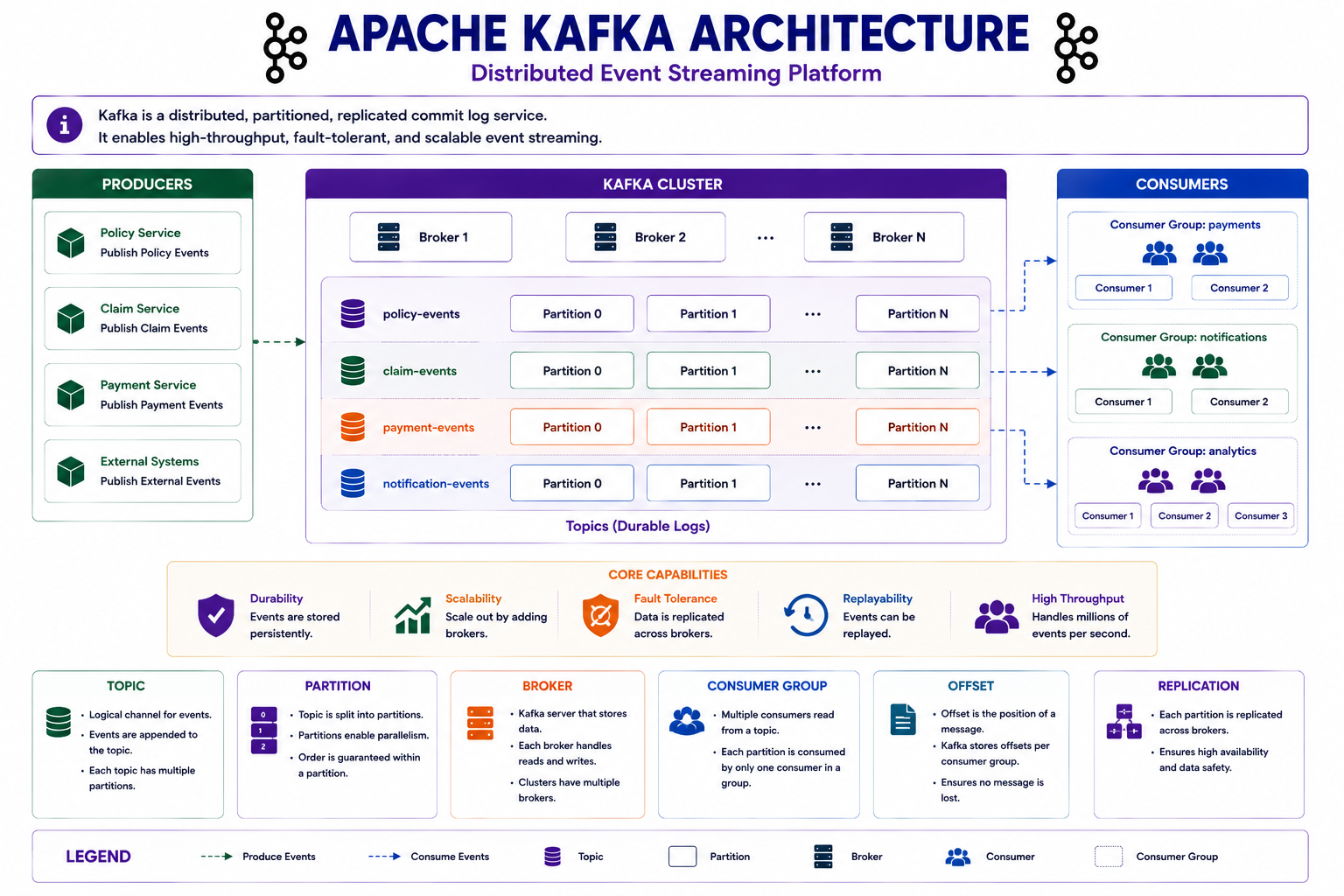
Kafka acts as the central event backbone.
Kafka Producer
A Producer publishes events.
Example:
Policy Service
      ↓
POLICY_CREATED Event
      ↓
Kafka Topic
Producer Example
kafkaTemplate.send(
    "policy-events",
    event
);
Kafka Consumer
Consumers subscribe to topics.
Example:
Notification Service

Analytics Service

Audit Service
can all consume the same event.
Consumer Example
@KafkaListener(
    topics = "policy-events")
public void consume(
        PolicyCreatedEvent event) {

}
Kafka Topics
Topics are logical channels used to organize events.
Examples:
policy-events

claim-events

payment-events

notification-events
Topic Example
policy-events
     ↓
POLICY_CREATED

POLICY_UPDATED

POLICY_CANCELLED
Kafka Partitions
Topics are divided into partitions.
Benefits:
Parallel Processing

Scalability

High Throughput
Example:
policy-events

Partition 0

Partition 1

Partition 2
Consumer Groups
Multiple consumers can work together.
Consumer Group
      ↓
Consumer 1

Consumer 2

Consumer 3
Kafka distributes partitions automatically.
Message Flow
Consider a new policy creation.
Customer Creates Policy
What happens next?
Kafka Message Flow
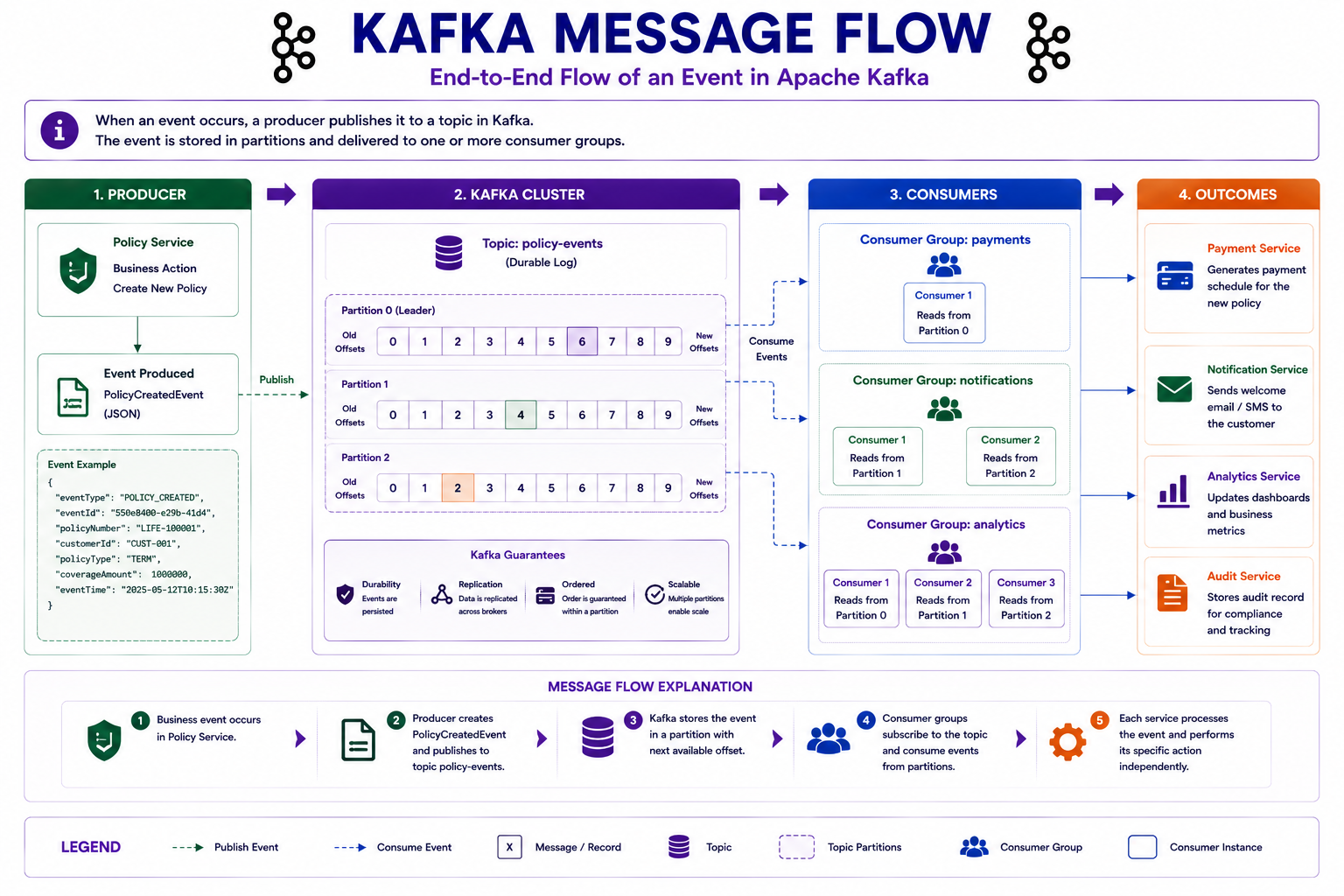
Multiple services react independently.
Event Contracts
Events should be treated as contracts.
Example:
{
  "eventType": "POLICY_CREATED",

  "policyNumber": "LIFE-100001",

  "policyType": "TERM",

  "coverageAmount": 1000000
}
Why Event Contracts Matter
Contracts ensure:
Consistency

Compatibility

Reliability
Consumers depend on event structure.
Event Versioning
Events evolve over time.
Example:
{
  "eventVersion": 2
}
Versioning prevents breaking consumers.
Insurance Domain Events
Typical IPMS events:
POLICY_CREATED

POLICY_UPDATED

CLAIM_SUBMITTED

CLAIM_APPROVED

CLAIM_REJECTED

PAYMENT_RECEIVED

CUSTOMER_REGISTERED
Event-Driven IPMS Architecture
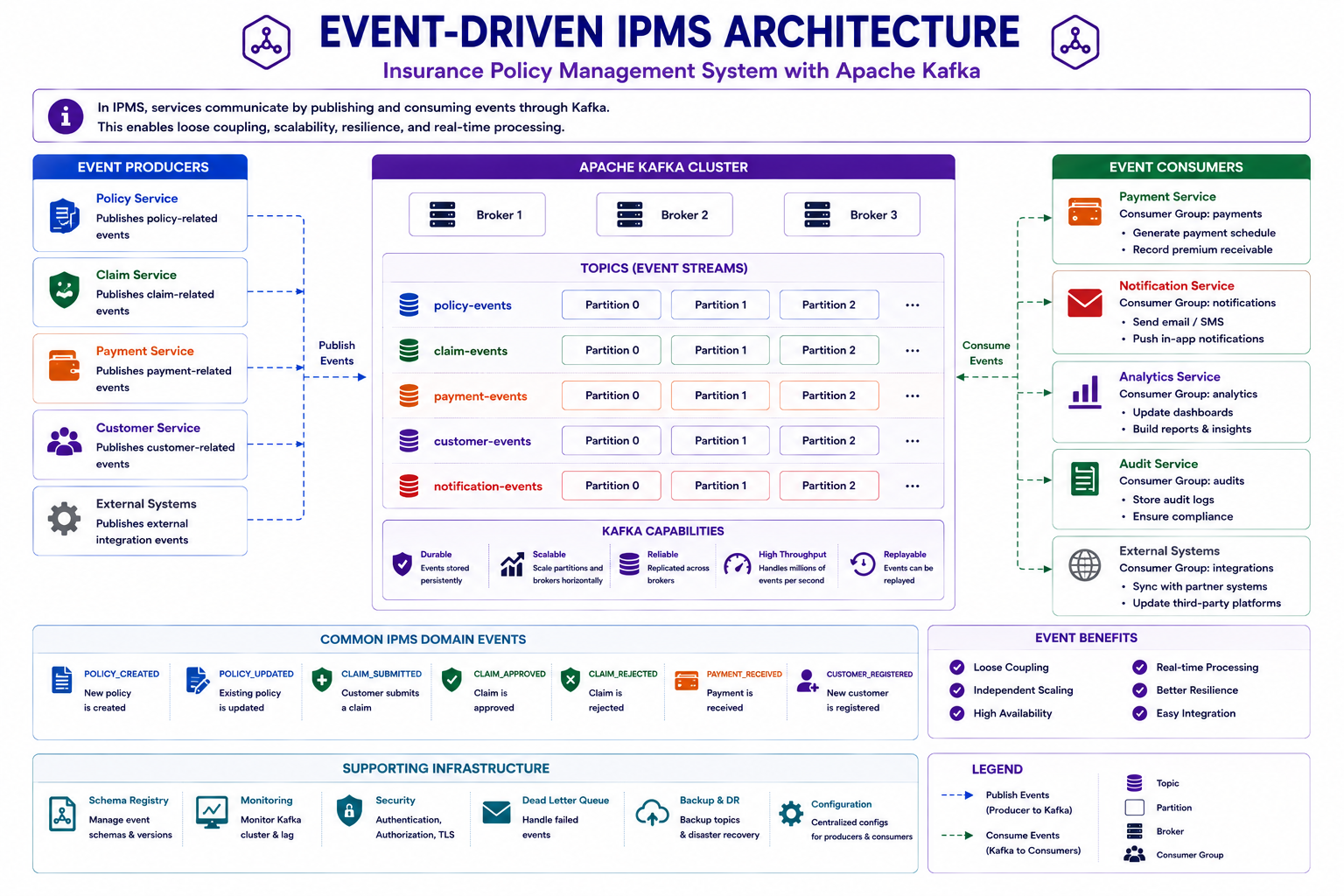
Kafka becomes the communication backbone.
Benefits of Event-Driven APIs
✅ Loose Coupling
✅ High Scalability
✅ Independent Services
✅ Better Resilience
✅ Asynchronous Processing
✅ Real-Time Communication
Challenges of Event-Driven Systems
⚠ Event Ordering
⚠ Duplicate Messages
⚠ Event Schema Evolution
⚠ Debugging Complexity
⚠ Distributed Transactions
Introduction to Event Sourcing
Traditional systems store:
Current State
Example:
Policy Status = ACTIVE
Event Sourcing Stores
Policy Created

Premium Paid

Policy Updated

Claim Submitted
All events are retained.
Traditional vs Event Sourcing
Traditional:
Current State Only
Event Sourcing:
Complete History
Benefits of Event Sourcing
Auditability

Traceability

Replayability
CQRS Overview
CQRS stands for:
Command Query Responsibility Segregation
CQRS separates:
Write Operations

Read Operations
Traditional Architecture
Reads
   ↓
Same Model
   ↑
Writes
CQRS Architecture
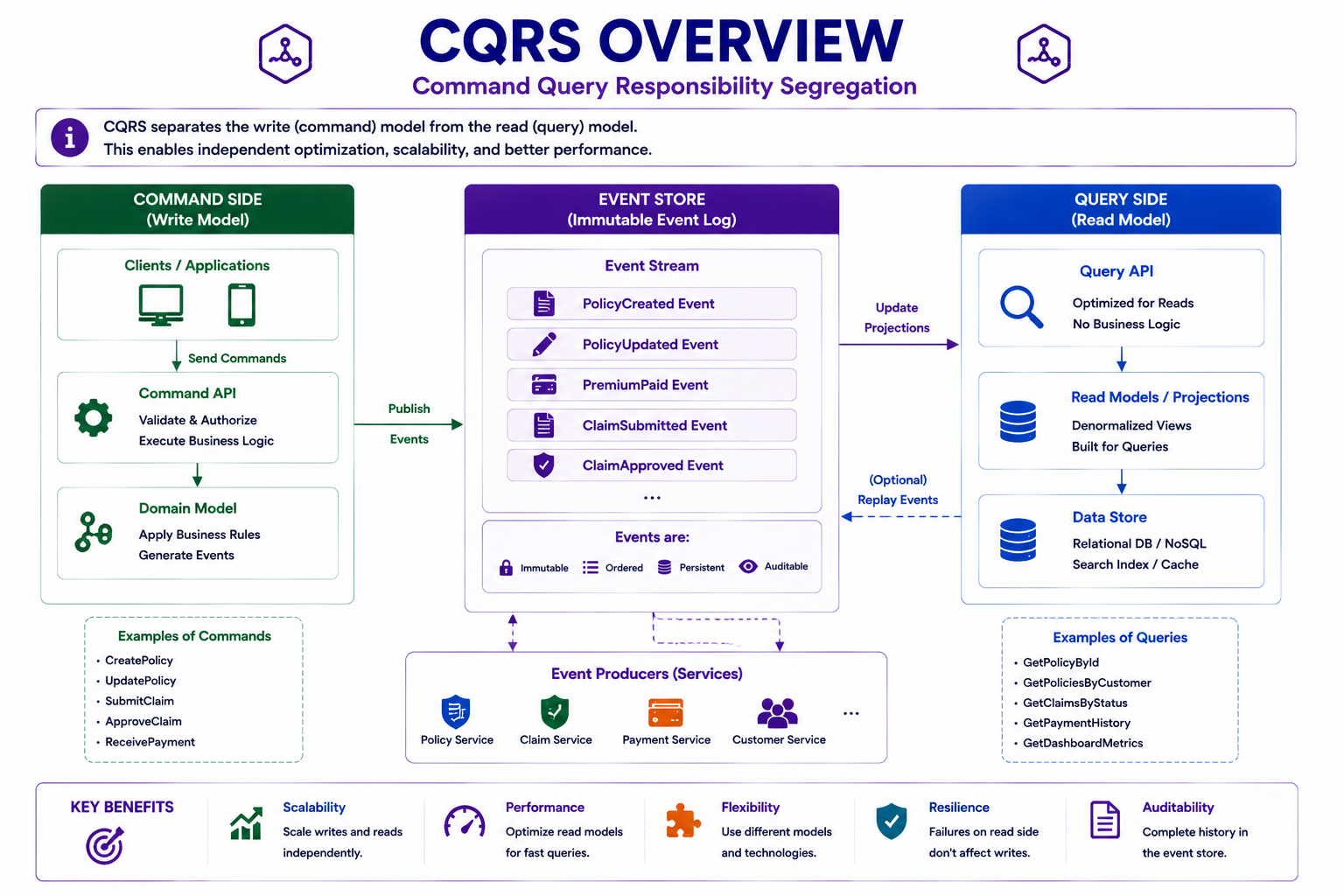
Commands and Queries use different models.
CQRS Benefits
Better Scalability

Optimized Queries

Independent Read Models
Kafka in Microservices
Kafka is often used for:
Event Streaming

Audit Logging

Notifications

Analytics

System Integration
Spring Boot Kafka Integration
Dependency:
<dependency>
    <groupId>
        org.springframework.kafka
    </groupId>

    <artifactId>
        spring-kafka
    </artifactId>
</dependency>
Producer Configuration
spring:
  kafka:
    bootstrap-servers: localhost:9092
Sending Events
kafkaTemplate.send(
    "policy-events",
    event);
Receiving Events
@KafkaListener(
        topics = "policy-events")
public void consume(
        PolicyCreatedEvent event) {

}
Best Practices
✅ Design stable event contracts
✅ Version events
✅ Keep events immutable
✅ Use meaningful topic names
✅ Use consumer groups
✅ Monitor Kafka clusters
✅ Handle duplicate events
✅ Secure Kafka communication
Common Mistakes
❌ Using events for everything
❌ Breaking event schemas
❌ Ignoring versioning
❌ Large event payloads
❌ Missing monitoring
❌ Tight coupling through events
Interview Questions
-
What is Event-Driven Architecture?
-
What is Kafka?
-
What is a Kafka Topic?
-
What is a Partition?
-
What is a Producer?
-
What is a Consumer?
-
What is a Consumer Group?
-
What is Event Sourcing?
-
What is CQRS?
-
Why use Kafka in microservices?
Practice Exercises
-
Create Kafka Producer.
-
Create Kafka Consumer.
-
Publish POLICY_CREATED event.
-
Create policy-events topic.
-
Create claim-events topic.
-
Implement event versioning.
-
Design IPMS event contracts.
-
Create CQRS read model.
Key Takeaways
- Event-Driven Architecture enables loose coupling.
- Kafka is a distributed event streaming platform.
- Producers publish events.
- Consumers subscribe to events.
- Topics organize event streams.
- Partitions provide scalability.
- Consumer Groups enable parallel processing.
- Event Contracts ensure compatibility.
- Event Sourcing preserves history.
- CQRS separates read and write models.
Chapter Summary
In this chapter, you learned:
- Event-Driven Architecture
- Kafka Fundamentals
- Producers
- Consumers
- Topics
- Partitions
- Consumer Groups
- Event Contracts
- Event Sourcing
- CQRS
Our Insurance Policy Management System can now communicate using scalable, resilient, event-driven patterns powered by Apache Kafka.
In the next chapter, we will learn how to containerize and deploy our Spring Boot applications using Docker and Kubernetes.