
Chapter 4: API Documentation Standards and Swagger Ecosystem
In the previous chapter, we learned how to define API contracts using the OpenAPI Specification.
An API contract is useful only when it is easily accessible, understandable, and consumable by developers.
Modern enterprises therefore invest heavily in API documentation, developer portals, and API governance platforms.
In this chapter, we will explore how OpenAPI contracts evolve into interactive documentation using Swagger and become a key part of the API consumer experience.
Using our Insurance Policy Management System (IPMS), we will continue building the same API definitions created in previous chapters.
🎯 Learning Objectives
By the end of this chapter, you will be able to:
- Understand the importance of API documentation
- Understand the Swagger ecosystem
- Generate interactive API documentation
- Use Swagger UI
- Use Swagger Editor
- Understand API developer portals
- Improve API discoverability
- Understand documentation governance
Why API Documentation Matters
An API without documentation is difficult to consume.
Consider the following endpoint:
GET /policies/{policyNumber}
Without documentation, consumers must guess:
- Required parameters
- Authentication requirements
- Response structure
- Error responses
Documentation removes ambiguity.
API Documentation Ecosystem

The OpenAPI contract becomes the foundation for documentation, testing, governance, and developer onboarding.
Common Documentation Challenges
Organizations frequently encounter:
- Missing documentation
- Outdated documentation
- Inconsistent examples
- Undocumented errors
- Poor discoverability
These issues increase support costs and integration failures.
Characteristics of Good API Documentation
Good documentation should provide:
Overview
Explain:
- Purpose
- Scope
- Business capabilities
Example:
Policy Management API

Provides APIs for managing insurance policies,
coverage, renewals, and policy search.
Authentication
Document:
- OAuth2
- JWT
- API Keys
Example:
Authorization: Bearer eyJhbGciOi...
Request Examples
Example:
GET /policies/LIFE-100001
Response Examples
Example:
{
  "policyNumber": "LIFE-100001",
  "status": "ACTIVE"
}
Error Examples
Example:
{
  "status": 404,
  "message": "Policy not found"
}
Swagger Ecosystem
Swagger provides tooling around OpenAPI.
The most common tools include:
Swagger UI

Swagger Editor

Swagger Codegen

SwaggerHub
Swagger Toolchain
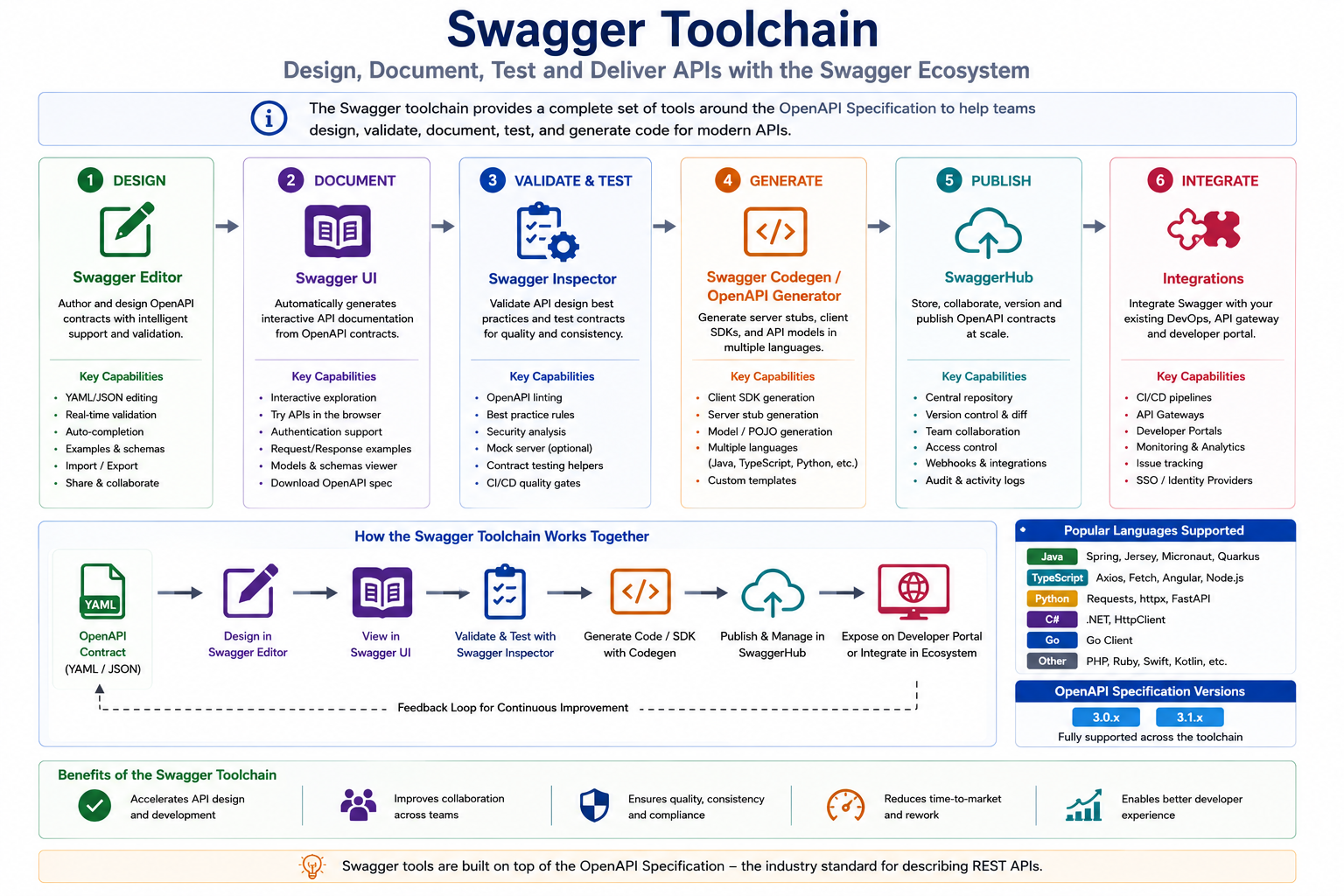
These tools help teams design, review, document, and generate API assets.
Swagger Editor
Swagger Editor provides:
- OpenAPI editing
- Validation
- Preview
- Collaboration
Example:
openapi: 3.0.3

info:
  title: Insurance Policy API
Benefits:
- Early feedback
- Validation
- Contract quality
Swagger UI
Swagger UI converts OpenAPI contracts into interactive documentation.
Features:
- Endpoint discovery
- Request execution
- Response visualization
- Authentication testing
Example Swagger UI Workflow
OpenAPI Contract
       ↓
Swagger UI
       ↓
Interactive Documentation
       ↓
Consumer Testing
Developer Portals
Large organizations expose APIs through Developer Portals.
Developer portals provide:
- API catalog
- Documentation
- SDKs
- Sample code
- Release notes
Examples:
Internal Developer Portal

Partner Portal

Public API Portal
Insurance Developer Portal

This is how Policy, Claims, and Payments APIs are typically presented to internal teams and partners.
API Documentation Lifecycle
Documentation must evolve alongside APIs.
Documentation Lifecycle
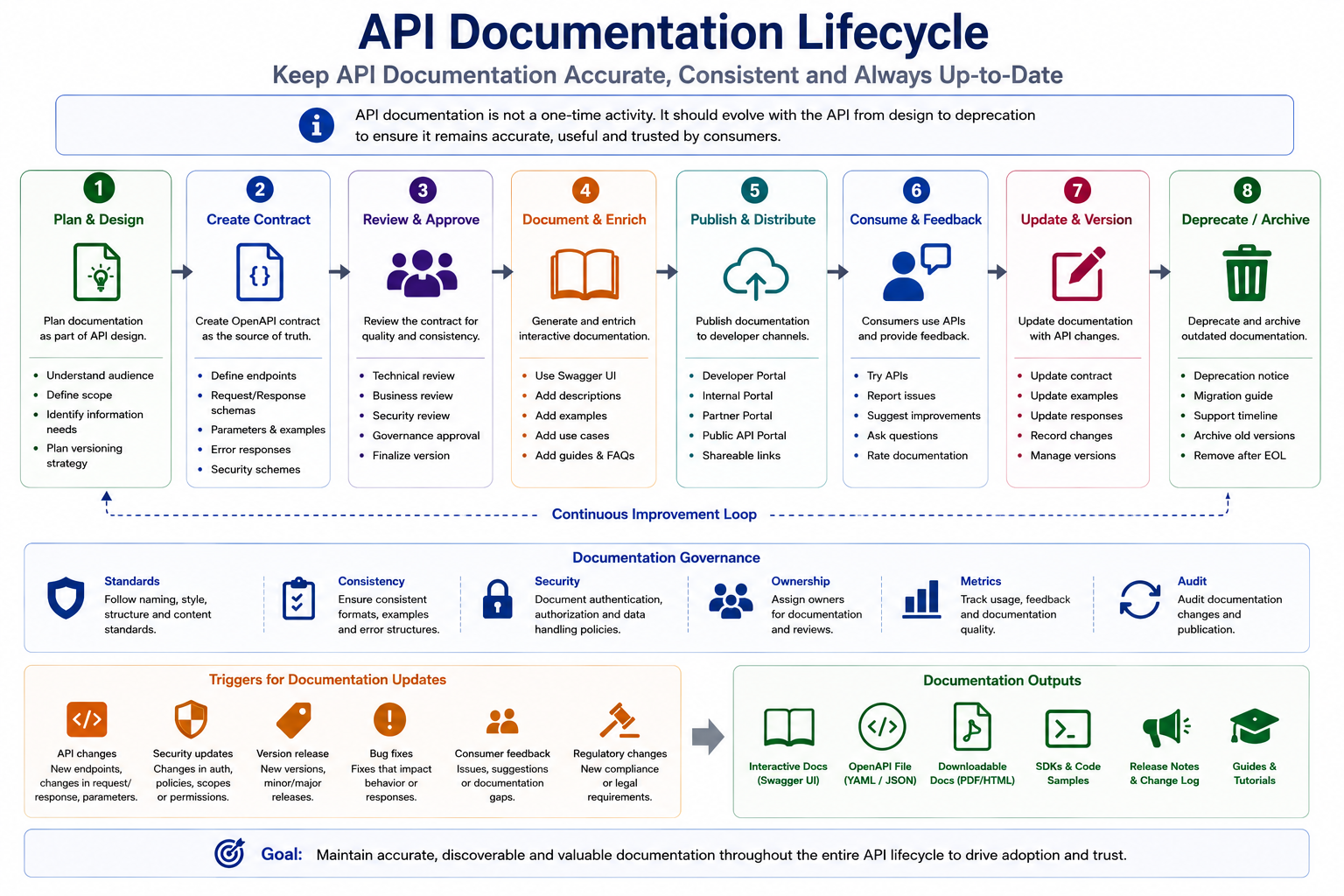
Documentation should be updated whenever:
- APIs change
- Versions change
- Security changes
- Error contracts change
Documentation Driven Governance
Enterprise governance teams review:
- Naming standards
- Versioning standards
- Security standards
- Documentation quality
Documentation becomes an important governance artifact.
Reusing Our Insurance API Contract
From Chapter03 we defined:
GET /policies/{policyNumber}
OpenAPI Contract:
paths:
  /policies/{policyNumber}:
    get:
      summary: Retrieve policy
Swagger UI automatically generates:
- Documentation
- Examples
- Interactive testing screens
No duplicate effort is required.
API Discoverability
Consumers should be able to easily discover APIs.
Recommended categories:
Policy APIs

Claims APIs

Coverage APIs

Payment APIs

Agent APIs
Good categorization improves adoption.
Documentation Best Practices
✅ Provide business context
✅ Include request examples
✅ Include response examples
✅ Include error examples
✅ Keep documentation synchronized
✅ Use OpenAPI as source of truth
✅ Provide version history
Common Documentation Mistakes
❌ Documentation created after development
❌ Missing examples
❌ Missing authentication details
❌ Outdated screenshots
❌ Duplicate documentation sources
Applying Documentation Standards to IPMS
The following APIs will be documented using OpenAPI and Swagger:
Policy Holder API

Policy API

Coverage API

Claims API

Premium Payment API

Agent API

Beneficiary API
These same APIs will be implemented in Spring Boot in upcoming chapters.
Interview Questions
-
Why is API documentation important?
-
What is Swagger UI?
-
What is Swagger Editor?
-
Difference between OpenAPI and Swagger?
-
What information should API documentation contain?
-
What is a Developer Portal?
-
Why should documentation be generated from contracts?
-
What are common documentation mistakes?
-
How does Swagger UI improve developer experience?
-
What role does documentation play in governance?
Practice Exercises
-
Document the Policy API.
-
Create example requests and responses.
-
Create standardized error examples.
-
Design categories for an Insurance Developer Portal.
-
Compare manually written documentation vs OpenAPI-generated documentation.
Key Takeaways
- Documentation is a critical part of API design.
- OpenAPI serves as the single source of truth.
- Swagger provides tooling around OpenAPI.
- Swagger UI generates interactive documentation.
- Developer portals improve discoverability.
- Documentation supports governance and adoption.
- Well-documented APIs are easier to consume and maintain.
Chapter Summary
In this chapter, you learned:
- API Documentation Standards
- Swagger Ecosystem
- Swagger UI
- Swagger Editor
- Developer Portals
- Documentation Governance
- API Discoverability
You are now ready to begin implementing APIs using Spring Boot while continuing to leverage the contracts and documentation created in previous chapters.