
Chapter 5: Spring Boot Architecture
In the previous chapters, we designed APIs, defined contracts using OpenAPI, and documented them using Swagger.
Now it is time to start implementation.
In this chapter, we will build the architectural foundation of our Insurance Policy Management System (IPMS) using Spring Boot.
Rather than focusing on coding immediately, we will first understand how enterprise Spring Boot applications are structured and how responsibilities are distributed across layers.
This architecture will serve as the foundation for all subsequent chapters.
🎯 Learning Objectives
By the end of this chapter, you will be able to:
- Understand Spring Boot architecture
- Understand layered architecture
- Understand Controller-Service-Repository pattern
- Understand Dependency Injection
- Understand DTOs and Entities
- Understand request processing flow
- Organize enterprise Spring Boot projects
- Design maintainable applications
Why Architecture Matters
As applications grow, complexity increases.
Without architecture:
Controller
      ↓
Database
applications quickly become:
- Difficult to maintain
- Difficult to test
- Difficult to scale
Enterprise applications therefore use layered architecture.
Spring Boot Layered Architecture
Layered Architecture Overview
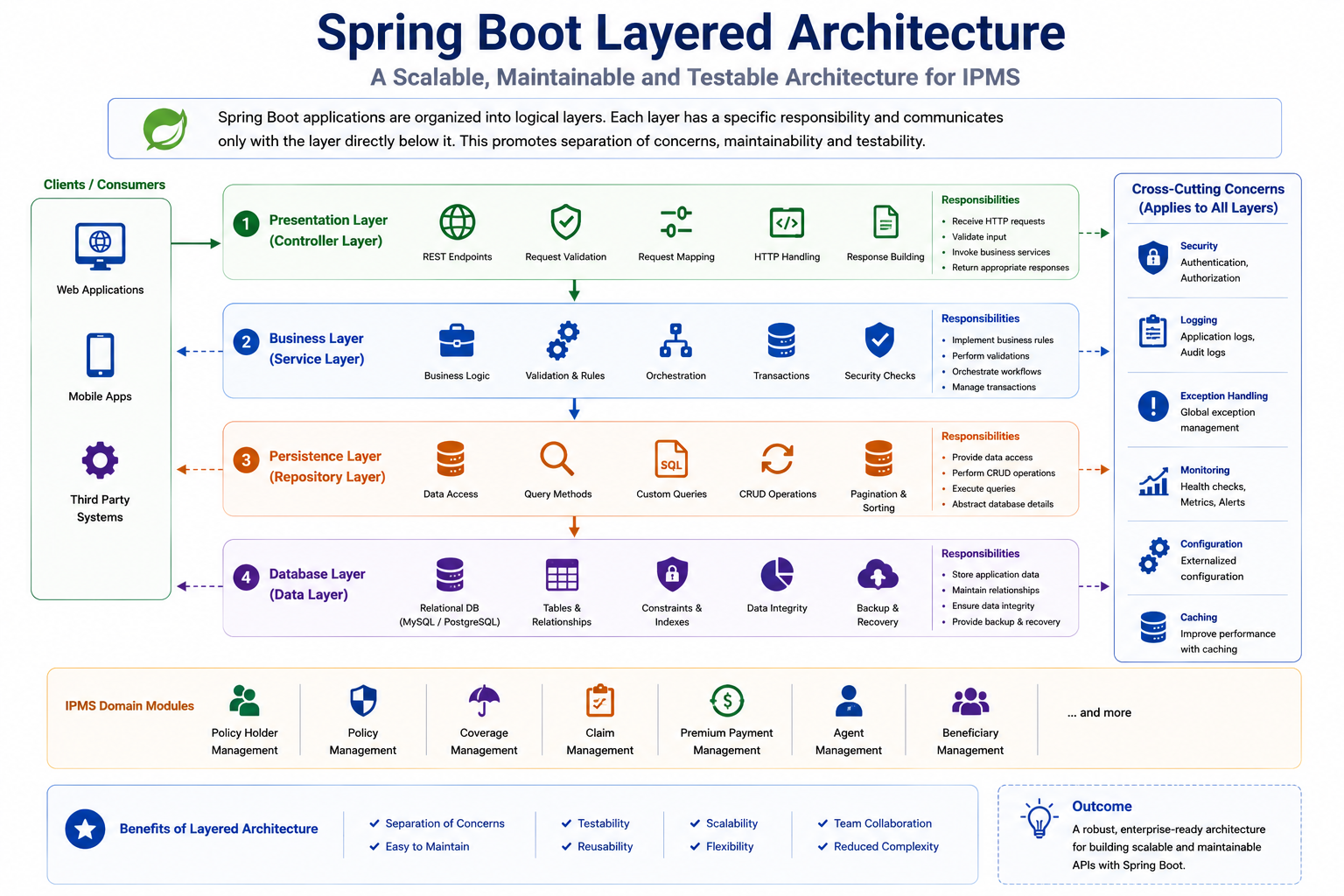
The application is divided into logical layers.
Each layer has a specific responsibility.
Benefits include:
- Separation of concerns
- Maintainability
- Testability
- Scalability
Insurance Policy Management System
Throughout the remainder of this tutorial we will implement:
PolicyHolder
Policy
Coverage
Claim
PremiumPayment
Agent
Beneficiary
using the layered architecture.
The Layers Explained
Presentation Layer
Also known as:
Controller Layer
Responsibilities:
- Receive HTTP requests
- Validate requests
- Invoke business services
- Return responses
Example:
GET /policies/LIFE-100001
Business Layer
Also known as:
Service Layer
Responsibilities:
- Business rules
- Validation logic
- Orchestration
- Transaction boundaries
Examples:
Create Policy

Submit Claim

Calculate Premium

Process Renewal
Persistence Layer
Also known as:
Repository Layer
Responsibilities:
- Database access
- CRUD operations
- Query execution
Technologies:
Spring Data JPA

Hibernate
Database Layer
Stores application data.
Examples:
Policy

Claim

Payment

Agent
Controller-Service-Repository Pattern
Enterprise Spring Boot applications commonly use:
Controller
      ↓
Service
      ↓
Repository
      ↓
Database
CSR Pattern Overview
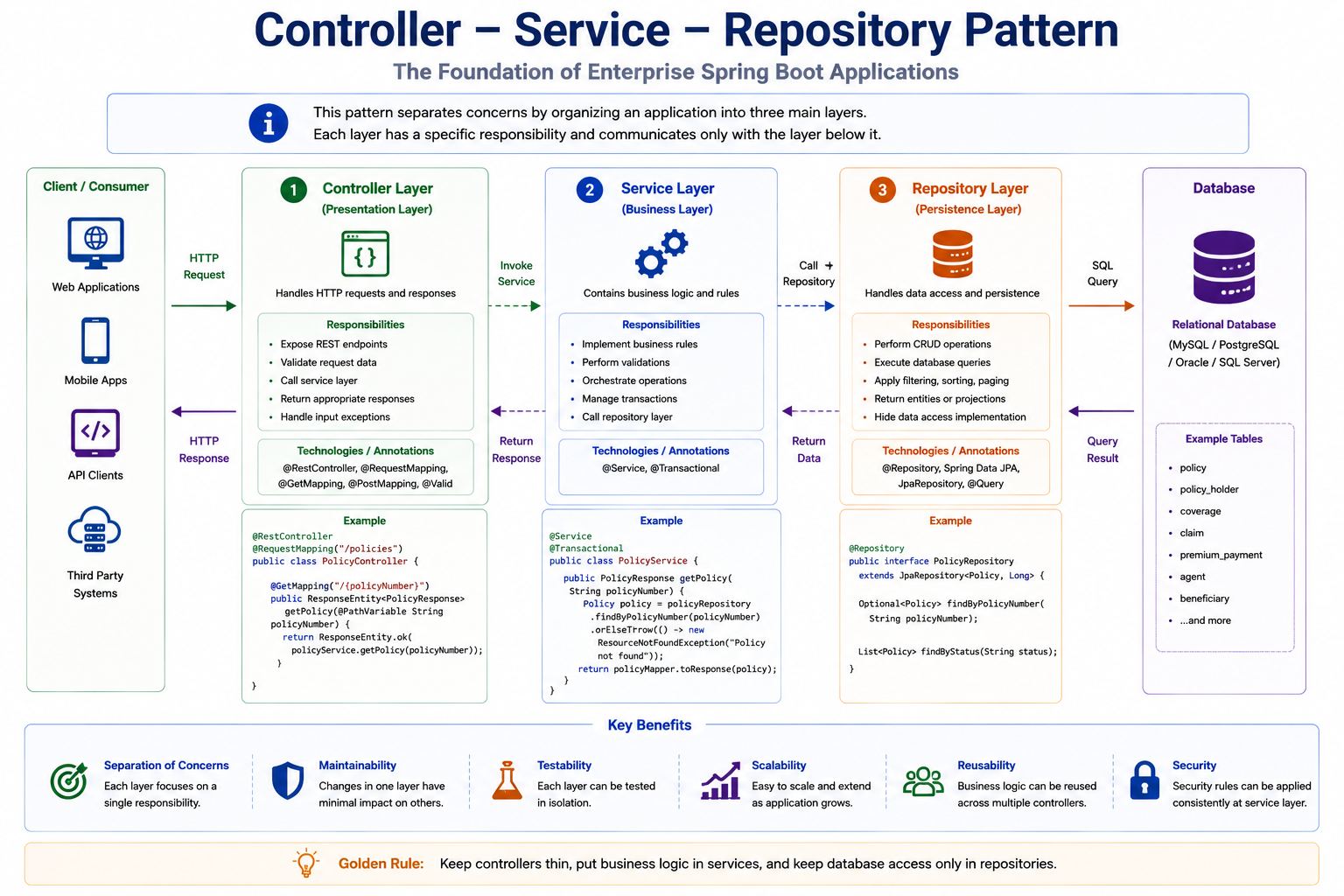
Each layer communicates only with the layer immediately below it.
This reduces coupling.
Building Our First Domain Model
From previous chapters:
Policy
OpenAPI Contract:
GET /policies/{policyNumber}
Now we create domain objects.
Policy Entity
public class Policy {

    private String policyNumber;

    private String policyType;

    private String status;

    private BigDecimal coverageAmount;
}
This object represents business data.
DTOs vs Entities
Many beginners expose database entities directly.
Enterprise applications avoid this.
Entity
Represents:
Database Structure
Example:
@Entity
public class Policy {
}
DTO
Represents:
API Contract
Example:
public class PolicyResponse {
}
Why DTOs?
Benefits:
- Security
- Encapsulation
- Versioning
- Flexibility
Dependency Injection
One of the most important Spring concepts is:
Dependency Injection (DI)
Instead of creating objects manually:
PolicyService service =
        new PolicyService();
Spring creates and injects them automatically.
Dependency Injection
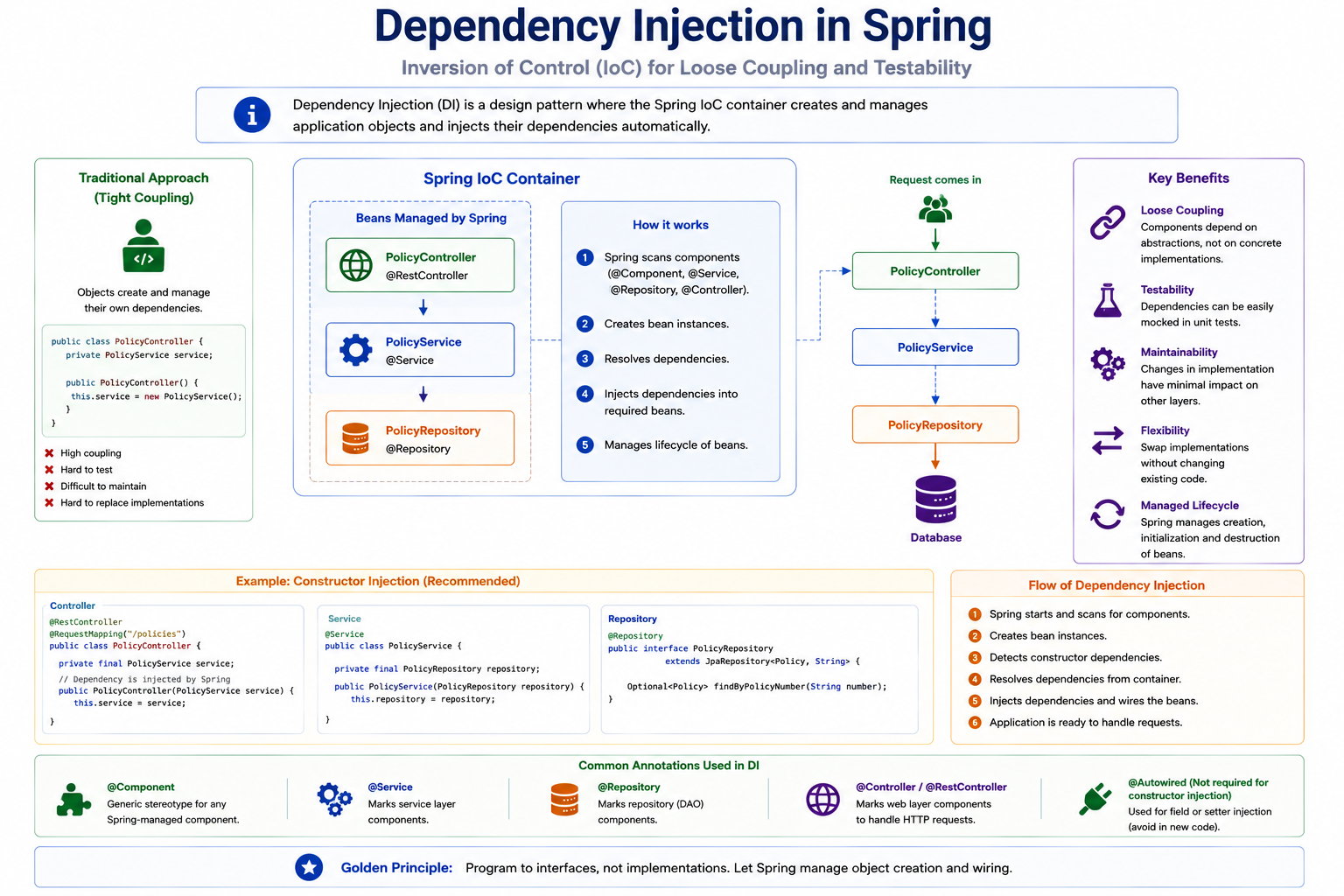
Spring manages object creation through the IoC container.
Benefits:
- Loose coupling
- Easier testing
- Better maintainability
Spring Stereotype Annotations
Spring identifies components using annotations.
Controller
@RestController
public class PolicyController {
}
Service
@Service
public class PolicyService {
}
Repository
@Repository
public interface PolicyRepository {
}
Request Processing Flow
Consider:
GET /policies/LIFE-100001
How does Spring process this request?
Request Flow
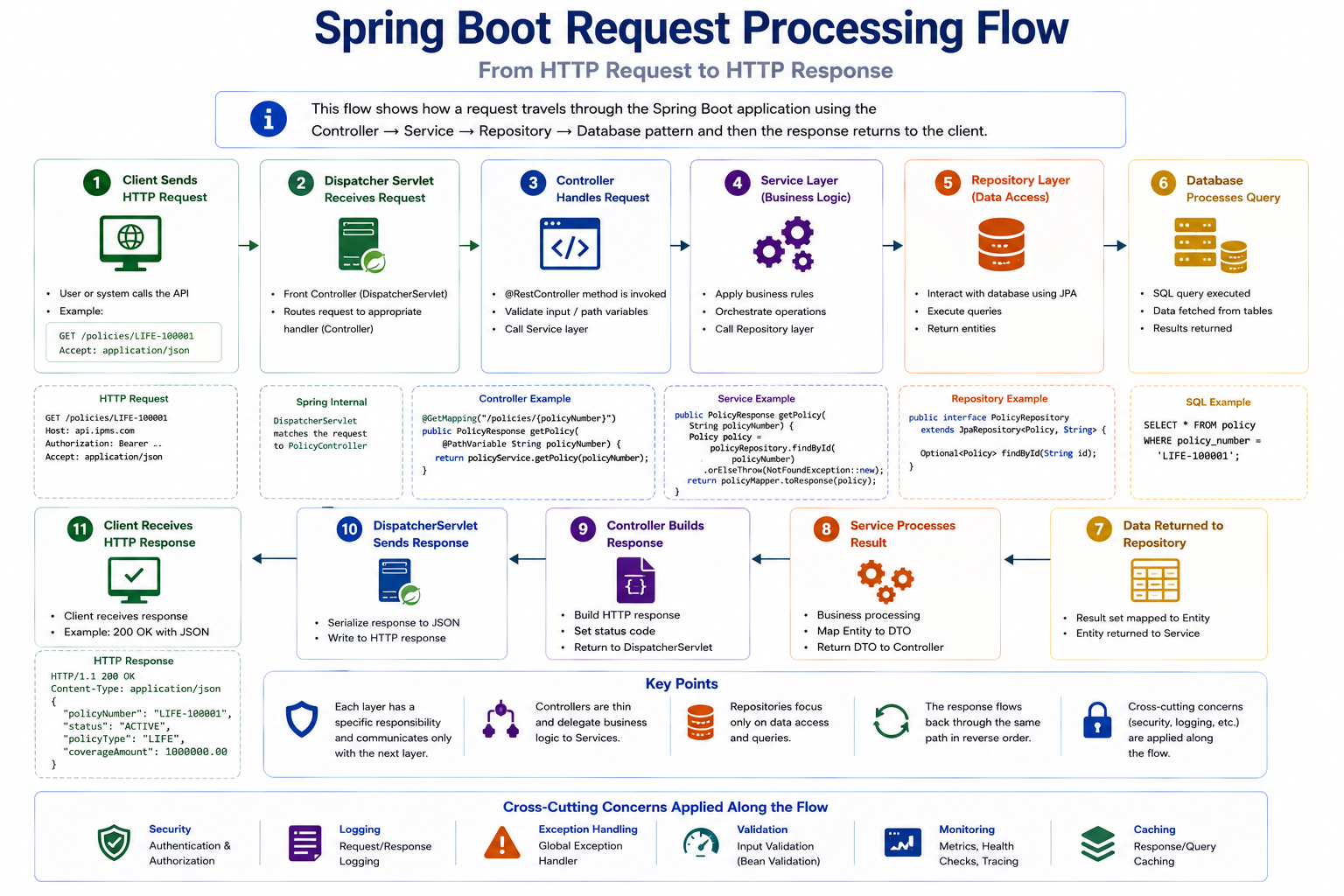
The request moves through multiple layers before a response is returned.
Example Flow
Step 1:
GET /policies/LIFE-100001
Step 2:
PolicyController
Step 3:
PolicyService
Step 4:
PolicyRepository
Step 5:
Database
Step 6:
{
  "policyNumber": "LIFE-100001",
  "status": "ACTIVE"
}
Project Structure
A clean project structure improves maintainability.
IPMS Project Structure
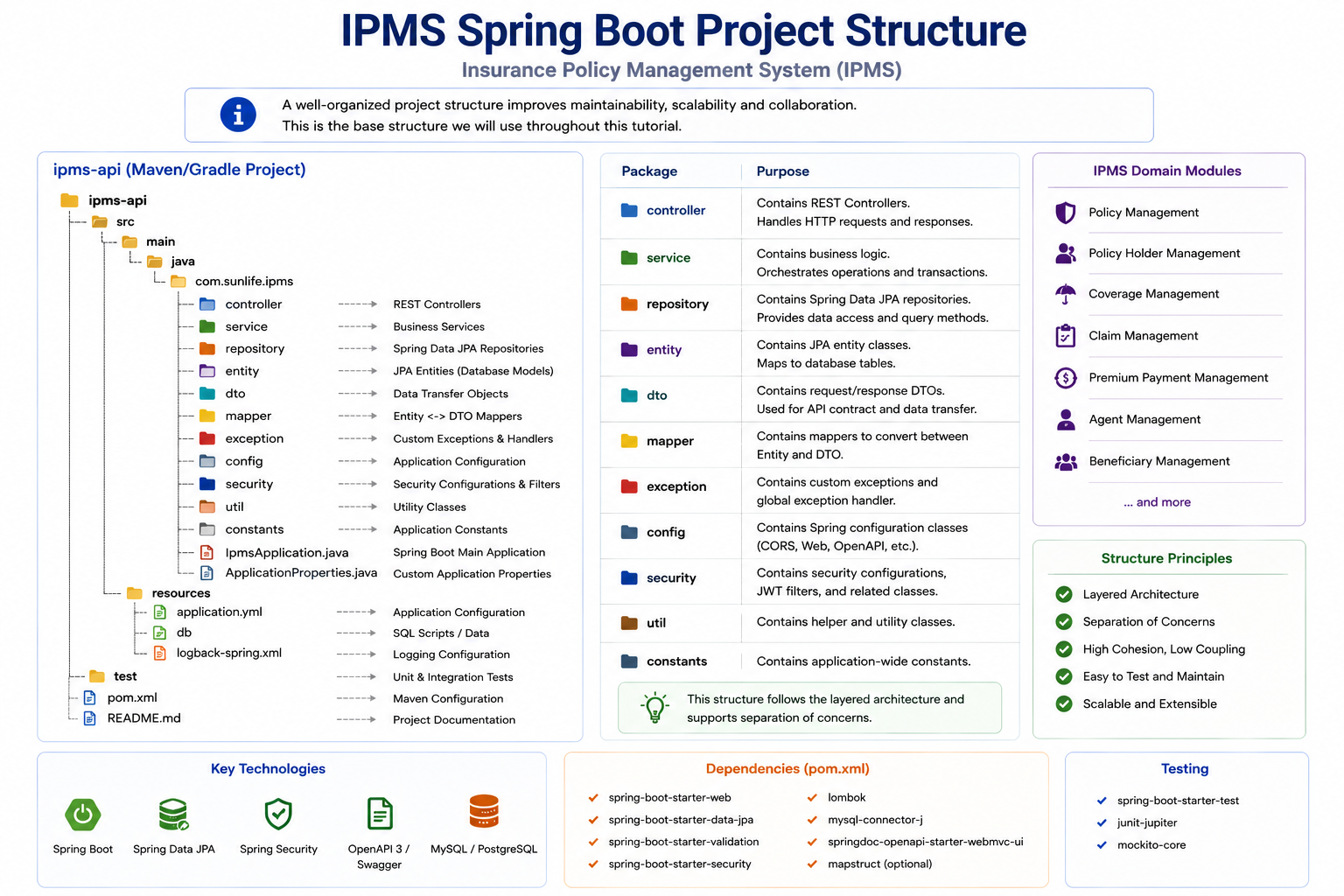
Recommended structure:
com.sunlife.ipms

├── controller
├── service
├── repository
├── entity
├── dto
├── mapper
├── config
├── exception
├── security
└── util
Why Package by Layer?
Advantages:
- Easy to understand
- Familiar to most developers
- Suitable for small and medium applications
Future Evolution
As the application grows:
Policy Module

Claim Module

Payment Module
we may evolve toward:
Package by Feature
architecture.
We will revisit this in the Microservices chapter.
Best Practices
✅ Keep controllers thin
✅ Put business logic in services
✅ Keep repositories focused on data access
✅ Use DTOs for APIs
✅ Use constructor injection
✅ Maintain clear package structure
Common Mistakes
❌ Business logic in controllers
❌ Database access in controllers
❌ Exposing entities directly
❌ Circular dependencies
❌ Large service classes
Interview Questions
-
What is layered architecture?
-
What is Dependency Injection?
-
Difference between Service and Repository?
-
Why use DTOs?
-
Why avoid exposing entities?
-
What is IoC?
-
What are stereotype annotations?
-
Why keep controllers thin?
-
What is constructor injection?
-
What are advantages of layered architecture?
Practice Exercises
-
Design Controller, Service, and Repository layers for Claims.
-
Create DTOs for Premium Payment APIs.
-
Design a package structure for Agent Management.
-
Identify responsibilities of each layer.
-
Refactor a tightly coupled design into a layered architecture.
Key Takeaways
- Spring Boot applications use layered architecture.
- Controllers handle requests.
- Services contain business logic.
- Repositories manage persistence.
- DTOs separate API contracts from entities.
- Dependency Injection promotes loose coupling.
- Clean project structure improves maintainability.
- Architecture decisions impact scalability and quality.
Chapter Summary
In this chapter, you learned:
- Spring Boot Layered Architecture
- Controller-Service-Repository Pattern
- DTOs and Entities
- Dependency Injection
- Request Processing Flow
- Project Structure
You now have the architectural foundation required to begin building real Spring Boot APIs in the next chapter.