
Chapter 7: Validation and Exception Handling
In the previous chapter, we built REST APIs for our Insurance Policy Management System (IPMS).
Our APIs can now:
- Create Policies
- Retrieve Policies
- Update Policies
- Delete Policies
However, they are not yet production ready.
Consider the following request:
{
  "policyType": "",
  "coverageAmount": -1000
}
Should the system accept it?
Of course not.
Enterprise APIs must validate incoming data and provide meaningful error responses when something goes wrong.
In this chapter, we will learn how to build robust APIs using Bean Validation and Global Exception Handling.
🎯 Learning Objectives
By the end of this chapter, you will be able to:
- Validate API requests
- Use Bean Validation annotations
- Create custom validation rules
- Handle exceptions globally
- Build standardized error responses
- Improve API usability
- Build production-ready APIs
Why Validation Matters
Without validation:
{
  "policyType": "",
  "coverageAmount": -5000
}
could enter the system.
This may lead to:
- Data corruption
- Business failures
- Regulatory issues
- Customer dissatisfaction
Validation ensures only valid data enters the application.
Validation Flow
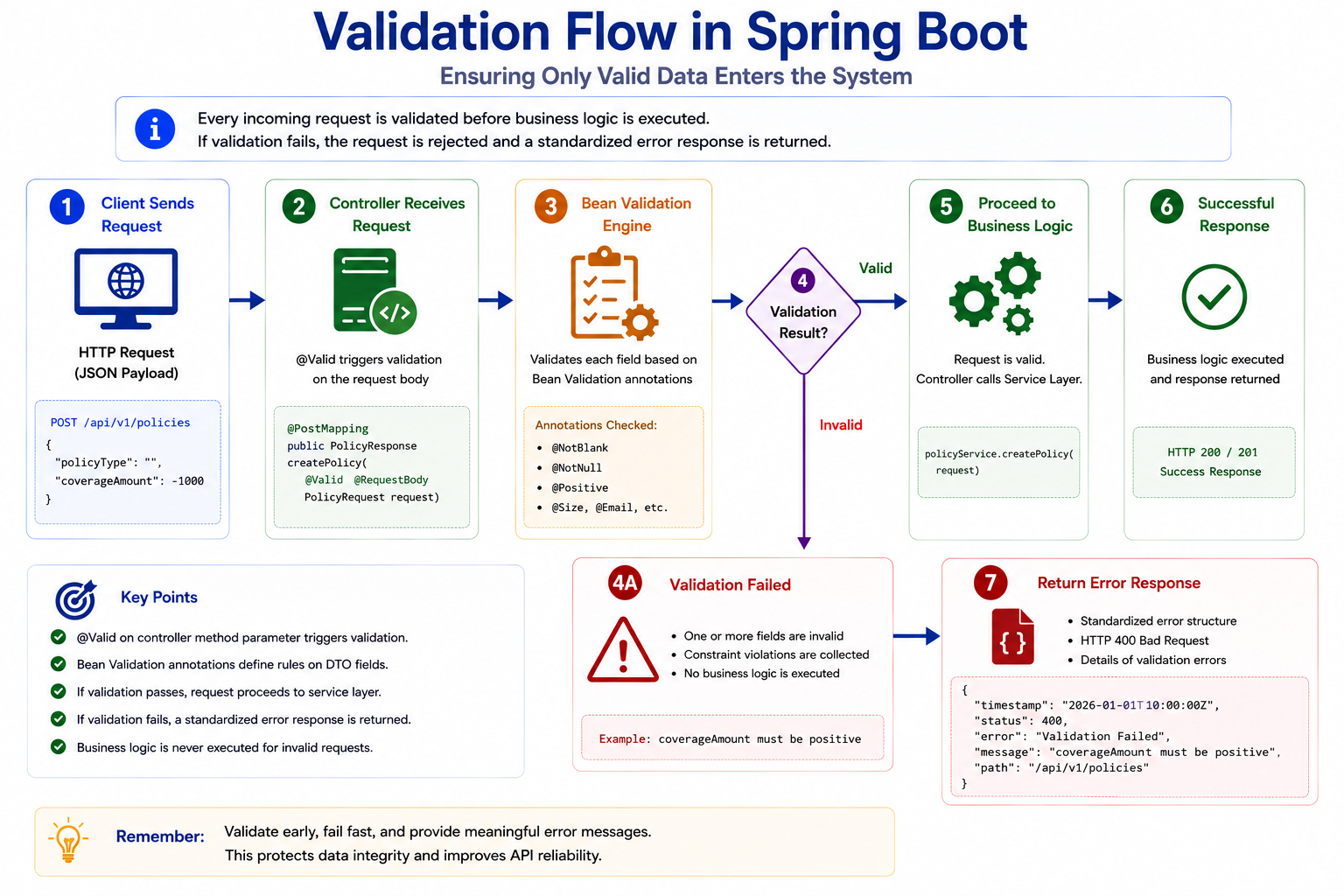
Every request should pass through validation before business processing begins.
Adding Validation Dependency
Spring Boot uses Jakarta Bean Validation.
Maven dependency:
<dependency>
    <groupId>org.springframework.boot</groupId>

    <artifactId>
        spring-boot-starter-validation
    </artifactId>
</dependency>
PolicyRequest DTO
From Chapter06:
public class PolicyRequest {

    private String policyType;

    private BigDecimal coverageAmount;

}
Currently nothing prevents invalid values.
Bean Validation
Spring integrates Bean Validation automatically.
PolicyRequest with Validation
public class PolicyRequest {

    @NotBlank
    private String policyType;

    @NotNull
    @Positive
    private BigDecimal coverageAmount;

}
Now Spring validates requests automatically.
Common Validation Annotations
Bean Validation Annotations
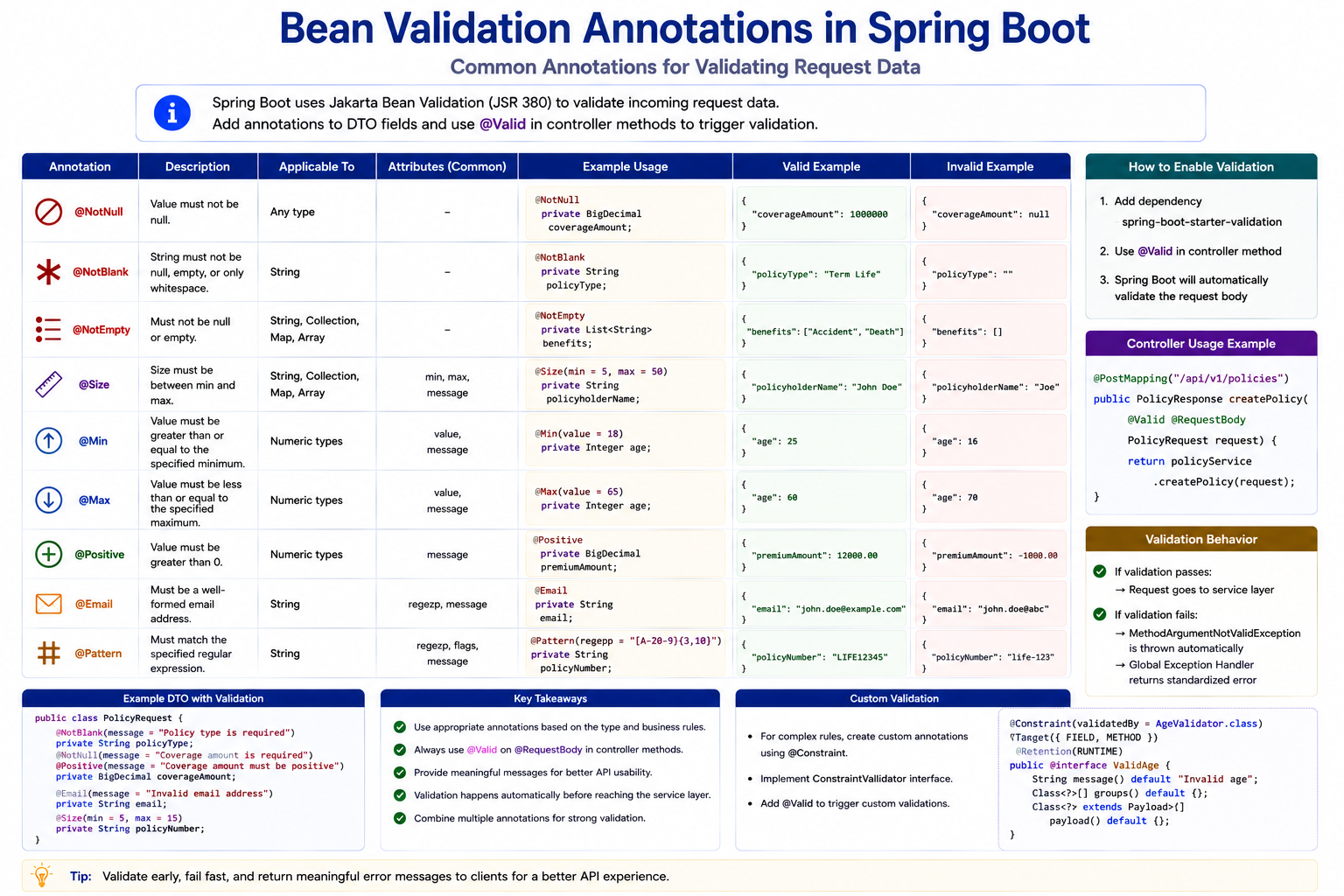
These annotations cover most enterprise validation requirements.
@NotNull
Ensures value exists.
@NotNull
private BigDecimal coverageAmount;
Invalid:
{
  "coverageAmount": null
}
@NotBlank
Ensures string contains data.
@NotBlank
private String policyType;
Invalid:
{
  "policyType": ""
}
@Size
Validates length.
@Size(min = 5, max = 50)
private String policyType;
Useful for Policy Holder APIs.
@Email
private String email;
@Positive
@Positive
private BigDecimal premiumAmount;
Valid:
12000
Invalid:
-12000
Enabling Validation in Controllers
Spring performs validation when:
@Valid
is used.
Controller Example
@PostMapping
public PolicyResponse createPolicy(

        @Valid

        @RequestBody
        PolicyRequest request) {

    return policyService.createPolicy(request);
}
If validation fails, Spring throws an exception automatically.
Example Invalid Request
{
  "policyType": "",
  "coverageAmount": -1000
}
Result:
Validation Failed
Default Validation Response
Spring returns a default error.
However, enterprise APIs usually require a custom format.
Standard Error Response
A consistent error structure improves usability.
Error Response Model
public class ErrorResponse {

    private String timestamp;

    private int status;

    private String error;

    private String message;

    private String path;

}
Standard Error Response
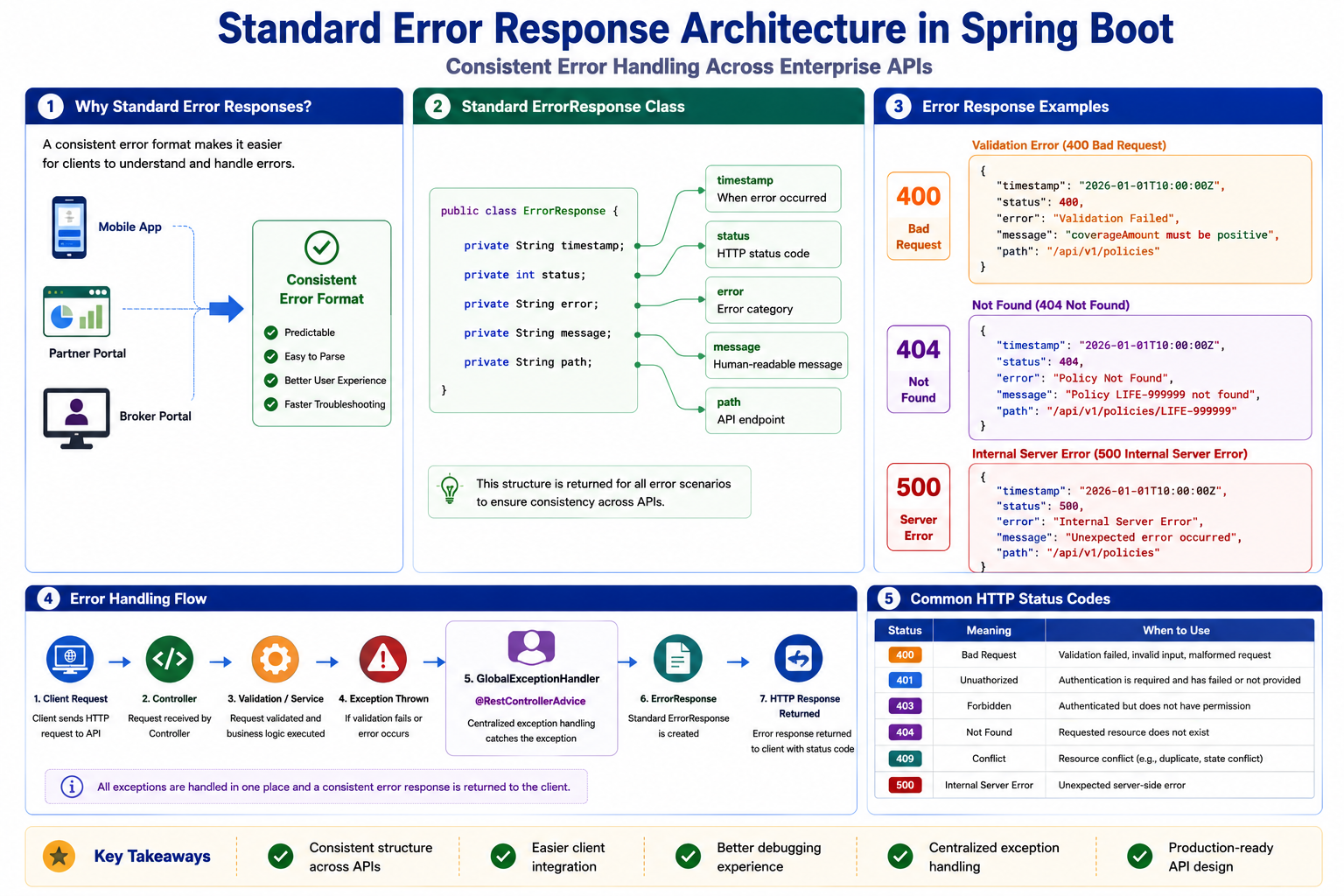
Example Error Response
{
  "timestamp": "2026-01-01T10:00:00Z",
  "status": 400,
  "error": "Validation Failed",
  "message": "coverageAmount must be positive",
  "path": "/api/v1/policies"
}
Exception Handling
Exceptions are inevitable.
Examples:
Policy Not Found

Database Error

Validation Failure

Unauthorized Access

External Service Failure
The goal is not to eliminate exceptions.
The goal is to handle them properly.
Traditional Approach
Many beginners use:
try {

}
catch(Exception ex) {

}
inside every controller.
Problems:
- Repeated code
- Poor maintainability
- Inconsistent responses
Global Exception Handling
Spring provides:
@RestControllerAdvice
to centralize exception management.
Global Exception Architecture
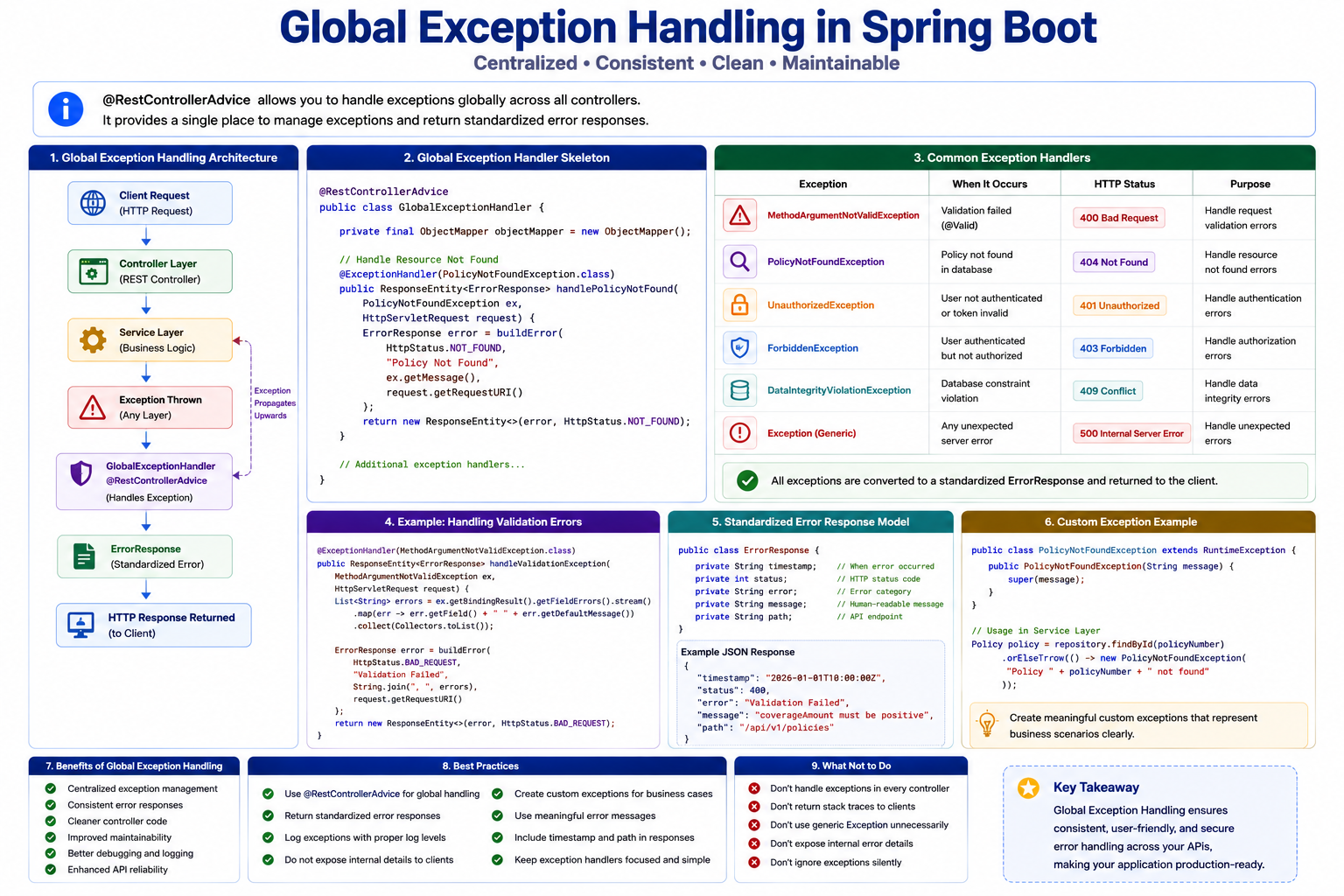
Creating Global Exception Handler
@RestControllerAdvice
public class GlobalExceptionHandler {

}
This class intercepts exceptions from all controllers.
Handling Policy Not Found
Custom exception:
public class PolicyNotFoundException
        extends RuntimeException {

    public PolicyNotFoundException(
            String message) {

        super(message);
    }
}
Throwing Exception
Policy policy =
        repository.findById(policyNumber)
                  .orElseThrow(() ->
                      new PolicyNotFoundException(
                          "Policy not found"));
Handling Exception
@ExceptionHandler(
        PolicyNotFoundException.class)

public ResponseEntity<ErrorResponse>
handlePolicyNotFound(
        PolicyNotFoundException ex) {

    ErrorResponse error =
            buildErrorResponse(
                HttpStatus.NOT_FOUND,
                ex.getMessage());

    return ResponseEntity
            .status(HttpStatus.NOT_FOUND)
            .body(error);
}
Handling Validation Errors
Spring throws:
MethodArgumentNotValidException
for validation failures.
Validation Exception Handler
@ExceptionHandler(
        MethodArgumentNotValidException.class)

public ResponseEntity<ErrorResponse>
handleValidationException(
        MethodArgumentNotValidException ex) {

    ErrorResponse error =
            buildErrorResponse(
                HttpStatus.BAD_REQUEST,
                "Validation Failed");

    return ResponseEntity
            .badRequest()
            .body(error);
}
Exception Processing Flow

Common HTTP Status Codes
| Status | Meaning |
|---|---|
| 200 | Success |
| 201 | Created |
| 400 | Validation Failure |
| 401 | Unauthorized |
| 403 | Forbidden |
| 404 | Resource Not Found |
| 500 | Internal Server Error |
Generic Exception Handler
Catch unexpected exceptions.
@ExceptionHandler(Exception.class)

public ResponseEntity<ErrorResponse>
handleGenericException(
        Exception ex) {

    ErrorResponse error =
            buildErrorResponse(
                HttpStatus.INTERNAL_SERVER_ERROR,
                "Unexpected Error");

    return ResponseEntity
            .status(HttpStatus.INTERNAL_SERVER_ERROR)
            .body(error);
}
Complete Error Handling Strategy
For IPMS:
Validation Failure
      ↓
400 Bad Request

Policy Not Found
      ↓
404 Not Found

Authentication Failure
      ↓
401 Unauthorized

Unexpected Error
      ↓
500 Internal Server Error
Best Practices
✅ Validate requests at API boundary
✅ Use DTO validation
✅ Return meaningful messages
✅ Use global exception handling
✅ Standardize error responses
✅ Log exceptions
Common Mistakes
❌ No validation
❌ Generic exception messages
❌ Stack traces returned to clients
❌ Duplicate try-catch blocks
❌ Inconsistent error structures
Interview Questions
-
Why is validation important?
-
What is Bean Validation?
-
Difference between @NotNull and @NotBlank?
-
What does @Valid do?
-
What is @RestControllerAdvice?
-
What is @ExceptionHandler?
-
Why use custom exceptions?
-
Why standardize error responses?
-
What is MethodArgumentNotValidException?
-
Why avoid try-catch in controllers?
Practice Exercises
-
Add validation to PolicyRequest.
-
Create ClaimRequest validation.
-
Create PolicyNotFoundException.
-
Implement GlobalExceptionHandler.
-
Standardize error responses.
Key Takeaways
- Validation protects application integrity.
- Bean Validation simplifies request validation.
- @Valid triggers automatic validation.
- Global exception handling centralizes error processing.
- Standardized error responses improve usability.
- Production APIs must validate and handle errors consistently.
Chapter Summary
In this chapter, you learned:
- Bean Validation
- Validation Annotations
- Request Validation
- Custom Exceptions
- Global Exception Handling
- Error Response Standardization
Your APIs are now significantly more robust and production-ready. In the next chapter, we will implement persistence using Spring Data JPA and Hibernate.