
Chapter 13: Microservices API Design
In the previous chapter, we learned how to build resilient applications using Resilience4j.
Our Insurance Policy Management System (IPMS) can now:
- Handle Failures Gracefully
- Implement Retry Mechanisms
- Use Circuit Breakers
- Apply Bulkhead Isolation
- Manage Timeouts
- Provide Fallback Responses
However, there is another architectural challenge.
As applications grow, a single monolithic application becomes difficult to maintain, scale, and deploy.
Enterprise systems solve this problem using:
Microservices Architecture
In this chapter, we will learn how to design APIs for microservices, decompose business domains into services, implement API Gateways, and enable service discovery.
🎯 Learning Objectives
By the end of this chapter, you will be able to:
- Understand Microservices Architecture
- Compare Monolith and Microservices
- Perform Service Decomposition
- Understand Bounded Contexts
- Design APIs for Microservices
- Understand Database-per-Service Pattern
- Understand API Gateway Architecture
- Implement Service Discovery
- Design Enterprise Microservice Ecosystems
- Apply Microservices Best Practices
Why Microservices?
As applications grow:
More Features

More Users

More Teams

More Complexity
A monolithic architecture becomes difficult to manage.
Example:
Policy Management

Claims Management

Payments

Agents

Notifications
all inside one application.
Problems with Monoliths
Typical challenges:
Large Codebase

Difficult Deployments

Slow Releases

Scaling Challenges

Technology Constraints
Monolith Architecture
Users
   ↓
Monolithic Application
   ↓
Single Database
Everything is deployed together.
What are Microservices?
Microservices split applications into small independent services.
Each service:
Owns a Business Capability

Has Independent Deployment

Can Scale Independently

Owns Its Data
Monolith vs Microservices
| Monolith | Microservices |
|---|---|
| Single Application | Multiple Services |
| Single Deployment | Independent Deployments |
| Shared Database | Database per Service |
| Difficult Scaling | Independent Scaling |
| Tight Coupling | Loose Coupling |
Microservices Architecture Overview
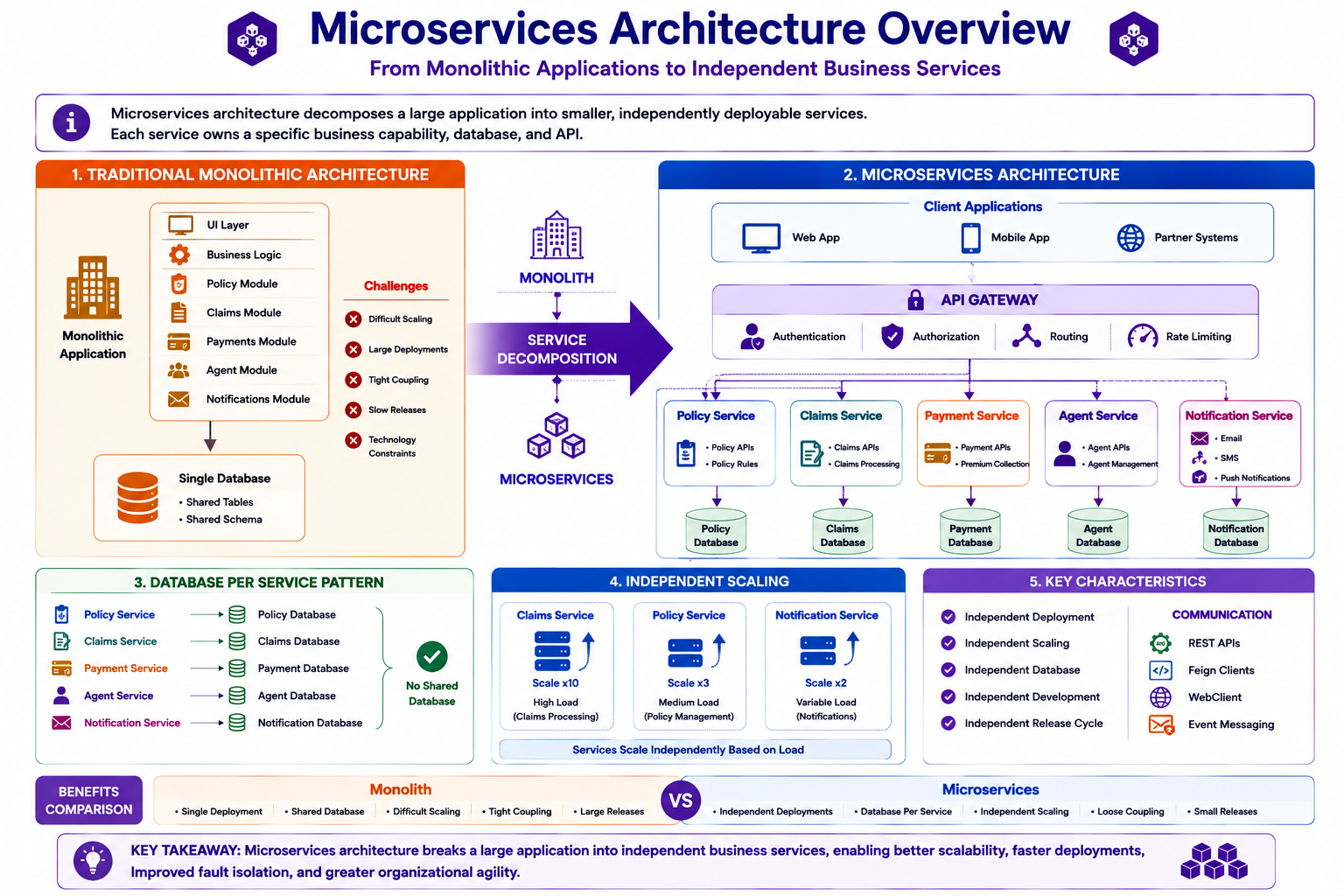
Business capabilities are separated into independent services.
Insurance Domain Decomposition
Our IPMS can be decomposed into:
Policy Service

Claims Service

Customer Service

Payment Service

Agent Service

Notification Service
Each service focuses on one responsibility.
Service Decomposition Principles
Good microservices follow:
Single Responsibility

Business Capability Focus

Loose Coupling

High Cohesion
Understanding Bounded Contexts
Bounded Context is a concept from Domain-Driven Design (DDD).
Each business domain owns:
Its Data

Its APIs

Its Rules

Its Vocabulary
Insurance Bounded Contexts
Examples:
Policy Context

Claims Context

Payments Context

Customer Context

Agent Context
Bounded Context Architecture
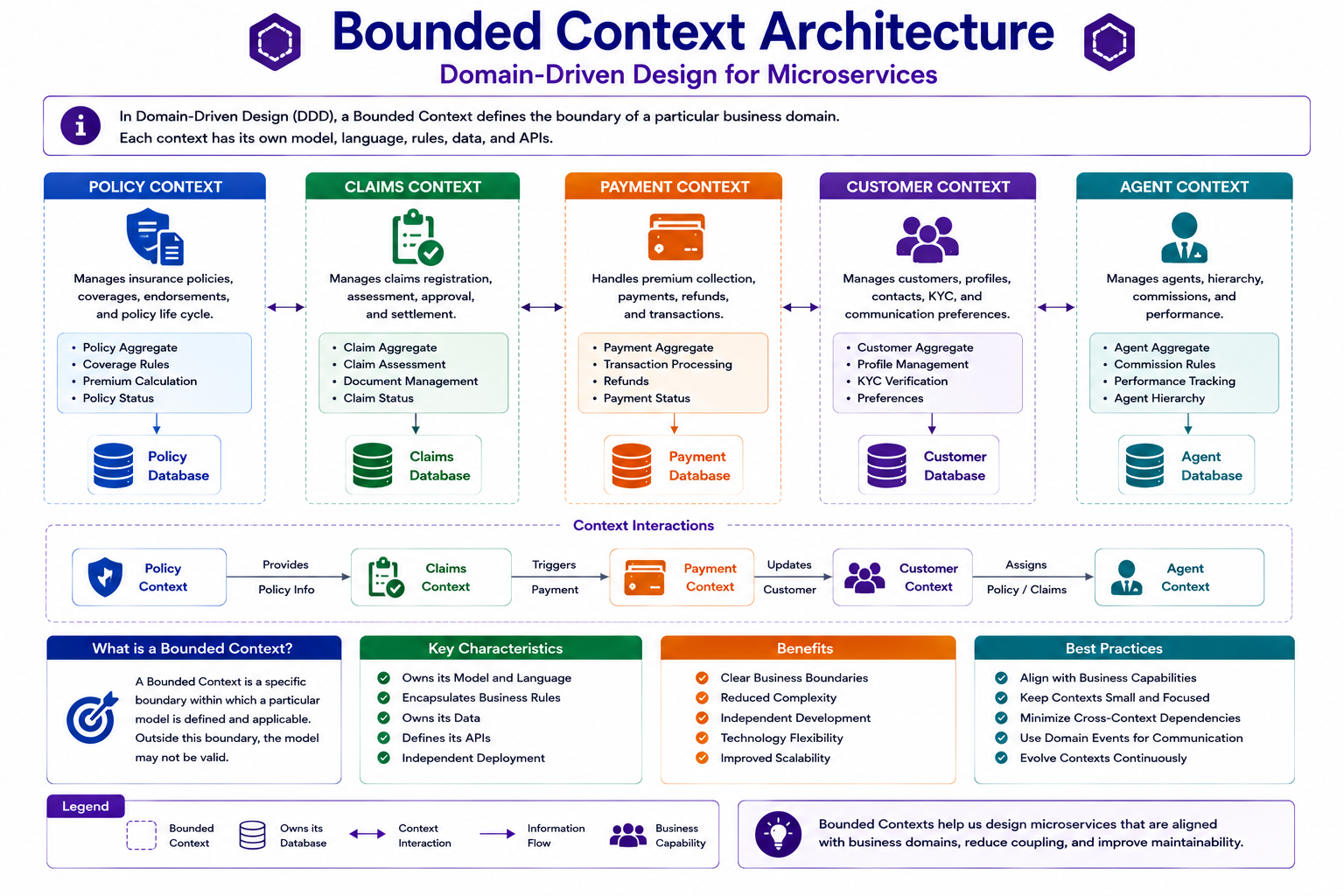
Each context owns its business logic and data.
Database Per Service Pattern
One of the most important microservice principles.
Each service owns its database.
Example
Policy Service
      ↓
Policy Database

Claims Service
      ↓
Claims Database

Payment Service
      ↓
Payment Database
Why Not Shared Databases?
Shared databases cause:
Tight Coupling

Schema Dependencies

Deployment Risks

Data Ownership Issues
Database Per Service Architecture
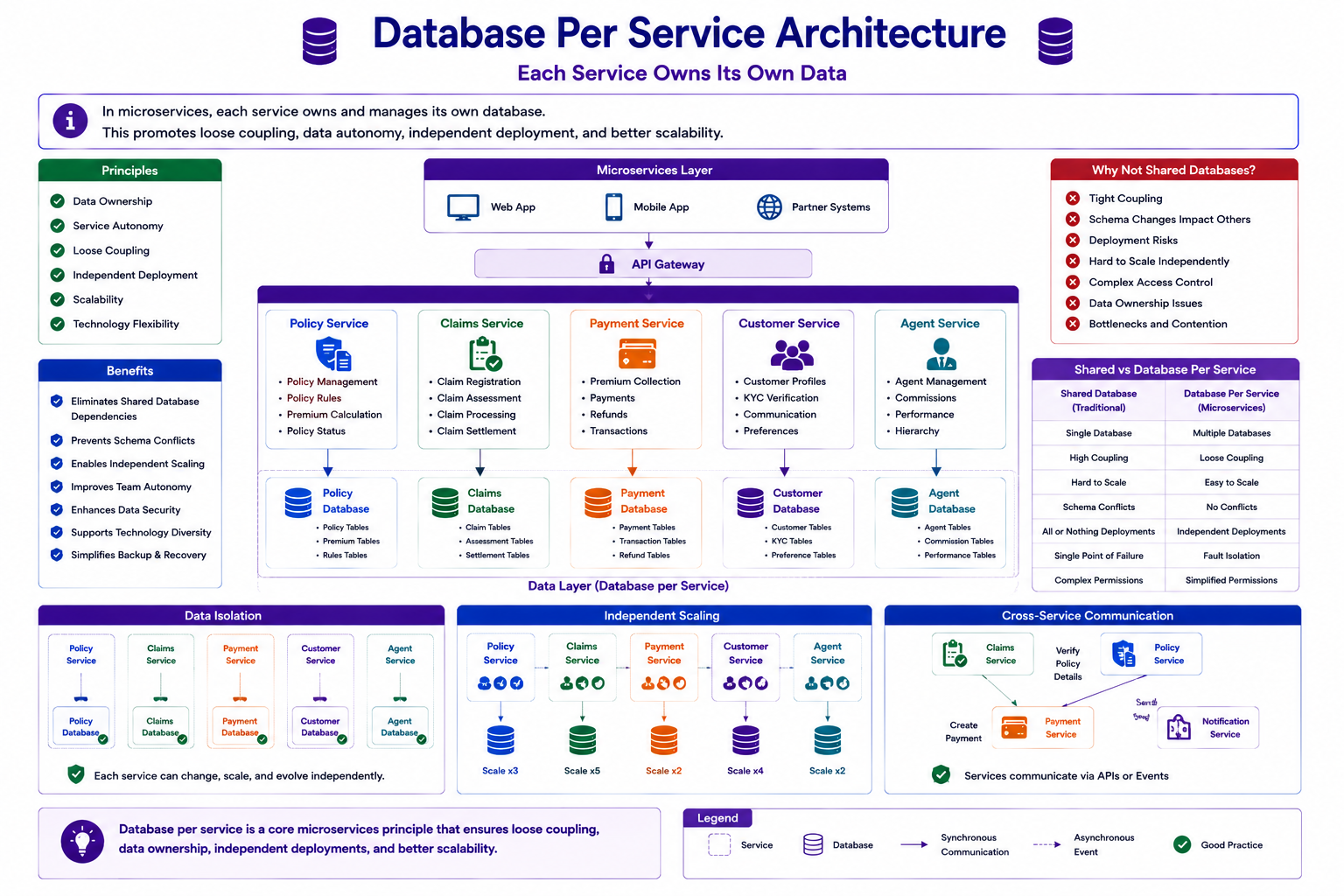
Data ownership remains within each service boundary.
Service-to-Service Communication
Microservices communicate using:
REST APIs

Feign Clients

WebClient

Messaging
Example:
Claims Service
       ↓
Policy Service
to verify policy information.
API Design for Microservices
Design APIs around business capabilities.
Example:
/api/policies

/api/claims

/api/payments
Avoid creating:
/api/all-business-functions
API Gateway
As services increase:
Policy Service

Claims Service

Payment Service

Agent Service
clients should not directly access every service.
What is an API Gateway?
API Gateway acts as:
Single Entry Point
for all clients.
Responsibilities:
Routing

Authentication

Authorization

Rate Limiting

Request Aggregation
API Gateway Architecture
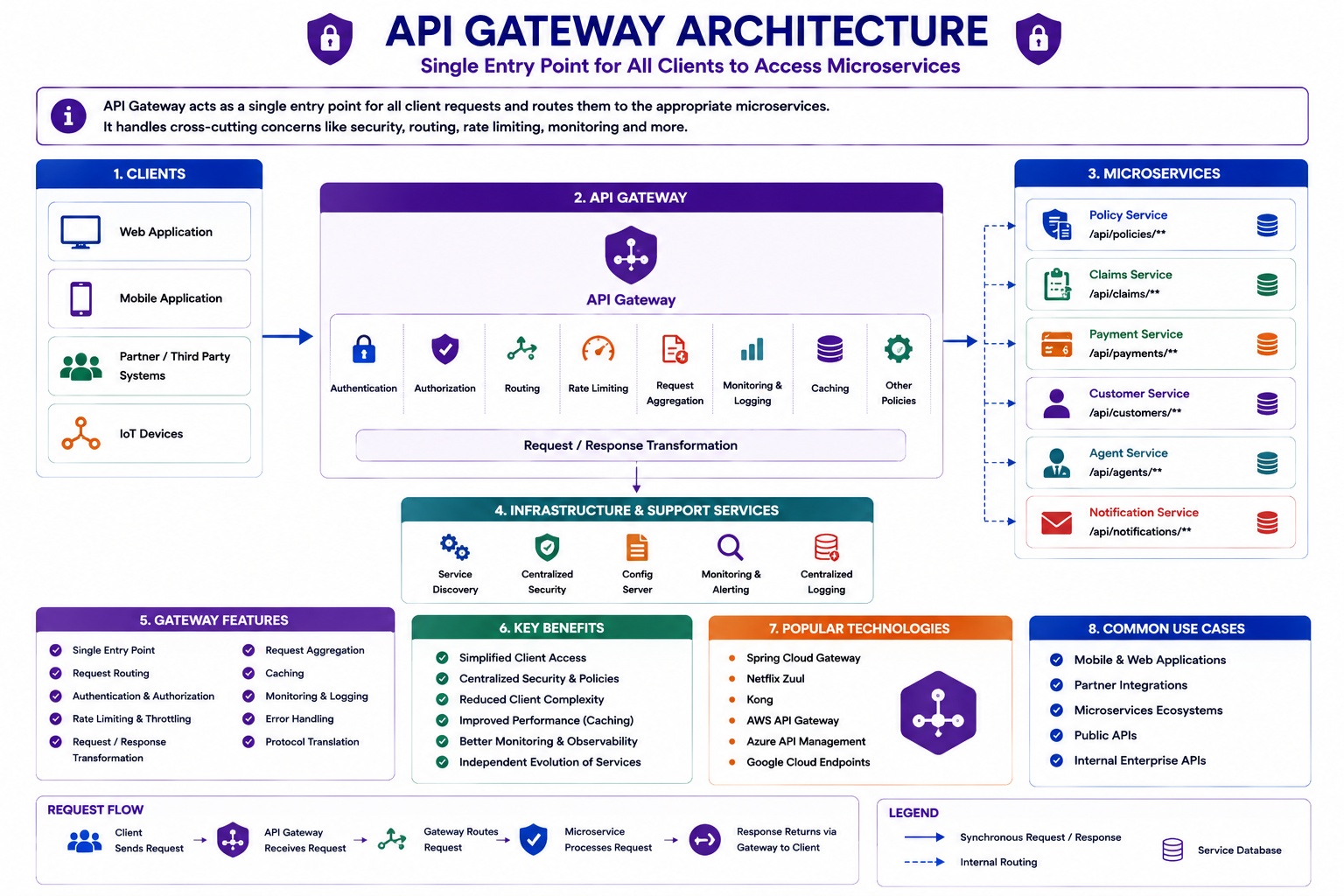
Clients communicate through a centralized gateway.
Benefits of API Gateway
✅ Centralized Security
✅ Centralized Routing
✅ Request Aggregation
✅ Monitoring
✅ Traffic Control
Service Discovery
In cloud environments:
Services Start

Services Stop

Services Scale
IP addresses constantly change.
Service Discovery Problem
Without discovery:
Policy Service
     ↓
Hardcoded URL
which becomes unreliable.
Service Discovery Solution
Use:
Service Registry
Examples:
Eureka

Consul

Kubernetes Service Discovery
Service Discovery Architecture
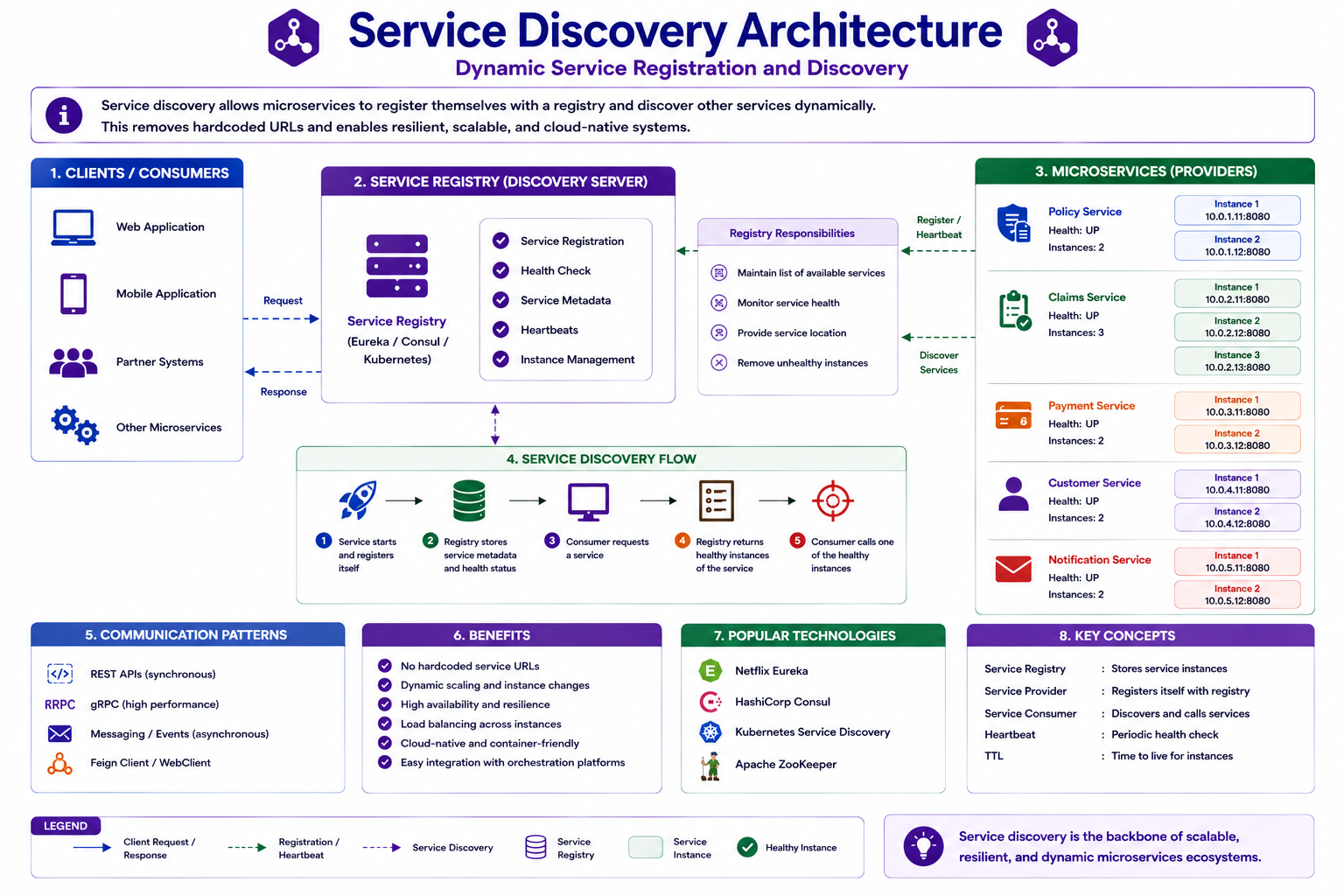
Services dynamically discover each other.
Scaling Microservices
Different services have different loads.
Example:
Claims Service
      ↓
High Traffic

Payment Service
      ↓
Medium Traffic
Microservices allow independent scaling.
Microservices Security
Common approaches:
OAuth2

JWT

API Gateway Security

Service-to-Service Authentication
Observability in Microservices
Microservices require:
Centralized Logging

Metrics

Tracing

Monitoring
Without observability:
Troubleshooting Becomes Difficult
IPMS Microservices Architecture
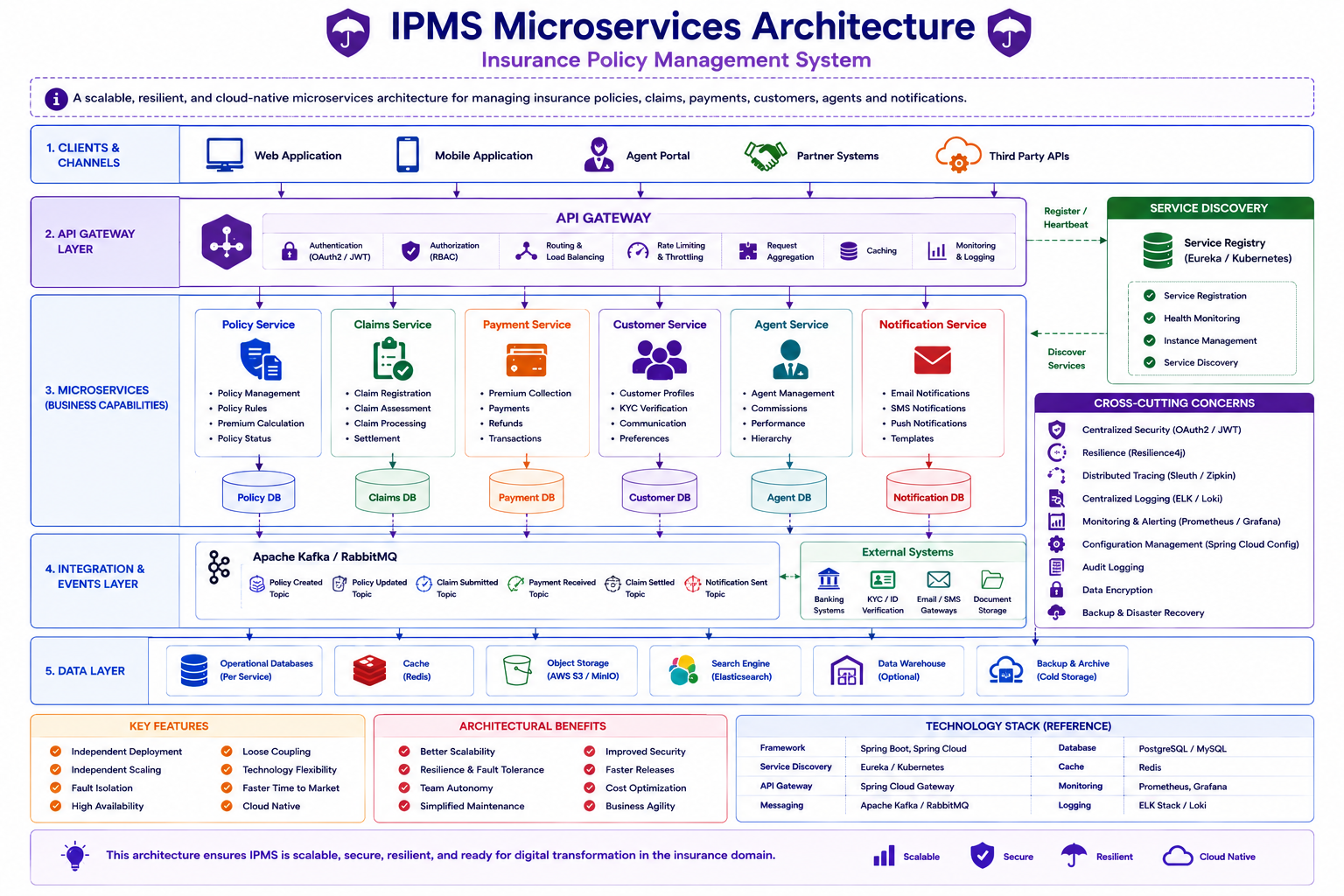
This architecture represents the target state of our Insurance Policy Management System.
Benefits of Microservices
✅ Independent Deployment
✅ Independent Scaling
✅ Technology Flexibility
✅ Better Fault Isolation
✅ Faster Releases
✅ Team Autonomy
Challenges of Microservices
⚠ Distributed Complexity
⚠ Network Latency
⚠ Data Consistency
⚠ Monitoring Complexity
⚠ Service Coordination
Best Practices
✅ Design around business capabilities
✅ Use bounded contexts
✅ Keep services small and focused
✅ Own data within each service
✅ Use API Gateway
✅ Implement service discovery
✅ Secure service communication
✅ Monitor everything
Common Mistakes
❌ Splitting services too early
❌ Shared databases
❌ Excessive service communication
❌ Missing observability
❌ Ignoring security
❌ Large distributed monoliths
Interview Questions
-
What is a microservice?
-
Difference between monolith and microservices?
-
What is a bounded context?
-
Why use database per service?
-
What is an API Gateway?
-
What is service discovery?
-
Why avoid shared databases?
-
What are the challenges of microservices?
-
How do microservices communicate?
-
How do you secure microservices?
Practice Exercises
-
Decompose IPMS into microservices.
-
Identify bounded contexts.
-
Design Policy Service APIs.
-
Design Claims Service APIs.
-
Create API Gateway routes.
-
Configure service discovery.
-
Implement service-to-service communication.
-
Design independent databases.
Key Takeaways
- Microservices decompose applications into independent services.
- Services should align with business capabilities.
- Bounded contexts help define service boundaries.
- Each service should own its database.
- API Gateway provides centralized access.
- Service Discovery enables dynamic communication.
- Microservices improve scalability and deployment flexibility.
- Proper design is critical for success.
Chapter Summary
In this chapter, you learned:
- Microservices Architecture
- Monolith vs Microservices
- Service Decomposition
- Bounded Contexts
- Database per Service
- API Gateway
- Service Discovery
- Enterprise Microservice Design
Our Insurance Policy Management System is now evolving from a traditional application into a scalable microservices ecosystem.
In the next chapter, we will learn Event-Driven Architecture using Apache Kafka, including Producers, Consumers, Topics, Event Contracts, and CQRS concepts.