
Chapter 10: API Security with OAuth2, JWT and RBAC
In the previous chapter, we introduced DTO Mapping and Data Transformation.
Our Insurance Policy Management System (IPMS) now has:
- Clean API Contracts
- Request DTOs
- Response DTOs
- Entity-DTO Mapping
- MapStruct Integration
However, there is another critical question.
Who should be allowed to access these APIs?
Can anyone create policies?
Can anyone approve claims?
Can anyone access customer information?
The answer is:
No.
Enterprise APIs must be secured to ensure that only authenticated and authorized users can access protected resources.
In this chapter, we will learn how to secure APIs using Spring Security, OAuth2, JWT (JSON Web Tokens), and Role-Based Access Control (RBAC).
🎯 Learning Objectives
By the end of this chapter, you will be able to:
- Understand API Security Fundamentals
- Differentiate Authentication and Authorization
- Understand OAuth2 Architecture
- Understand OpenID Connect
- Implement JWT Authentication
- Validate JWT Tokens
- Configure Spring Security
- Implement Role-Based Access Control (RBAC)
- Secure REST APIs
- Apply Enterprise Security Best Practices
Why API Security Matters
Imagine an unsecured insurance API.
GET /api/policies
Without security:
Anyone Can Access Policies

Anyone Can View Customer Data

Anyone Can Modify Claims

Anyone Can Delete Policies
This is unacceptable in enterprise systems.
Security protects:
Confidentiality

Integrity

Availability
Security in Insurance Systems
Insurance applications handle sensitive data.
Examples:
Policy Information

Customer Personal Data

Claim Information

Payment Information

Beneficiary Information
Unauthorized access can result in:
Data Breach

Financial Loss

Compliance Violations

Reputation Damage
API Security Overview
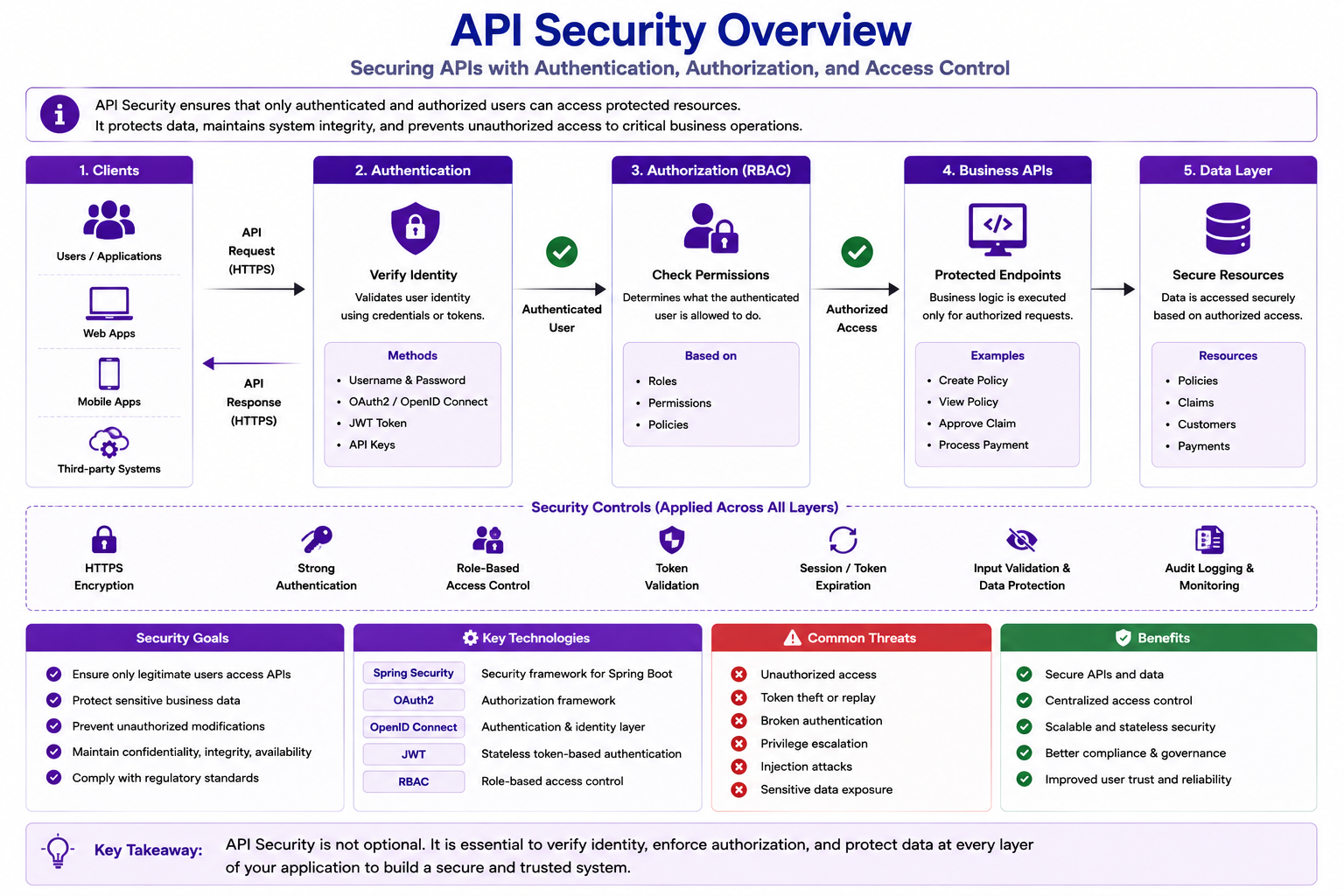
Security is applied before business logic is executed.
Authentication vs Authorization
Many developers confuse these concepts.
They are different.
Authentication
Authentication answers:
Who Are You?
Examples:
Username + Password

OAuth Login

JWT Token

Biometric Authentication
Authorization
Authorization answers:
What Are You Allowed To Do?
Examples:
Create Policy

View Policy

Approve Claim

Delete Policy
Authentication and Authorization Flow
Authentication occurs first.
Authorization occurs second.
Spring Security Overview
Spring Security is the standard security framework for Spring Boot.
Provides:
Authentication

Authorization

Session Management

CSRF Protection

Password Encryption

OAuth2 Support

JWT Support
Spring Security Architecture
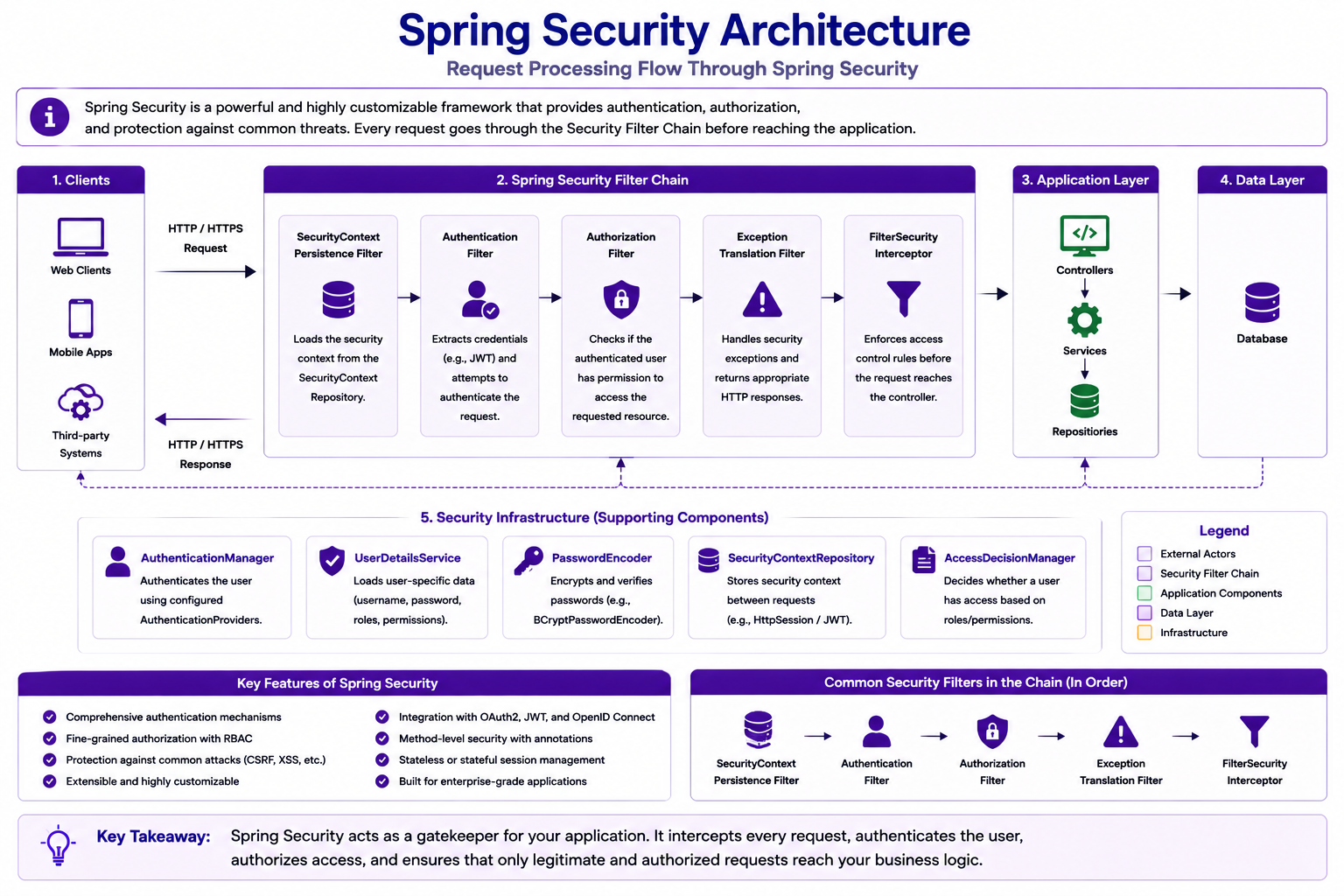
Every request passes through the security filter chain.
Adding Spring Security
Maven Dependency
<dependency>
    <groupId>
        org.springframework.boot
    </groupId>

    <artifactId>
        spring-boot-starter-security
    </artifactId>
</dependency>
Default Security Behavior
Once added:
All Endpoints Become Protected
Spring automatically creates:
Generated Password

Basic Authentication

Security Filters
OAuth2 Fundamentals
Modern APIs rarely use username/password directly.
Instead they use:
OAuth2
OAuth2 is an authorization framework.
It allows secure delegated access.
OAuth2 Actors
OAuth2 includes:
Resource Owner

Client Application

Authorization Server

Resource Server
OAuth2 Architecture
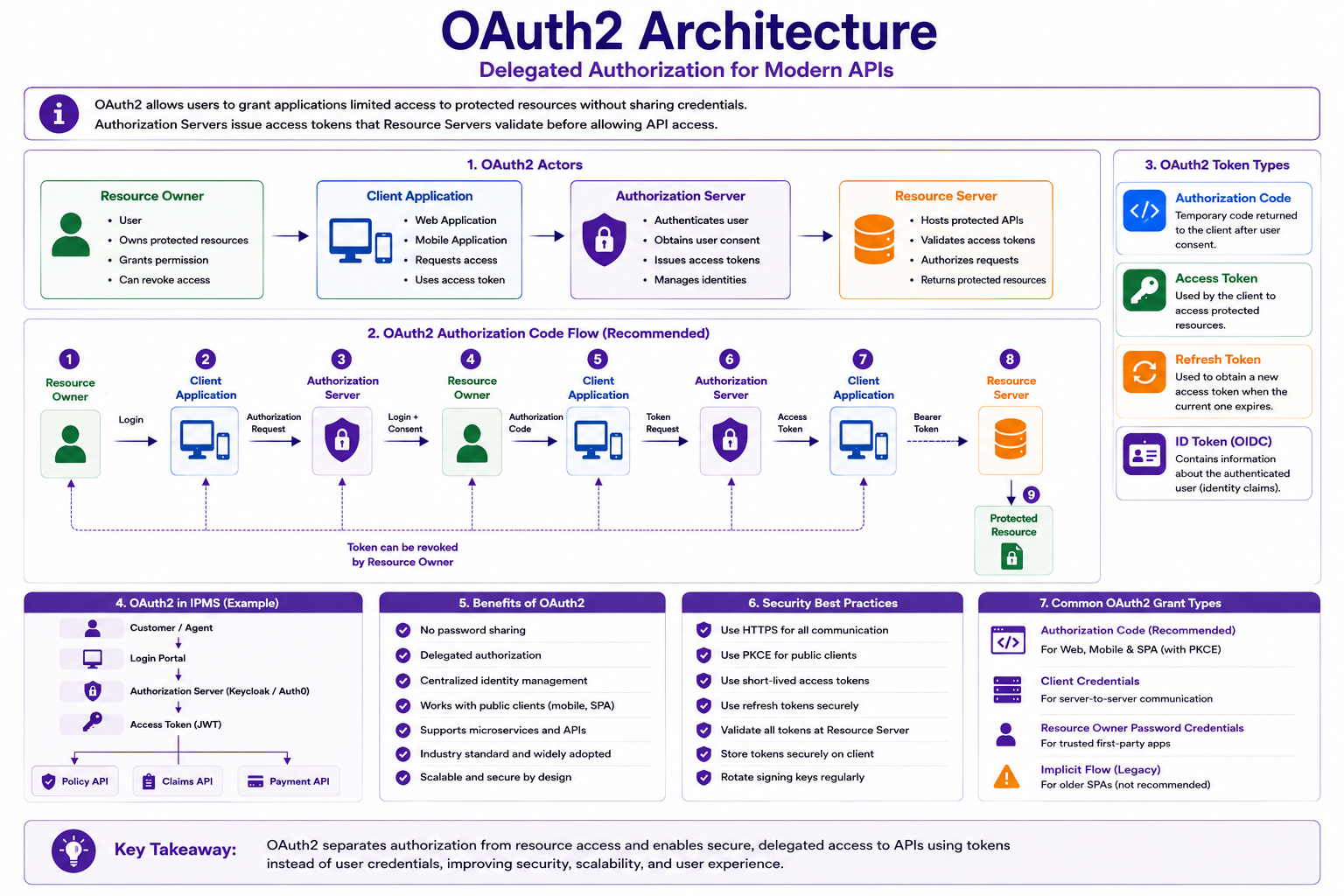
OAuth2 separates authentication from resource access.
What is OpenID Connect?
OAuth2 handles authorization.
OpenID Connect (OIDC) adds:
Authentication
OIDC provides:
Identity Information

User Profile

Login Support
Examples:
Google Login

Microsoft Login

GitHub Login
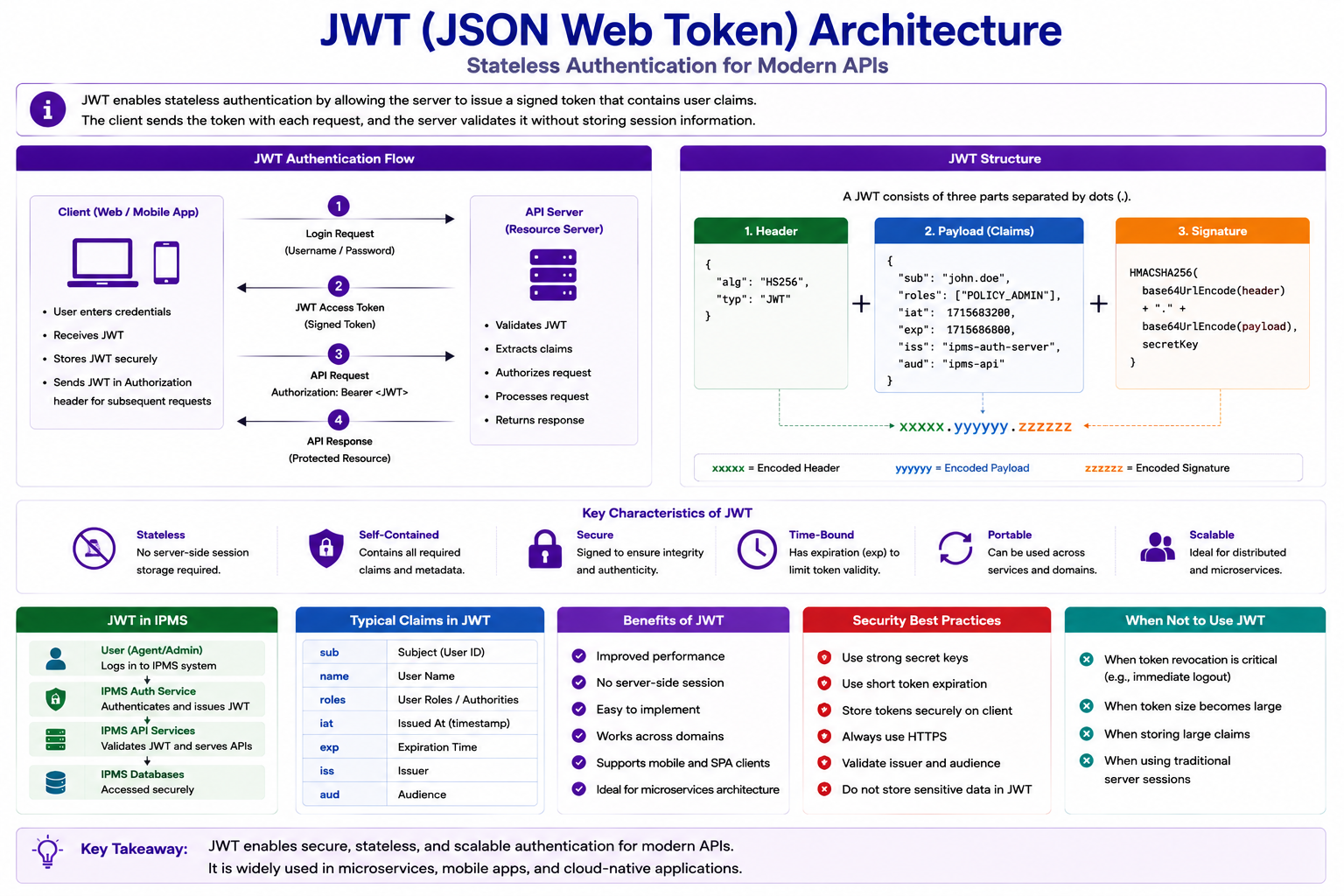
What is JWT?
JWT stands for:
JSON Web Token
JWT enables stateless authentication.
Instead of storing sessions:
Server Issues Token

Client Sends Token

Server Validates Token
JWT Structure
A JWT contains three parts.
Header
   .

Payload
   .

Signature
Example:
xxxxx.yyyyy.zzzzz
JWT Architecture
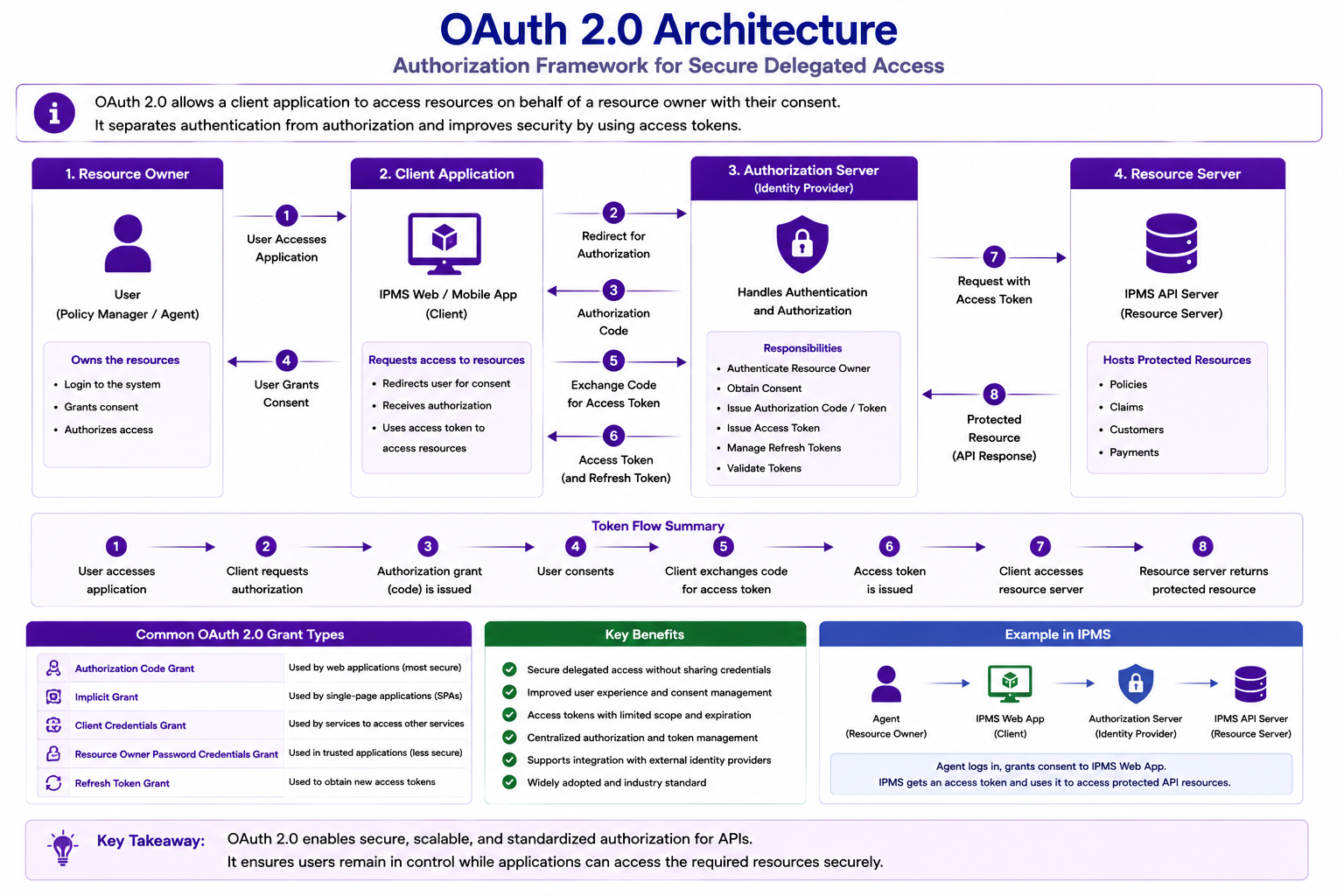
JWT removes the need for server-side session storage.
JWT Header Example
{
  "alg": "HS256",
  "typ": "JWT"
}
JWT Payload Example
{
  "sub": "john.doe",

  "roles": ["POLICY_ADMIN"],

  "exp": 1735689600
}
JWT Signature
Signature ensures:
Token Integrity

Tamper Detection
If payload changes:
Signature Invalid
JWT Authentication Flow
This is the most common architecture used by modern APIs.
Login API Example
POST /api/auth/login
Request:
{
  "username": "agent01",
  "password": "password"
}
Response:
{
  "accessToken": "eyJhbGciOi..."
}
Sending JWT in Requests
Client sends:
Authorization:
Bearer eyJhbGciOi...
JWT Validation
Server validates:
Signature

Expiration

Issuer

Audience

Claims
Only valid tokens are accepted.
Role-Based Access Control (RBAC)
Authentication identifies users.
RBAC determines permissions.
Example Roles
ADMIN

POLICY_ADMIN

CLAIMS_ADMIN

AGENT

CUSTOMER
RBAC Model
Insurance Policy Management System

CUSTOMER
   ↓
View Own Policies

AGENT
   ↓
Create Policies

CLAIMS_ADMIN
   ↓
Approve Claims

ADMIN
   ↓
Full System Access
Roles simplify authorization management.
Insurance System Role Matrix
| Role | Create Policy | Approve Claim | View Customer |
|---|---|---|---|
| ADMIN | Yes | Yes | Yes |
| POLICY_ADMIN | Yes | No | Yes |
| CLAIMS_ADMIN | No | Yes | Yes |
| AGENT | Yes | No | Limited |
| CUSTOMER | No | No | Own Data |
Securing Endpoints
@GetMapping("/policies")
Protect using:
@PreAuthorize(
 "hasRole('POLICY_ADMIN')"
)
RBAC Example
@PreAuthorize(
    "hasRole('CLAIMS_ADMIN')")
public void approveClaim() {

}
Only claim administrators can execute this method.
Security Configuration
@Configuration
@EnableMethodSecurity
public class SecurityConfig {

    @Bean
    SecurityFilterChain securityFilterChain(
            HttpSecurity http)
            throws Exception {

        return http.build();
    }

}
Centralized security management.
Security Filter Chain
@Bean
SecurityFilterChain securityFilterChain(
        HttpSecurity http)
        throws Exception {

    return http.build();
}
Security Processing Flow
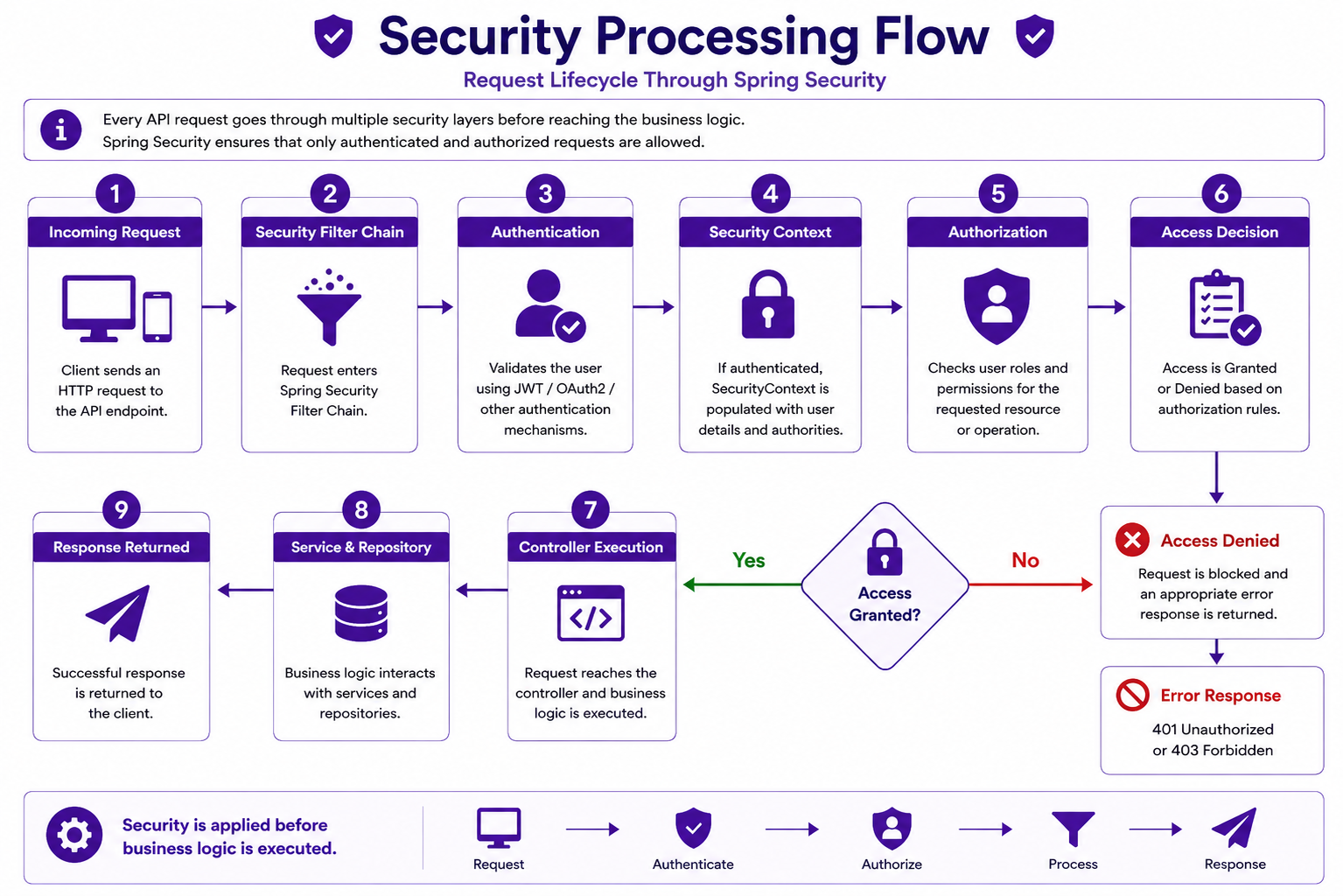
Every API request is validated before reaching controllers.
Password Encryption
Passwords must never be stored in plain text.
Use:
BCryptPasswordEncoder
Example
String encodedPassword =
    encoder.encode(password);
Security Best Practices
✅ Use HTTPS everywhere
✅ Use JWT expiration
✅ Use strong password policies
✅ Encrypt sensitive data
✅ Apply RBAC
✅ Validate all tokens
✅ Use least-privilege access
✅ Rotate signing keys
Common Security Mistakes
❌ Hardcoding secrets
❌ Exposing internal APIs
❌ Using plain-text passwords
❌ Missing token validation
❌ Excessive permissions
❌ Storing JWTs insecurely
Interview Questions
-
Difference between Authentication and Authorization?
-
What is OAuth2?
-
What is OpenID Connect?
-
What is JWT?
-
Explain JWT structure.
-
What is RBAC?
-
Why use Spring Security?
-
What is a Security Filter Chain?
-
Why use BCrypt?
-
Why is JWT considered stateless?
Practice Exercises
-
Add Spring Security to IPMS.
-
Create login endpoint.
-
Generate JWT token.
-
Validate JWT token.
-
Create ADMIN role.
-
Create AGENT role.
-
Secure policy APIs.
-
Secure claim approval APIs.
Key Takeaways
- Security is mandatory for enterprise APIs.
- Authentication identifies users.
- Authorization controls access.
- OAuth2 enables delegated authorization.
- OpenID Connect adds identity support.
- JWT provides stateless authentication.
- RBAC simplifies permission management.
- Spring Security is the standard security framework for Spring Boot.
Chapter Summary
In this chapter, you learned:
- Authentication
- Authorization
- Spring Security
- OAuth2
- OpenID Connect
- JWT
- RBAC
- Endpoint Security
- Password Encryption
Our Insurance Policy Management System can now authenticate users, authorize access, and secure APIs using enterprise-grade security standards.
In the next chapter, we will focus on Enterprise Integration using Feign Clients and Spring WebClient for communication with external systems.