
Chapter 19: Insurance Policy Management System (IPMS) Reference Architecture
Throughout this tutorial, we have incrementally built the foundation for designing, developing, securing, deploying, monitoring, and governing enterprise APIs.
We explored:
- API Design Principles
- OpenAPI Specifications
- Spring Boot Development
- Validation and Error Handling
- JPA and Hibernate
- DTO Mapping
- OAuth2 and JWT Security
- Service Integrations
- Resilience Patterns
- Microservices Architecture
- Event-Driven Architecture
- Docker and Kubernetes
- Performance Optimization
- Observability
- API Governance
In this final chapter, we bring everything together using a realistic enterprise case study:
Insurance Policy Management System (IPMS)
The IPMS serves as a reference architecture that demonstrates how all concepts learned throughout this tutorial work together in a production-grade platform.
🎯 Learning Objectives
By the end of this chapter, you will be able to:
- Understand the complete IPMS architecture
- Identify domain boundaries
- Understand API interactions
- Understand event-driven integrations
- Understand deployment architecture
- Review security implementation
- Review observability implementation
- Review governance controls
- Perform enterprise architecture reviews
- Evaluate production readiness
Business Context
Insurance companies manage:
Policies

Policy Holders

Claims

Premium Payments

Beneficiaries

Agents
Traditionally, these systems were built as monolithic applications.
Modern insurance platforms require:
Scalability

Availability

Security

Integration

Auditability
which makes microservices and API-first architectures ideal.
IPMS Business Domains
The Insurance Policy Management System consists of six primary domains.
Policy Management
Responsible for:
Create Policy

Update Policy

Renew Policy

Cancel Policy
Policy Holder Management
Responsible for:
Customer Profiles

Identity Management

Contact Information
Claims Management
Responsible for:
Claim Submission

Claim Processing

Claim Approval

Claim Settlement
Premium Payment Management
Responsible for:
Premium Collection

Payment Tracking

Receivables Management
Beneficiary Management
Responsible for:
Nominee Registration

Beneficiary Updates

Beneficiary Validation
Agent Management
Responsible for:
Agent Registration

Commission Tracking

Agent Performance
IPMS Domain Overview
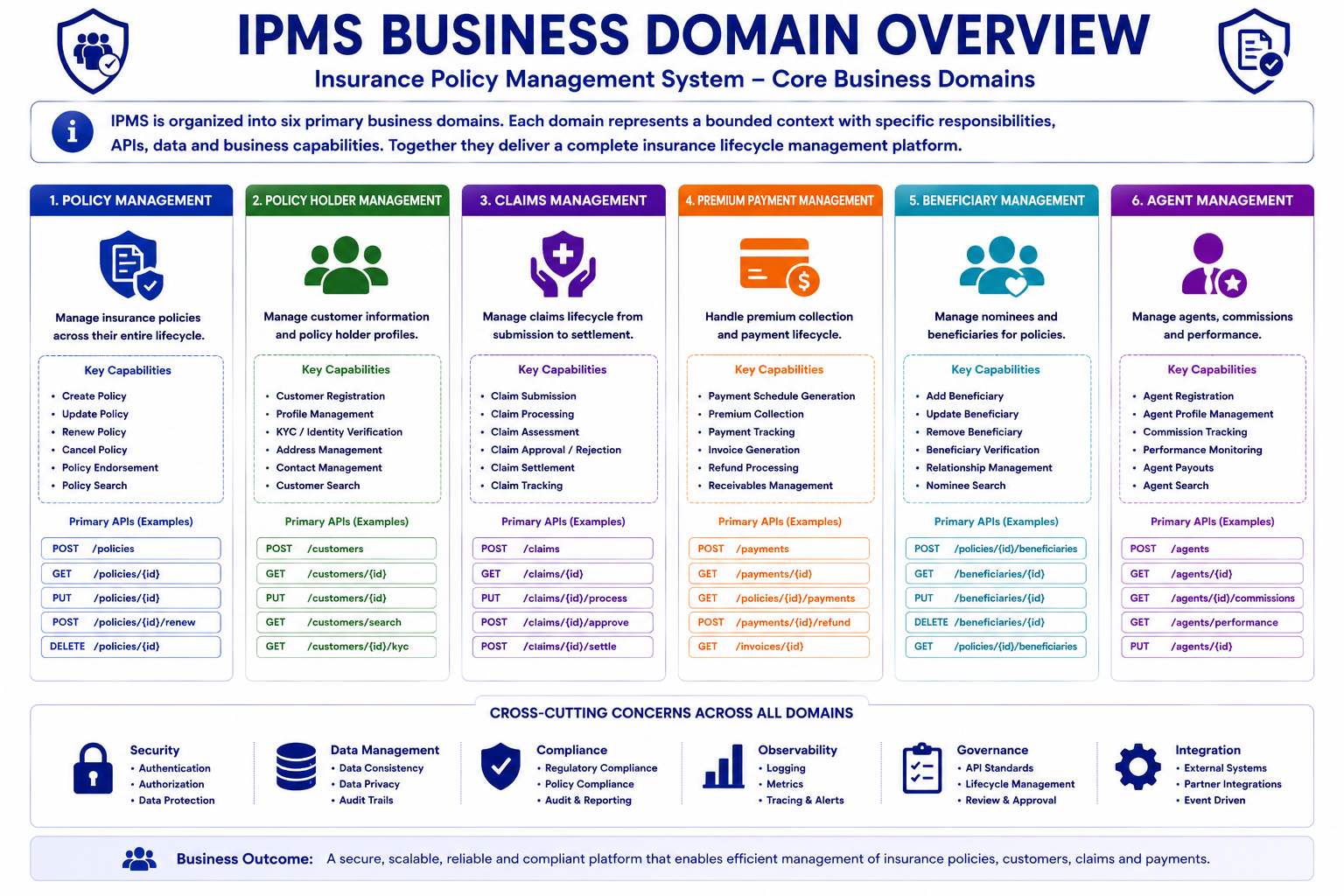
Domain Driven Design Perspective
Each domain becomes an independent bounded context.
Policy Service

Customer Service

Claim Service

Payment Service

Beneficiary Service

Agent Service
Benefits:
Independent Development

Independent Deployment

Independent Scaling
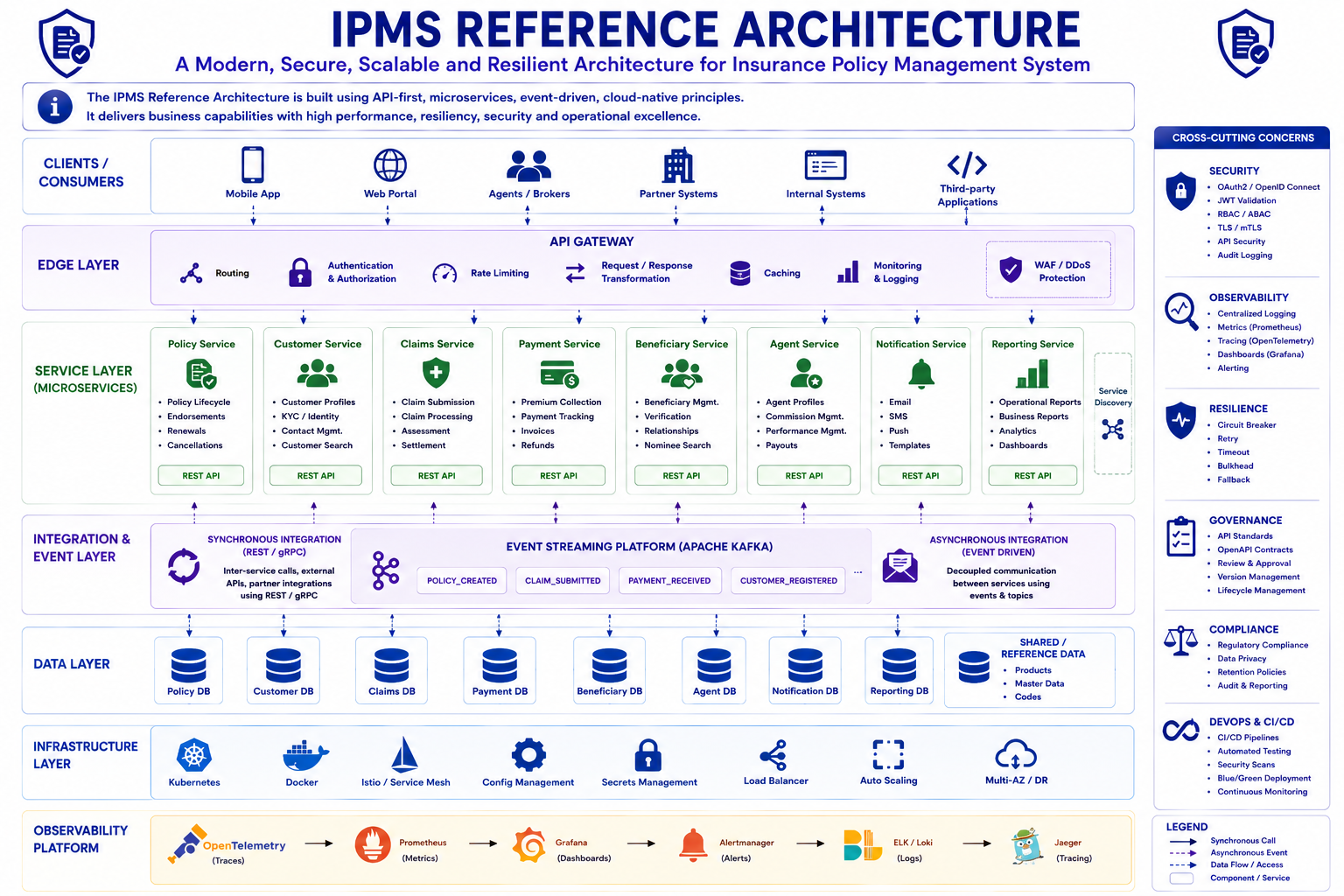
IPMS Reference Architecture
The complete architecture combines all concepts learned throughout the tutorial.
IPMS Reference Architecture
API Layer
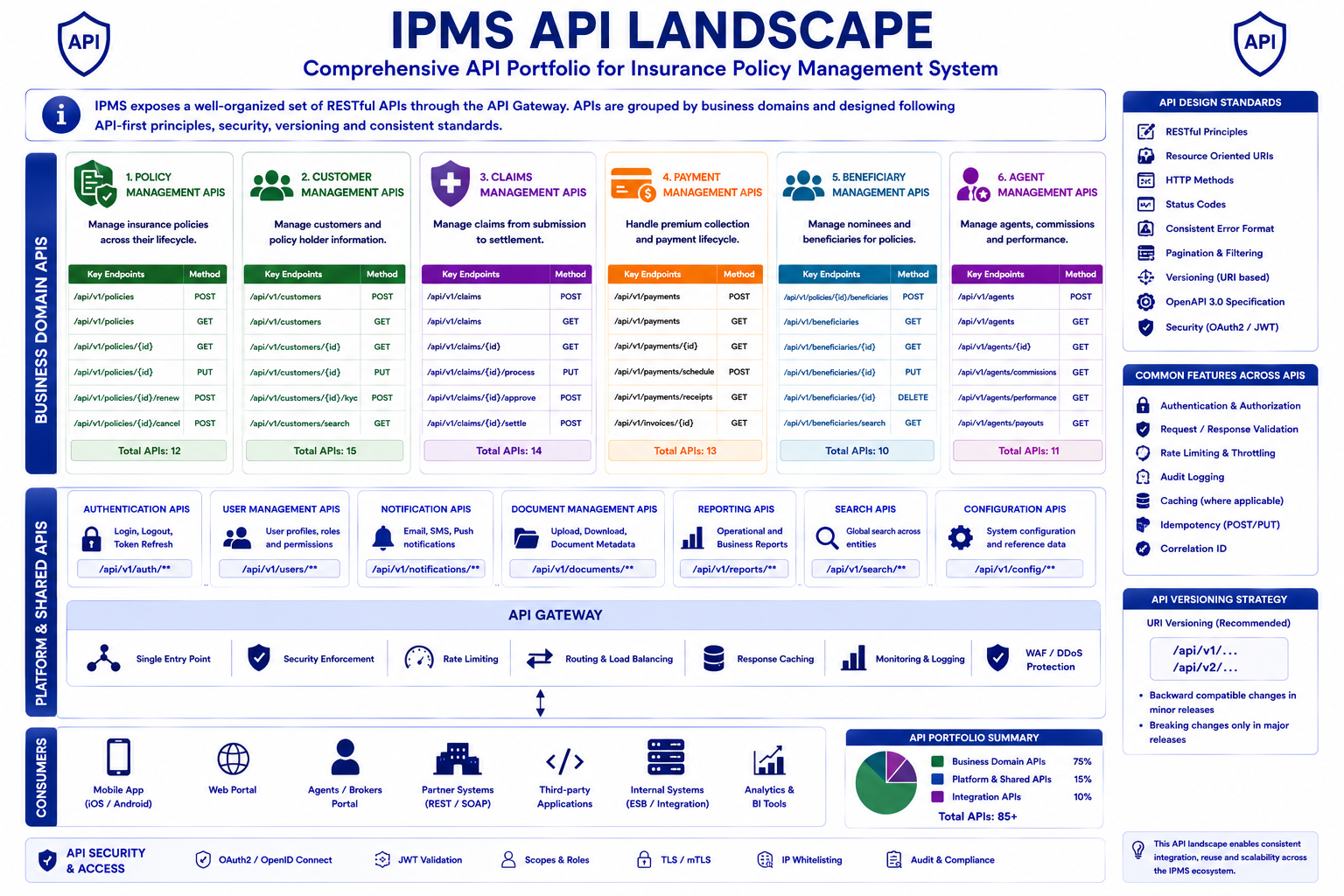
The API layer exposes business capabilities.
Examples:
GET /policies

POST /policies

POST /claims

GET /payments
Responsibilities:
Authentication

Authorization

Validation

Routing
API Gateway
All requests enter through:
API Gateway
Responsibilities:
Routing

Rate Limiting

Authentication

Monitoring

Caching
Benefits:
Single Entry Point

Centralized Security

Traffic Management
IPMS API Landscape
Security Architecture
The platform uses:
OAuth2

OpenID Connect

JWT

RBAC
Authentication Flow:
Client
   ↓
Identity Provider
   ↓
JWT Token
   ↓
API Gateway
   ↓
Microservices
Security controls include:
TLS

JWT Validation

Role-Based Access Control

Audit Logging
Persistence Layer
Each service owns its own database.
Examples:
Policy Database

Claims Database

Payment Database
Benefits:
Loose Coupling

Independent Scaling

Service Autonomy
Service Integration
Services communicate using:
REST APIs

Feign Clients

WebClient
Example:
Claim Service
      ↓
Policy Service
for policy validation.
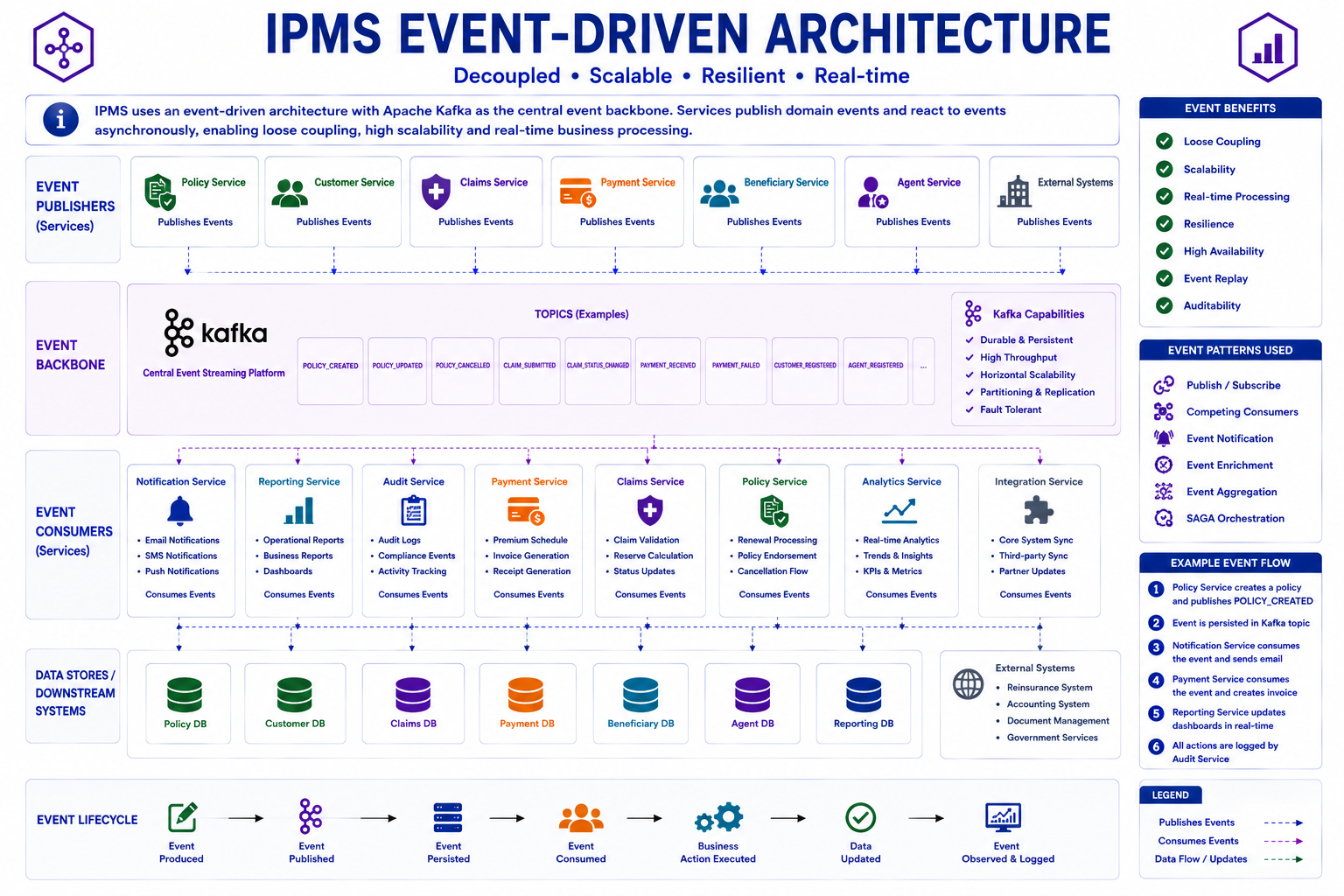
Event-Driven Architecture
IPMS uses Kafka for asynchronous communication.
Examples:
POLICY_CREATED

CLAIM_SUBMITTED

PAYMENT_RECEIVED

CUSTOMER_REGISTERED
Benefits:
Loose Coupling

Scalability

Resilience
Event-Driven IPMS Architecture
Resilience Architecture
IPMS uses:
Retry

Circuit Breaker

Timeout

Bulkhead
through Resilience4j.
Benefits:
Fault Isolation

Graceful Degradation

Improved Availability
Performance Architecture
Performance optimizations include:
Redis Caching

Connection Pooling

Pagination

Database Indexing
Examples:
Policy Cache

Reference Data Cache

Product Catalog Cache
Observability Architecture
The platform implements:
Logs

Metrics

Traces

Dashboards
using:
OpenTelemetry

Prometheus

Grafana

Jaeger
Benefits:
Root Cause Analysis

Performance Monitoring

Operational Visibility
Governance Architecture
Governance ensures:
Consistent APIs

Security Compliance

Documentation Standards

Lifecycle Management
Review processes include:
Architecture Review

Security Review

Performance Review

Compliance Review
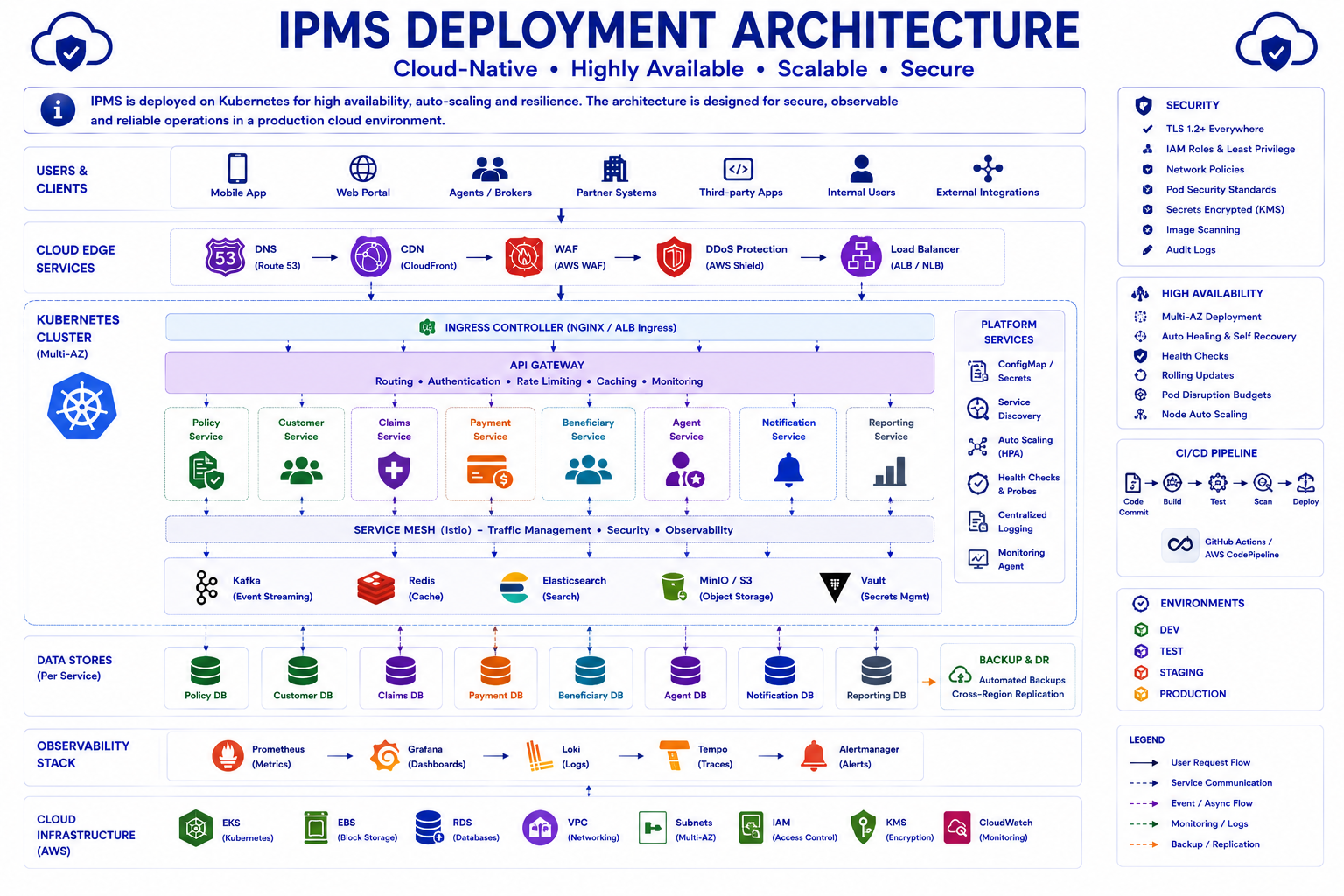
Deployment Architecture
IPMS is deployed using Kubernetes.
Components include:
API Gateway

Microservices

Kafka

Redis

MySQL

Observability Stack
IPMS Deployment Architecture
CI/CD Pipeline
Deployment pipeline:
Developer Commit
        ↓
Build
        ↓
Unit Tests
        ↓
Security Scan
        ↓
Docker Build
        ↓
Kubernetes Deployment
Benefits:
Automation

Consistency

Faster Releases
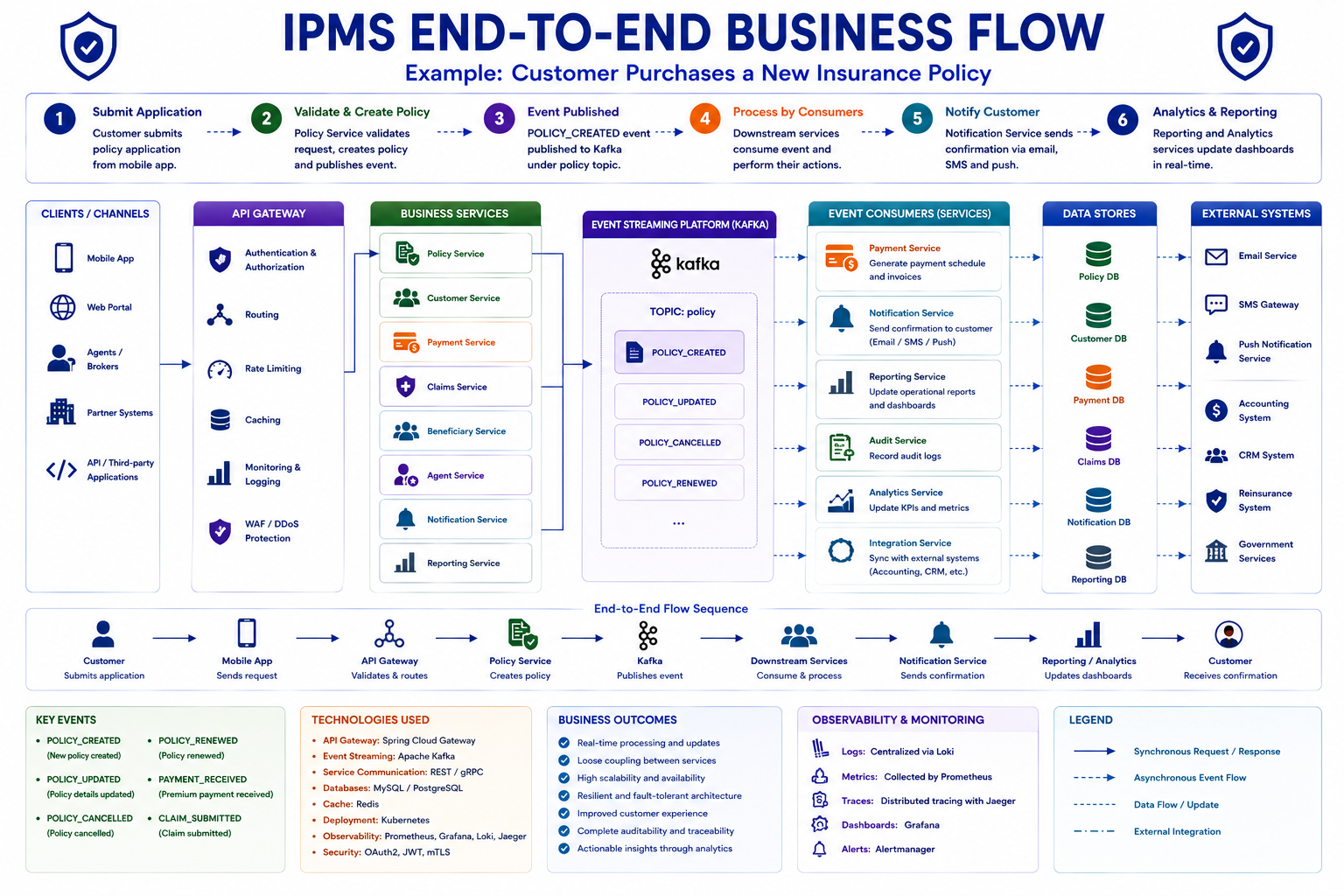
End-to-End Business Flow
Example:
Customer Purchases Policy
Step 1
Customer submits policy application.
Mobile App
      ↓
API Gateway
Step 2
Policy Service validates request.
Policy Service
      ↓
Customer Service
Step 3
Policy is created.
POLICY_CREATED Event
published to Kafka.
Step 4
Payment Service receives event.
Generate Payment Schedule
Step 5
Notification Service sends confirmation.
Email

SMS

Push Notification
End-to-End Flow
Production Readiness Checklist
Architecture
✅ Bounded Contexts Defined
✅ Independent Services
✅ API Gateway Configured
Security
✅ OAuth2 Implemented
✅ JWT Validation
✅ TLS Enabled
Reliability
✅ Circuit Breakers
✅ Retries
✅ Health Checks
Performance
✅ Redis Caching
✅ Database Optimization
✅ Connection Pooling
Observability
✅ Structured Logging
✅ Metrics Collection
✅ Distributed Tracing
Governance
✅ OpenAPI Contracts
✅ Documentation
✅ Review Processes
Enterprise Architecture Review
The IPMS architecture satisfies key enterprise quality attributes.
Scalability
Achieved through:
Microservices

Kubernetes

Kafka

Redis
Availability
Achieved through:
Redundant Deployments

Health Checks

Self Healing
Security
Achieved through:
OAuth2

JWT

RBAC

TLS
Maintainability
Achieved through:
Layered Architecture

DTOs

OpenAPI

Governance
Observability
Achieved through:
Logs

Metrics

Traces

Dashboards
Best Practices
✅ Design APIs First
✅ Use OpenAPI Contracts
✅ Secure APIs Consistently
✅ Implement Resilience Patterns
✅ Use Event-Driven Integration
✅ Monitor Everything
✅ Govern API Lifecycle
✅ Automate Deployments
Interview Questions
-
What are the primary domains in IPMS?
-
Why use microservices for insurance systems?
-
Why is Kafka used in IPMS?
-
Why does each service own its database?
-
How is security implemented?
-
What observability tools are used?
-
Why is Redis used?
-
What governance controls exist?
-
How is scalability achieved?
-
What makes the architecture production ready?
Final Key Takeaways
- Enterprise APIs require more than CRUD operations.
- API-first design improves consistency and reuse.
- Security must be integrated from the beginning.
- Event-driven architectures improve scalability.
- Docker and Kubernetes enable cloud-native deployments.
- Observability is essential for production operations.
- Governance ensures long-term maintainability.
- Enterprise architecture balances functionality, scalability, security, and operational excellence.
Tutorial Summary
Congratulations!
You have completed the tutorial:
Building Enterprise APIs using Java & Spring Boot
You learned how to design, build, secure, integrate, deploy, monitor, govern, and operate enterprise-grade APIs using modern technologies and industry best practices.
The Insurance Policy Management System (IPMS) demonstrated how these concepts work together in a real-world enterprise platform.
You are now equipped to design and build production-ready enterprise API ecosystems.