
Chapter 3: API Contracts and OpenAPI Specification
In the previous chapter, we designed REST APIs for our Insurance Policy Management System (IPMS).
We identified resources such as:
- Policy Holder
- Policy
- Coverage
- Claim
- Premium Payment
- Agent
- Beneficiary
However, designing URIs alone is not enough.
Enterprise APIs require a formal contract that clearly defines:
- Available endpoints
- Request structures
- Response structures
- Error responses
- Security requirements
- API documentation
In this chapter, we will learn how to define API contracts using the OpenAPI Specification (formerly Swagger Specification) and adopt a Contract-First approach used by modern enterprises.
🎯 Learning Objectives
By the end of this chapter, you will be able to:
- Understand API contracts
- Understand OpenAPI Specification
- Create OpenAPI documents
- Generate Swagger documentation
- Design APIs using Contract-First principles
- Define request and response schemas
- Understand Consumer Driven Contracts
- Create enterprise-grade API documentation
What is an API Contract?
An API contract is a formal agreement between API providers and API consumers.
The contract defines:
- Available endpoints
- Request parameters
- Request payloads
- Response payloads
- Status codes
- Authentication mechanisms
- Error structures
Without a contract:
Consumer guesses API behavior
With a contract:
Consumer understands API behavior
before implementation begins
OpenAPI Ecosystem Overview

The OpenAPI Specification serves as the central contract between providers, consumers, developers, testers, and API governance teams.
Why API Contracts Matter
Enterprise APIs are consumed by multiple teams.
Examples:
Customer Mobile App

Broker Portal

Agent Portal

Claims Processing System

Partner Integrations

Regulatory Systems
A contract ensures all consumers have a consistent understanding of API behavior.
Benefits include:
- Faster development
- Better collaboration
- Reduced misunderstandings
- Automated documentation
- Automated testing
- Improved governance
Introduction to OpenAPI Specification
OpenAPI Specification (OAS) is the industry standard for describing REST APIs.
It provides a machine-readable contract that can be used to:
- Generate documentation
- Generate SDKs
- Generate client code
- Generate server stubs
- Validate requests
- Validate responses
Current versions:
OpenAPI 3.0.x
OpenAPI 3.1.x
OpenAPI Example
A simple endpoint definition:
paths:
  /policies/{policyNumber}:
    get:
      summary: Retrieve policy information
Although simple, this contract already defines:
- Endpoint
- HTTP Method
- Purpose
Additional information can be added progressively.
OpenAPI Document Structure
An OpenAPI document consists of several sections.
OpenAPI Structure
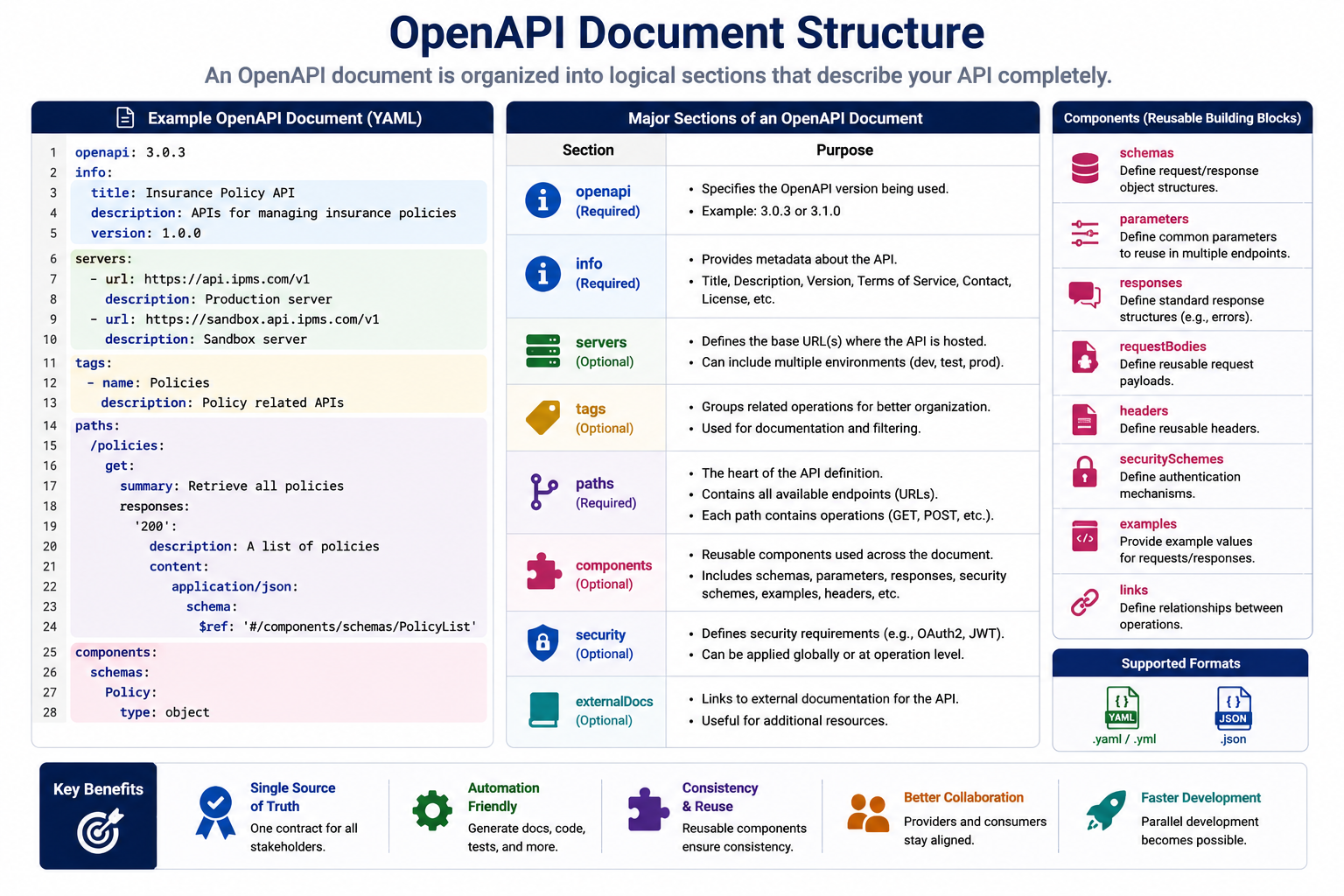
Typical sections include:
openapi

info

servers

paths

components

security

tags
Info Section
Provides API metadata.
Example:
openapi: 3.0.3

info:
  title: Insurance Policy API
  description: Insurance Policy Management System
  version: 1.0.0
Server Section
Defines deployment endpoints.
Example:
servers:
  - url: https://dev.api.ipms.com

  - url: https://test.api.ipms.com

  - url: https://api.ipms.com
Paths Section
Defines API endpoints.
Example:
paths:
  /policies:
    get:
      summary: Retrieve all policies
Components Section
Defines reusable schemas.
Example:
components:
  schemas:
    Policy:
      type: object
Reusable schemas reduce duplication and improve consistency.
Designing Our First Policy Contract
Let us create a contract for retrieving a policy.
Endpoint
GET /policies/{policyNumber}
Request Parameters
parameters:
  - name: policyNumber
    in: path
    required: true
Successful Response
responses:
  "200":
    description: Policy retrieved successfully
Policy Schema
Policy:
  type: object

  properties:
    policyNumber:
      type: string

    policyType:
      type: string

    status:
      type: string

    coverageAmount:
      type: number
Complete Insurance Policy API Example
openapi: 3.0.3

info:
  title: Insurance Policy API
  version: 1.0.0

paths:
  /policies/{policyNumber}:
    get:
      summary: Get Policy

      parameters:
        - name: policyNumber
          in: path
          required: true
          schema:
            type: string

      responses:
        "200":
          description: Policy Retrieved

          content:
            application/json:
              schema:
                $ref: "#/components/schemas/Policy"

components:
  schemas:
    Policy:
      type: object

      properties:
        policyNumber:
          type: string

        policyType:
          type: string

        status:
          type: string

        coverageAmount:
          type: number
Swagger and OpenAPI
Many people use the terms Swagger and OpenAPI interchangeably.
However, they are different.
| OpenAPI | Swagger |
|---|---|
| Specification | Tooling Ecosystem |
| Contract Standard | Documentation & Tools |
| Vendor Neutral | SmartBear Toolset |
Examples:
OpenAPI Specification

Swagger UI

Swagger Editor

Swagger Codegen
Swagger UI
Swagger UI provides interactive API documentation.
Features:
- Browse endpoints
- Execute API calls
- View responses
- Test APIs
Typical enterprise workflow:
OpenAPI Contract
         ↓
Swagger UI
         ↓
Developer Portal
Contract-First Development
Traditionally teams followed:
Code First
Approach:
Develop API
      ↓
Document API
Problems:
- Inconsistent contracts
- Documentation gaps
- Integration delays
Contract-First Development
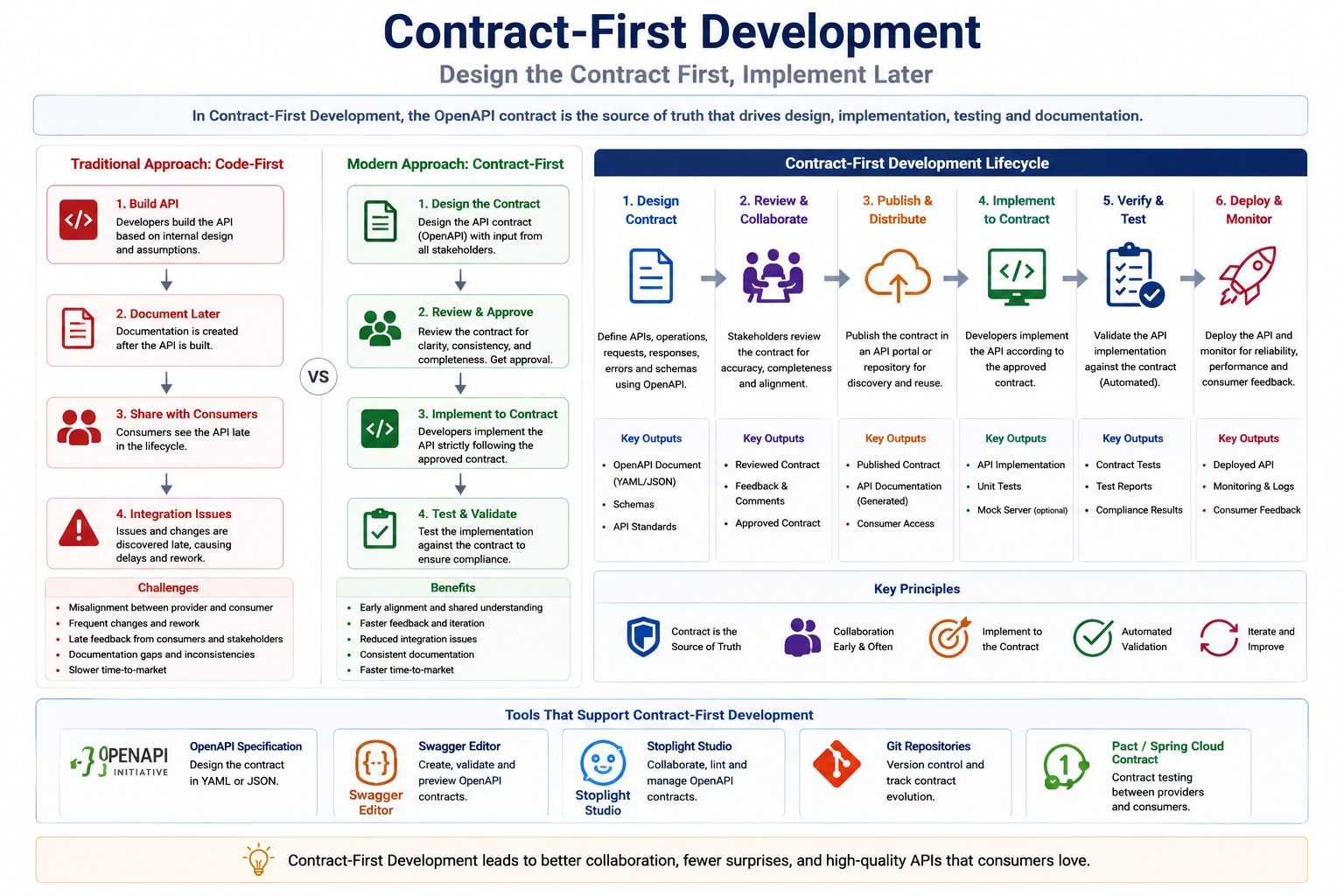
Modern organizations prefer:
Design Contract
       ↓
Review Contract
       ↓
Approve Contract
       ↓
Implement API
       ↓
Test API
Benefits:
- Better governance
- Early stakeholder feedback
- Consistent API standards
- Faster development
Insurance API Design Review Example
Before implementation, architects review:
GET /policies/{policyNumber}

POST /policies

PUT /policies/{policyNumber}

DELETE /policies/{policyNumber}
The OpenAPI contract becomes the official source of truth.
Request and Response Validation
Contracts help validate:
- Required fields
- Field types
- Allowed values
- Formats
Example:
email:
  type: string
  format: email
Validation can be automated.
Error Response Contracts
Enterprise APIs should standardize errors.
Example:
{
  "timestamp": "2026-01-01T10:00:00Z",
  "status": 404,
  "error": "Not Found",
  "message": "Policy not found",
  "path": "/policies/LIFE-100001"
}
Documenting errors improves API usability.
Consumer Driven Contracts (CDC)
Large organizations often have multiple consumers for the same API.
Examples:
Customer Mobile App

Broker Portal

Claims Portal

Partner Systems
Different consumers may have different expectations.
Consumer Driven Contracts
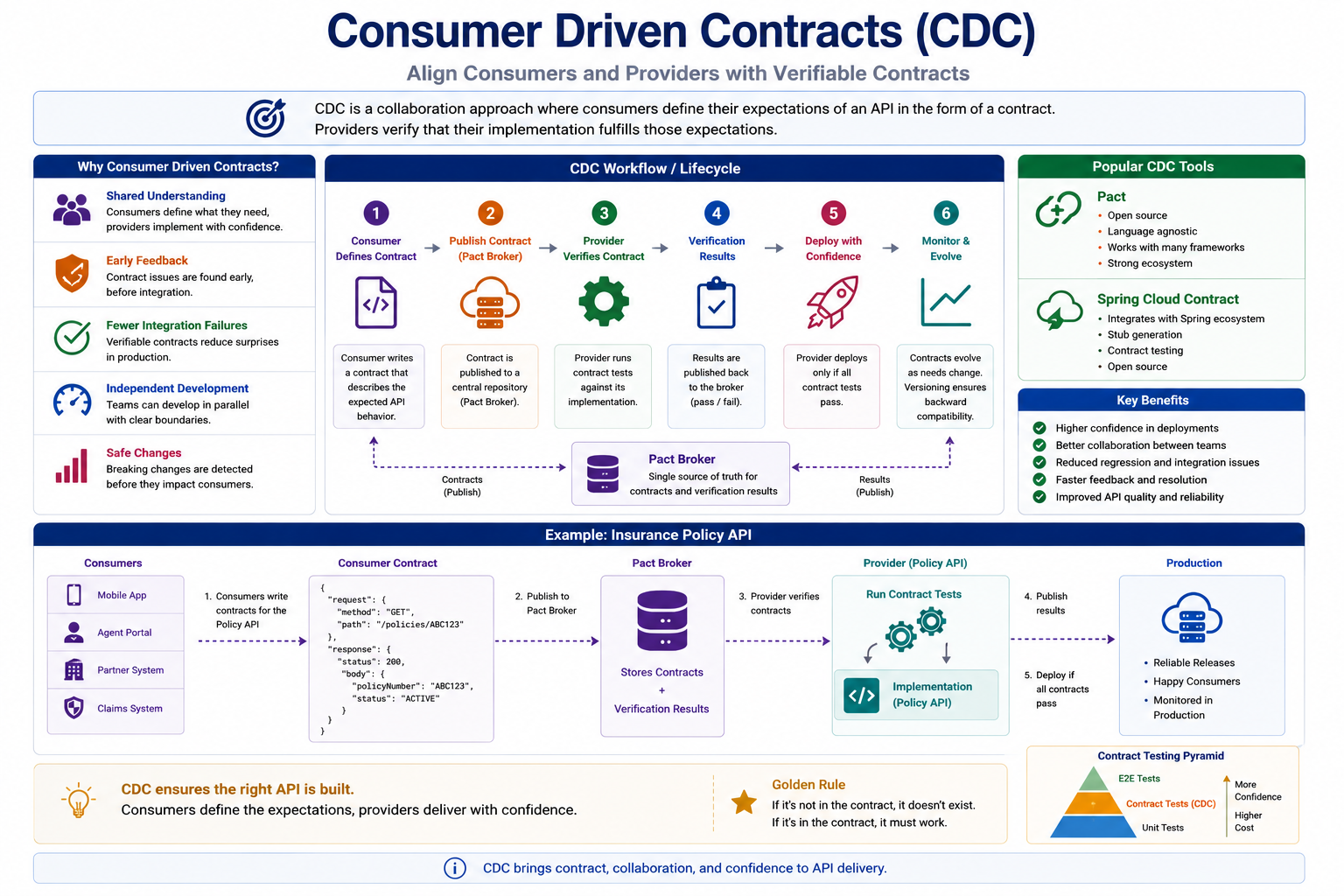
Consumers define expectations that providers must satisfy.
Benefits:
- Reduced integration failures
- Faster testing
- Better collaboration
- Higher confidence during deployments
Popular tools:
Pact

Spring Cloud Contract
API Documentation Best Practices
✅ Document every endpoint
✅ Provide request examples
✅ Provide response examples
✅ Document error responses
✅ Include authentication details
✅ Keep documentation synchronized with implementation
Common Documentation Mistakes
❌ Outdated documentation
❌ Missing examples
❌ Missing error contracts
❌ Undocumented breaking changes
❌ Documentation maintained separately from code
Applying OpenAPI to Our Insurance APIs
The following APIs will eventually receive OpenAPI contracts:
Policy Holder API

Policy API

Coverage API

Claims API

Premium Payment API

Agent API

Beneficiary API
In upcoming chapters, these contracts will be implemented using Spring Boot and automatically published through Swagger UI.
Interview Questions
-
What is an API contract?
-
Why are API contracts important?
-
What is OpenAPI Specification?
-
Difference between OpenAPI and Swagger?
-
What is Contract-First Development?
-
What are the major sections of an OpenAPI document?
-
Why are reusable schemas important?
-
What are Consumer Driven Contracts?
-
What is Swagger UI used for?
-
Why should error responses be documented?
Practice Exercises
-
Create an OpenAPI contract for:
- Policy Holder API
-
Define request and response schemas for:
- Claim API
-
Add standard error responses.
-
Design reusable schemas for:
- Policy
- Claim
- Agent
-
Compare Code-First and Contract-First approaches.
Key Takeaways
- API contracts define how consumers interact with APIs.
- OpenAPI is the industry standard for REST API contracts.
- Swagger provides tooling around OpenAPI.
- Contract-First development improves quality and governance.
- Reusable schemas improve consistency.
- Consumer Driven Contracts improve integration reliability.
- Documentation is a critical part of API design.
Chapter Summary
In this chapter, you learned:
- API Contracts
- OpenAPI Specification
- Swagger
- Contract-First Development
- OpenAPI Document Structure
- Request and Response Schemas
- Consumer Driven Contracts
- API Documentation Best Practices
You now have formal API contracts for the Insurance Policy Management System and are ready to begin implementing APIs using Spring Boot.