
Chapter 18: API Governance and Enterprise Standards
In the previous chapter, we implemented observability for our Insurance Policy Management System (IPMS) using structured logging, distributed tracing, Prometheus, Grafana, and monitoring dashboards.
Our platform can now:
- Monitor API performance
- Collect logs and metrics
- Trace requests across services
- Generate alerts proactively
However, as organizations build hundreds or thousands of APIs, a new challenge emerges.
How do we ensure APIs follow consistent standards?
How do we prevent duplicated APIs?
How do we maintain security, quality, and compliance?
How do we manage APIs throughout their lifecycle?
This is where API Governance becomes essential.
API Governance establishes policies, standards, processes, and controls that ensure APIs remain secure, consistent, maintainable, and aligned with enterprise architecture principles.
In this chapter, we will explore API governance practices and enterprise standards used by large organizations.
🎯 Learning Objectives
By the end of this chapter, you will be able to:
- Understand API Governance Fundamentals
- Manage API Lifecycles
- Implement API Standards
- Govern API Versions
- Apply Security Governance
- Govern API Documentation
- Conduct API Reviews
- Create Governance Checklists
- Establish Enterprise API Standards
- Govern the IPMS API Portfolio
Why API Governance Matters
Imagine an organization with:
500+ APIs

50 Development Teams

Multiple Business Units

Several Technology Platforms
Without governance:
Duplicate APIs

Inconsistent Naming

Security Gaps

Version Conflicts

Poor Documentation
Result:
Increased Complexity

Higher Maintenance Costs

Poor Developer Experience
Governance helps establish consistency and control.
What is API Governance?
API Governance is the framework of:
Policies

Standards

Processes

Reviews

Controls
used to manage APIs throughout their lifecycle.
Governance ensures APIs remain:
- Consistent
- Secure
- Reusable
- Discoverable
- Maintainable
API Governance Overview
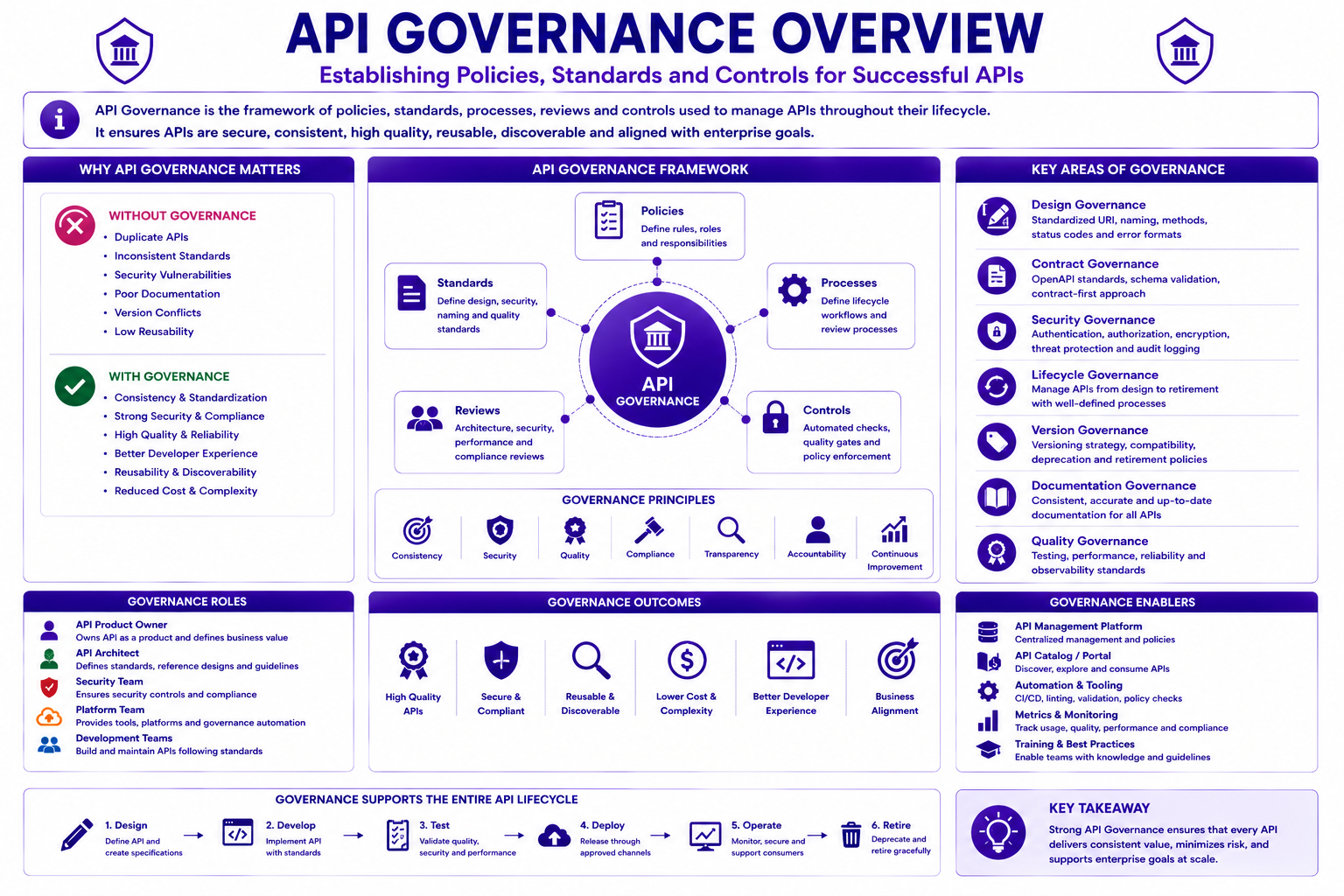
Goals of API Governance
Governance aims to ensure:
Consistency

Security

Quality

Compliance

Reusability

Scalability
across all APIs.
API Lifecycle Management
Every API follows a lifecycle.
Design
   ↓
Develop
   ↓
Test
   ↓
Deploy
   ↓
Operate
   ↓
Retire
Proper governance controls each phase.
API Lifecycle Management
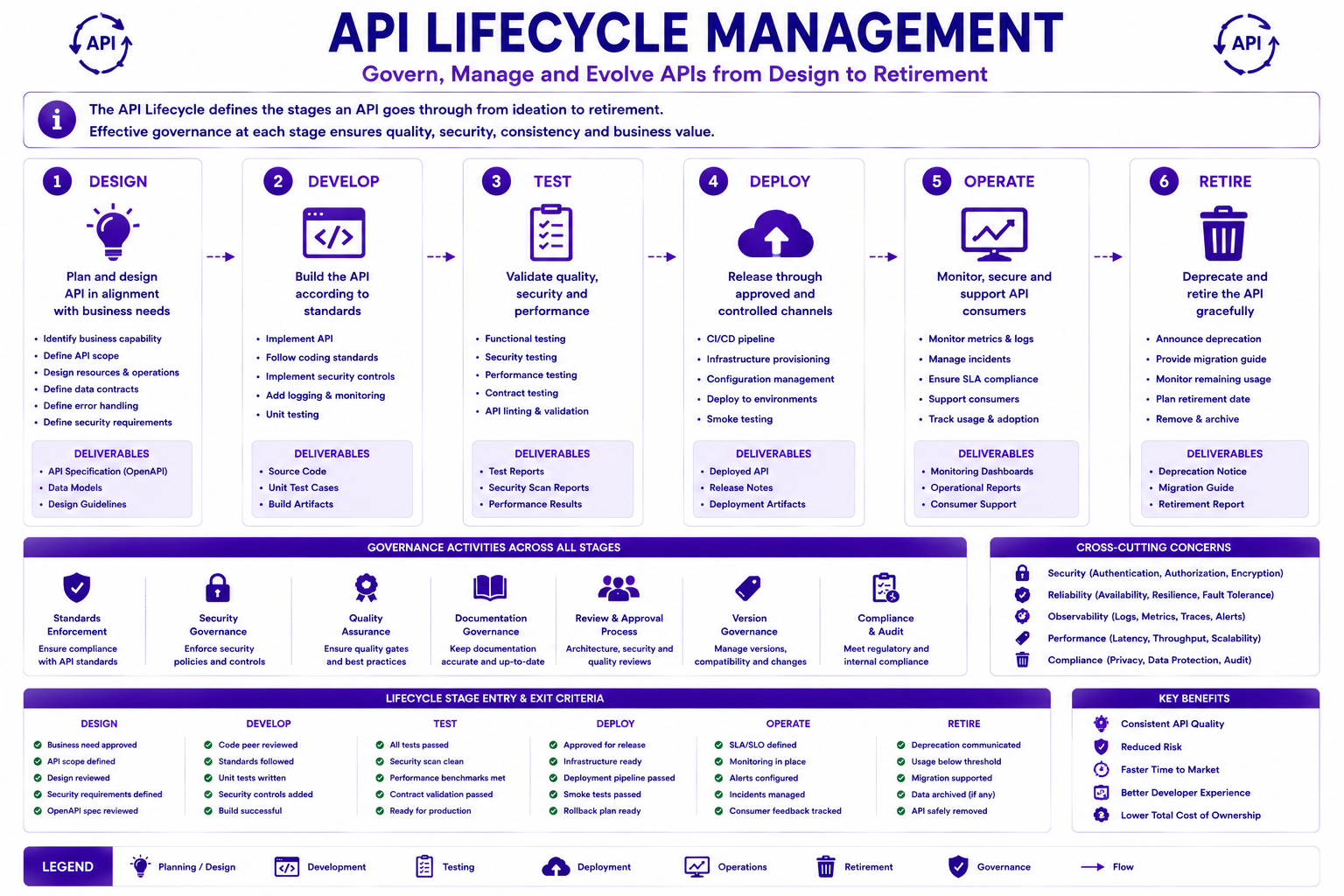
API Design Governance
Design governance ensures APIs follow enterprise standards.
Key areas include:
Resource Naming

URI Design

HTTP Methods

Status Codes

Error Formats

Versioning
Example:
GET /policies
GET /claims
GET /payments
instead of:
GET /getPolicies
GET /retrieveClaims
Contract Governance
API contracts must be governed.
Organizations commonly use:
OpenAPI Specification

Swagger

Contract-First Design
Benefits:
Consistency

Automation

Consumer Alignment
Documentation Governance
Documentation should be treated as a first-class artifact.
Every API should include:
Purpose

Request Examples

Response Examples

Error Codes

Security Requirements

Version Information
Documentation must remain synchronized with implementation.
API Version Governance
APIs evolve over time.
Governance defines how versions are managed.
Common approaches:
URI Versioning

Header Versioning

Media Type Versioning
Example:
/api/v1/policies

/api/v2/policies
Version Governance Rules
Examples:
No Breaking Changes in Minor Releases

Deprecation Notice Required

Backward Compatibility Preferred

Retirement Policies Defined
API Version Governance
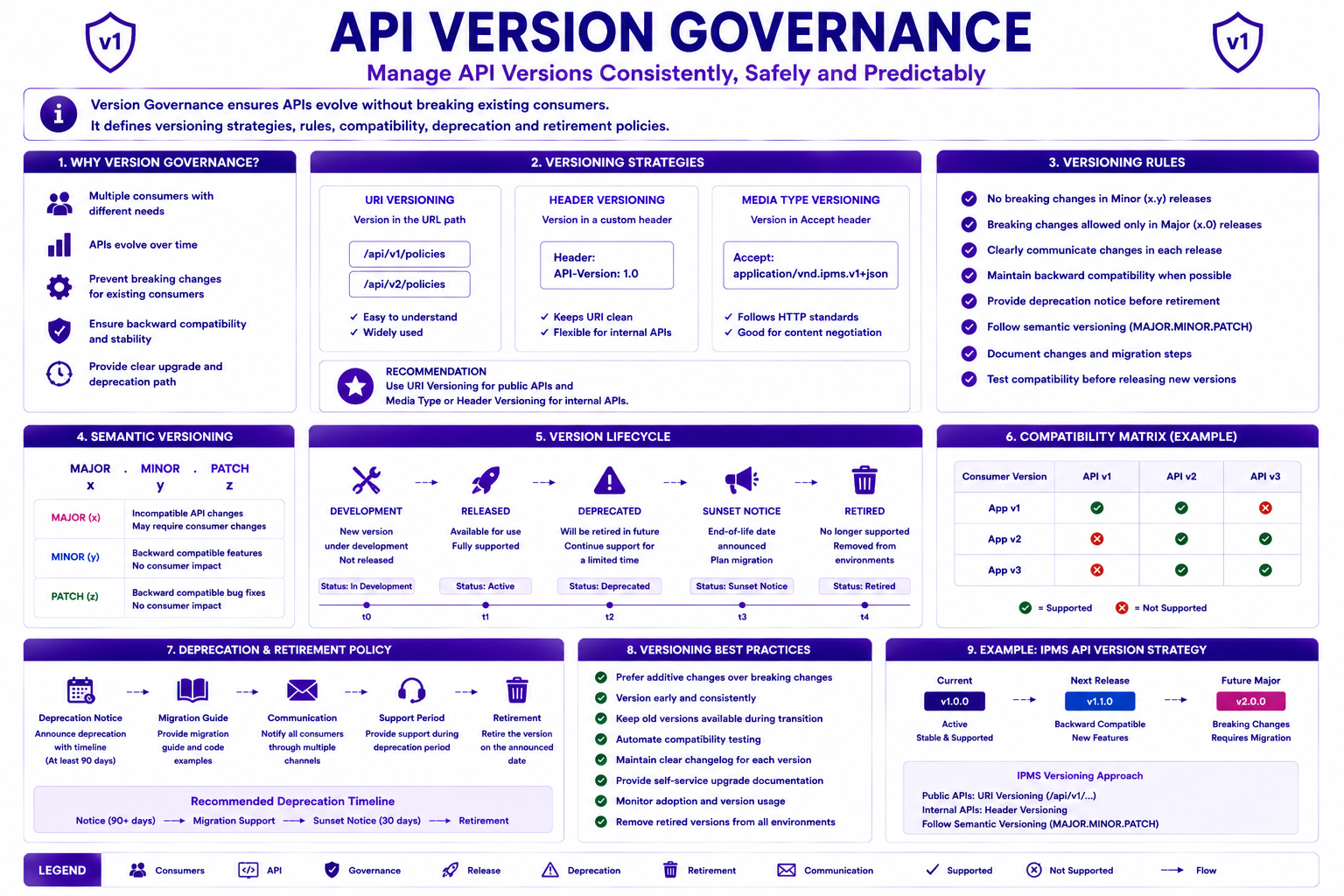
Security Governance
Security must be enforced consistently.
Governance typically mandates:
OAuth2

OpenID Connect

JWT

TLS Encryption

RBAC
Requirements may include:
Authentication

Authorization

Audit Logging

Threat Protection
Security Review Checklist
Example:
✓ Authentication Implemented

✓ Authorization Verified

✓ TLS Enabled

✓ Sensitive Data Protected

✓ Secrets Managed Securely
Documentation Standards
Enterprise APIs should follow common standards.
Examples:
OpenAPI

JSON Schema

RFC Standards

Internal API Standards
Benefits:
Interoperability

Consistency

Maintainability
API Quality Governance
Quality checks ensure APIs meet expectations.
Areas reviewed:
Functionality

Performance

Security

Reliability

Maintainability
Common metrics:
Response Time

Availability

Error Rate

Test Coverage
API Portfolio Management
Organizations manage APIs as products.
API inventory should include:
API Name

Owner

Version

Status

Consumers

Documentation
Benefits:
Visibility

Discoverability

Reuse
API Catalog
Enterprise API catalogs help teams discover APIs.
Examples:
SwaggerHub

Backstage

Developer Portals

Internal API Registries
Governance Roles
Successful governance requires clear ownership.
Typical roles:
API Product Owner
Responsible for business requirements.
API Architect
Defines standards and designs.
Security Team
Performs security reviews.
Platform Team
Provides governance tooling.
Development Team
Implements standards.
API Review Process
Enterprise APIs typically undergo review before release.
Review categories:
Architecture Review

Security Review

Performance Review

Compliance Review
API Review Process
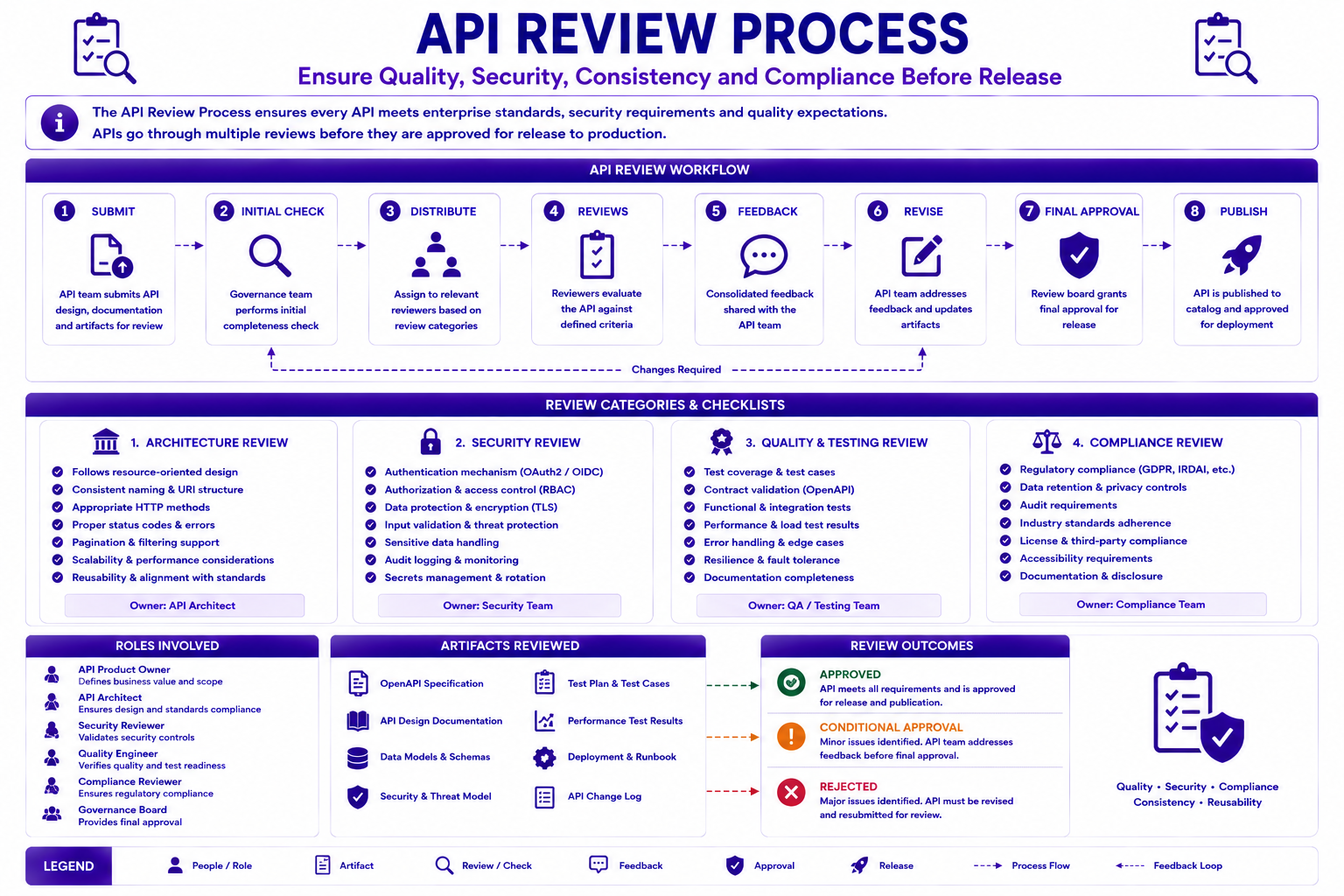
Architecture Review Checklist
Example:
✓ Resource-Oriented Design

✓ Naming Standards

✓ Version Strategy

✓ Scalability Considerations

✓ Reuse Opportunities
Security Review Checklist
Example:
✓ OAuth2 Implemented

✓ Authorization Verified

✓ Sensitive Data Protected

✓ Audit Logging Enabled

✓ Secrets Externalized
Performance Review Checklist
Example:
✓ Pagination Implemented

✓ Caching Strategy Defined

✓ Database Queries Optimized

✓ Load Testing Completed
Compliance Governance
Many industries require regulatory compliance.
Insurance organizations may need:
Audit Trails

Data Retention

Privacy Controls

Regulatory Reporting
Governance helps enforce these requirements.
API Deprecation and Retirement
APIs eventually reach end-of-life.
Governance defines:
Deprecation Notice

Migration Plan

Retirement Date

Consumer Communication
Example:
Deprecation: true
Sunset: 2027-12-31
Enterprise Governance Maturity
Organizations evolve through stages.
Level 1
Ad Hoc

Level 2
Standardized

Level 3
Governed

Level 4
Automated

Level 5
Optimized
Mature organizations automate governance wherever possible.
Governance Automation
Modern platforms automate governance through:
CI/CD Pipelines

Linting Rules

Security Scanning

Contract Validation

Quality Gates
Benefits:
Consistency

Faster Reviews

Reduced Risk
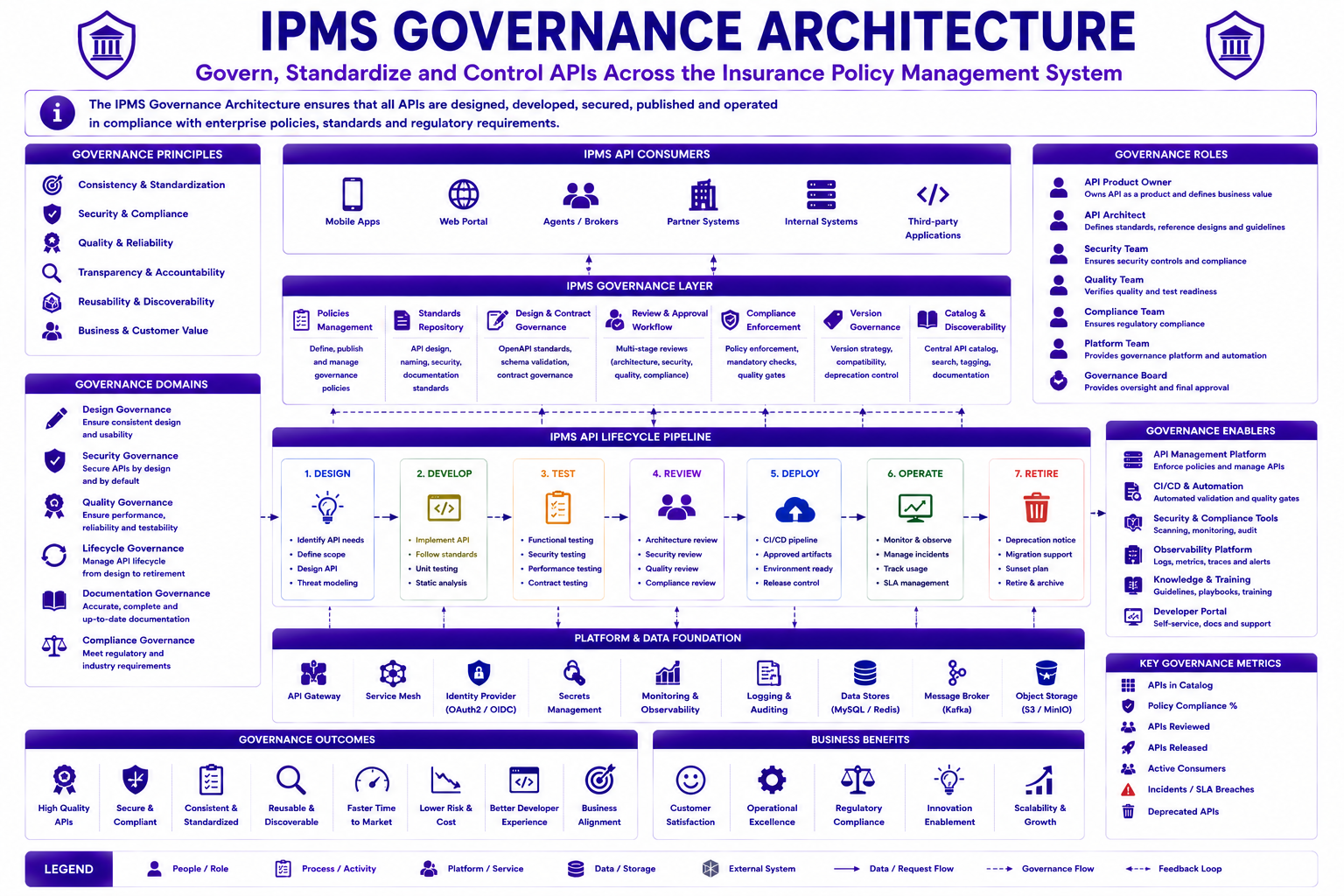
IPMS Governance Architecture
The Insurance Policy Management System uses governance across:
Design

Development

Deployment

Operations
to ensure quality and compliance.
IPMS Governance Architecture
Best Practices
✅ Define enterprise API standards
✅ Use OpenAPI for contracts
✅ Establish review processes
✅ Maintain API catalogs
✅ Implement version governance
✅ Automate policy enforcement
✅ Monitor compliance continuously
✅ Treat APIs as products
Common Mistakes
❌ No governance framework
❌ Inconsistent naming standards
❌ Poor documentation
❌ No version strategy
❌ Missing security reviews
❌ Manual governance processes
❌ Untracked API inventory
Interview Questions
-
What is API Governance?
-
Why is governance important?
-
What is API Lifecycle Management?
-
What are governance standards?
-
What is version governance?
-
How do you govern API security?
-
What is an API catalog?
-
What is an API review board?
-
How do you retire APIs?
-
What governance metrics should be tracked?
-
What is governance automation?
-
How do APIs support compliance requirements?
Practice Exercises
-
Create API governance guidelines.
-
Design an API review checklist.
-
Define versioning standards.
-
Create a documentation template.
-
Build an API inventory for IPMS.
-
Define deprecation policies.
-
Create security governance controls.
-
Automate API validation in CI/CD.
Key Takeaways
- API Governance ensures consistency and quality.
- Governance spans the entire API lifecycle.
- Security governance protects enterprise APIs.
- Documentation governance improves discoverability.
- Version governance manages API evolution.
- Review processes enforce standards.
- API catalogs improve reuse.
- Governance automation increases efficiency.
- APIs should be treated as enterprise products.
Chapter Summary
In this chapter, you learned:
- API Governance Fundamentals
- API Lifecycle Management
- Design Governance
- Documentation Governance
- Security Governance
- Version Governance
- API Review Processes
- Compliance Governance
- Governance Automation
- Enterprise Standards
Our Insurance Policy Management System now follows enterprise-grade governance practices from design through retirement.
In the next chapter, we will bring everything together by exploring the complete Insurance Policy Management System (IPMS) Reference Architecture and performing an end-to-end enterprise architecture review.