
Chapter 01: Evolution of Enterprise Data Platforms
Modern enterprises rarely succeed without a robust data platform strategy.
Banks, retailers, healthcare providers, insurance companies, and government organizations continuously evolve their data platforms to ensure:
- Data is available when and where it's needed
- Analytics deliver accurate insights
- AI/ML models have high-quality training data
- Regulatory compliance is maintained
- Business decisions are data-driven
- Customer experiences are personalized
This evolution is primarily enabled through Modern Data Platforms.
In this chapter, we will explore the evolution of enterprise data platforms, understand different architectural approaches, and learn why modern data modeling has become the foundation of data-driven organizations.
Throughout this tutorial, we will use a simplified Digital Banking Platform as our primary case study.
🎯 Learning Objectives
By the end of this chapter, you will be able to:
- Understand what enterprise data platforms are and why they exist
- Explain the evolution from data silos to modern data platforms
- Differentiate between different data architectural approaches
- Understand the key drivers of platform evolution
- Recognize the limitations of traditional architectures
- Identify the components of a modern data platform
- Understand the role of cloud in modern data architecture
- Recognize common banking industry data use cases
What is an Enterprise Data Platform?
An enterprise data platform is the practice of:
Using integrated tools and architectures
to collect, store, process, and analyze data at scale
and deliver insights across the entire organization.
Think of a data platform as the nervous system of a modern enterprise.
Data Sources (Operational Systems)
      ↓
  Data Integration (ETL/ELT)
      ↓
  Data Storage & Processing
      ↓
  Data Consumption (Analytics, AI/ML)
Real-World Banking Example
Suppose a bank wants to provide real-time fraud detection for customer transactions.
Traditional approach:
Step 1: Extract transaction data (Batch, 24-hour delay)
Step 2: Process in data warehouse (Overnight)
Step 3: Detect fraud patterns (Next day)
Step 4: Block suspicious transactions (Too late!)
Modern data platform approach:
Step 1: Stream transactions in real-time (Kafka)
Step 2: Process with streaming analytics (Flink)
Step 3: Detect fraud patterns in milliseconds
Step 4: Block suspicious transactions immediately
Why Modern Data Platforms Matter
Without modern data platforms, organizations struggle with:
- Data silos across business units
- Inconsistent data definitions
- Delayed insights for decision-making
- High data management costs
- Inability to support AI/ML at scale
- Regulatory compliance challenges
- Poor customer experiences
Modern data platforms provide:
- Real-time insights
- Unified data views (e.g., Customer 360)
- Scalable storage and processing
- AI/ML-ready data
- Consistent data governance
- Reduced total cost of ownership
- Competitive advantage
Evolution of Enterprise Data Platforms
Before modern data platforms, data was fragmented and hard to access.
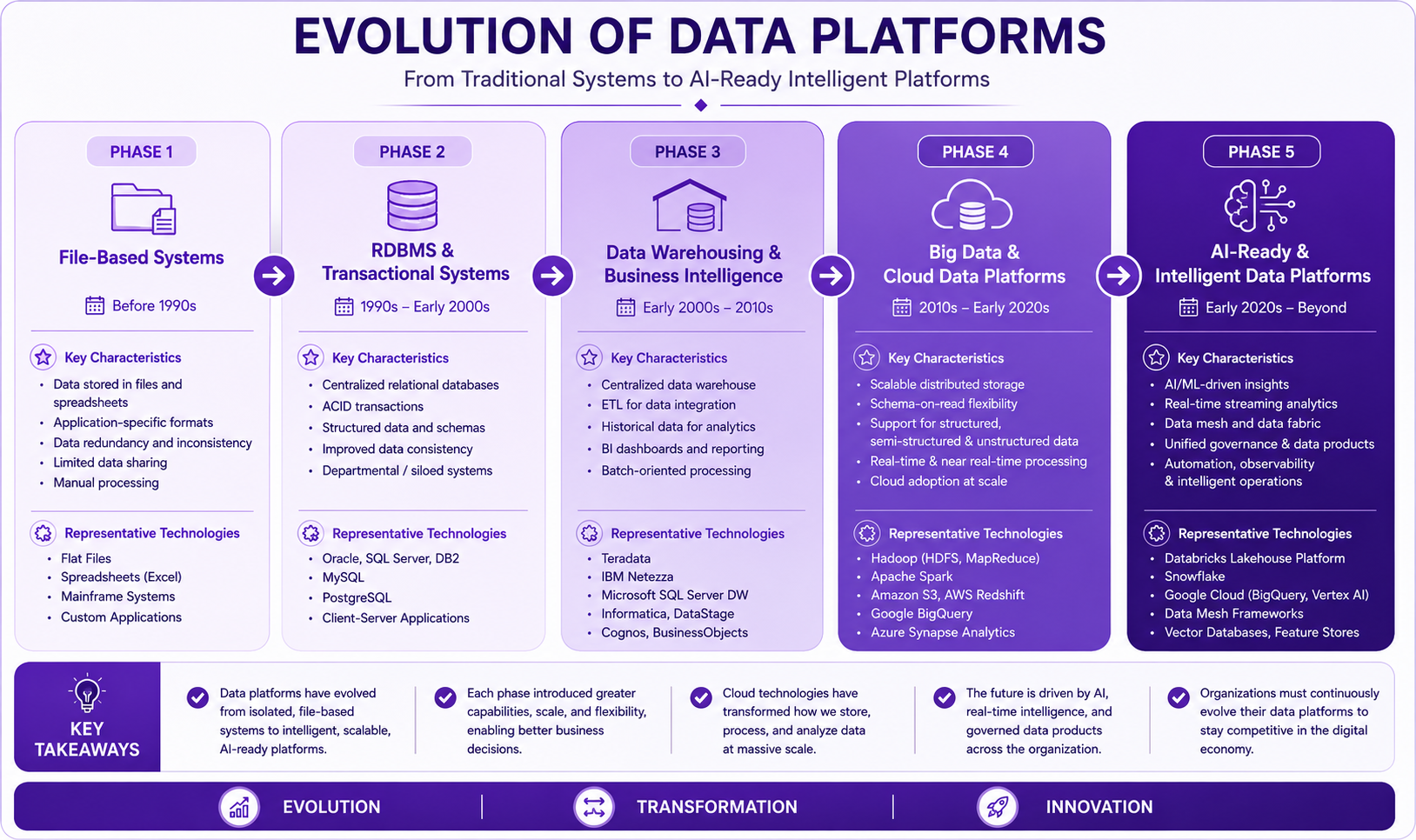
Prompt: Create an evolution timeline showing 5 phases of data platform evolution with the following structure:
Phase 1: Data Silos (1980s-1990s)
- Description: Isolated databases per department
- Characteristics: No integration, redundant data, inconsistent definitions
- Color: Purple #F3E5F5 (lightest)
Phase 2: Data Warehousing (1990s-2000s)
- Description: Centralized enterprise data warehouse
- Characteristics: Single source of truth, ETL processes, batch processing
- Color: Purple #E1BEE7
Phase 3: Data Lakes (2010s)
- Description: Store raw data in any format
- Characteristics: Schema-on-read, Hadoop ecosystem, unlimited storage
- Color: Purple #CE93D8
Phase 4: Lakehouse Architecture (2020s)
- Description: Combine data lake and warehouse capabilities
- Characteristics: ACID transactions, schema enforcement, performance
- Color: Purple #AB47BC
Phase 5: AI-Ready Data Platforms (Present)
- Description: Data optimized for AI/ML workloads
- Characteristics: Feature stores, vector embeddings, real-time
- Color: Purple #7B1FA2 (darkest)
Include: Timeline arrows, key technologies (RDBMS, Teradata, Hadoop, Delta Lake, BigQuery, Vertex AI), and key takeaways at bottom.
Phase 1: Data Silos (1980s-1990s)
Department A (Marketing)
   ↓
   Oracle Database

Department B (Finance)
   ↓
   SQL Server

Department C (Sales)
   ↓
   IBM DB2
Characteristics:
- Each department maintained its own database
- Data duplicated across multiple systems
- Inconsistent data definitions (e.g., "customer" meant different things)
- No integration between systems
- Limited analytical capabilities
Phase 2: Enterprise Data Warehousing (1990s-2000s)
Operational Systems
   ↓ (ETL - Extract, Transform, Load)
Enterprise Data Warehouse
   ↓
Business Intelligence / Reporting
Characteristics:
- Single source of truth for reporting
- Dimensional modeling (Kimball/Inmon)
- Batch-oriented processing
- Structured data only
- Expensive and complex to scale
Key Technologies:
- Teradata
- Oracle Exadata
- IBM Netezza
- Microsoft SQL Server
Phase 3: Data Lakes (2010s)
Structured Data → Raw Data Lake → Processed Data → Analytics
Semi-structured Data → Data Lake → Analytics
Unstructured Data → Data Lake → Analytics
Characteristics:
- Store raw data in native format
- Schema-on-read flexibility
- Support for all data types
- Hadoop ecosystem
- Lower storage costs
Key Technologies:
- Apache Hadoop
- HDFS (Hadoop Distributed File System)
- Apache Hive
- Apache Spark
- Amazon S3
- Google Cloud Storage
- Azure Blob Storage
Challenges:
- Data quality issues
- Performance limitations
- No ACID transactions
- Data governance challenges
- Not suitable for BI workloads
Phase 4: Lakehouse Architecture (2020s)
Data Sources → Data Lake (Raw) → Data Lakehouse (Processed) → Analytics/AI
                    ↑                    ↑
                Storage Layer         Metadata/ACID Layer
Lakehouse combines the best of both worlds:
| Feature | Data Lake | Data Warehouse | Lakehouse |
|---|---|---|---|
| Data Types | All | Structured | All |
| Schema | Schema-on-read | Schema-on-write | Both |
| ACID Transactions | ❌ | ✅ | ✅ |
| Performance | Low | High | High |
| Cost | Low | High | Low |
| Governance | Poor | Good | Good |
| BI Workloads | ❌ | ✅ | ✅ |
| AI/ML Workloads | ✅ | Limited | ✅ |
Key Technologies:
- Delta Lake
- Apache Iceberg
- Apache Hudi
- Databricks
- Google BigQuery (with lake capabilities)
- AWS Lake Formation
- Azure Synapse
Phase 5: AI-Ready Data Platforms (Present)
Data Sources → Lakehouse → Feature Store → AI/ML Models → Insights
                    ↓            ↓
                Vector DB    Knowledge Graph
                    ↓            ↓
                RAG Applications
Characteristics:
- Data optimized for AI/ML
- Feature store for ML features
- Vector embeddings for semantic search
- Knowledge graphs for context
- Real-time and batch processing
- Responsible AI and governance
Key Technologies:
- Google Vertex AI (Feature Store, Vector Search)
- Pinecone, Weaviate (Vector databases)
- Neo4j (Graph databases)
- LangChain, LlamaIndex (RAG frameworks)
- TensorFlow, PyTorch (ML frameworks)
Data Platform Comparison
| Feature | Data Silos | Data Warehouse | Data Lake | Lakehouse | AI-Ready Platform |
|---|---|---|---|---|---|
| Data Types | Structured | Structured | All | All | All |
| Integration | ❌ | ✅ | Limited | ✅ | ✅ |
| Scalability | Low | Medium | High | High | High |
| Real-time | ❌ | ❌ | Limited | ✅ | ✅ |
| Cost | Medium | High | Low | Low | Medium |
| AI/ML Support | ❌ | ❌ | Limited | ✅ | ✅ |
| Governance | ❌ | ✅ | Poor | Good | Excellent |
| Complexity | Low | High | Medium | Medium | High |
Google Cloud Data Platform Evolution
Google Cloud has evolved its data platform to support all these phases:
Google Cloud Data Platform Architecture:
┌─────────────────────────────────────────────────────────────┐
│                   AI-Ready Data Platform                    │
├─────────────────────────────────────────────────────────────┤
│              Vertex AI (Feature Store, Vector Search)       │
├─────────────────────────────────────────────────────────────┤
│                   BigQuery + Lakehouse                       │
├─────────────────────────────────────────────────────────────┤
│              Cloud Storage (Data Lake)                      │
├─────────────────────────────────────────────────────────────┤
│             Dataflow, Dataproc, Pub/Sub                     │
├─────────────────────────────────────────────────────────────┤
│              Cloud SQL, Spanner (OLTP)                      │
└─────────────────────────────────────────────────────────────┘
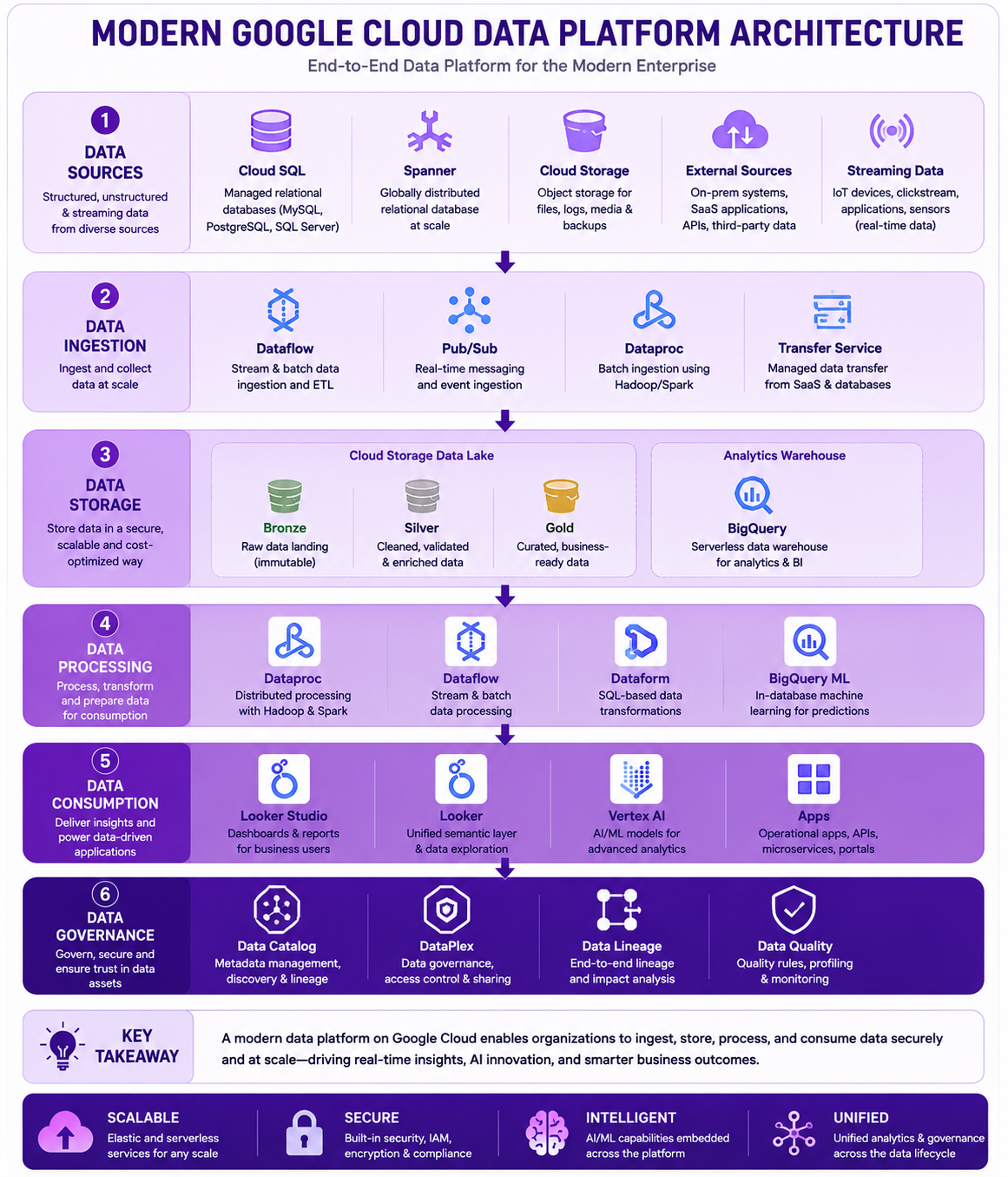
Prompt: Create a modern Google Cloud data platform architecture diagram with 6 layers from top to bottom:
Layer 1: Data Sources (Top)
- Color: Purple #F3E5F5
- Components: Cloud SQL, Spanner, Cloud Storage, External Sources, Streaming Data
Layer 2: Data Ingestion
- Color: Purple #E1BEE7
- Components: Dataflow, Pub/Sub, Dataproc, Transfer Service
Layer 3: Data Storage (Lakehouse)
- Color: Purple #CE93D8
- Components: Cloud Storage (Bronze - Raw), BigQuery (Silver - Processed), BigQuery (Gold - Curated), BigQuery (Serving)
Layer 4: Data Processing
- Color: Purple #AB47BC
- Components: Dataproc, Dataflow, DLT (Dataform), BigQuery ML
Layer 5: Data Consumption
- Color: Purple #7B1FA2
- Components: Looker Studio, Looker, Vertex AI, Apps
Layer 6: Data Governance (Bottom)
- Color: Purple #4A148C
- Components: Data Catalog, DataPlex, Data Lineage, Data Quality
Use downward arrows between layers. Include key takeaway and footer tags: Scalable, Secure, Intelligent, Unified. Enterprise-style clean layout with rounded corners.
Data Platform Evolution Drivers
| Driver | Impact |
|---|---|
| Data Volume Growth | Petabytes to Exabytes of data |
| Data Velocity | Real-time processing requirements |
| Data Variety | Structured, semi-structured, unstructured |
| AI/ML Adoption | Data must be ML-ready |
| Cloud Economics | Pay-as-you-go, no CAPEX |
| Regulatory Compliance | GDPR, CCPA, Basel III |
| Business Agility | Faster time-to-insight |
Modern Data Platform Components
1. Data Integration
- Batch ETL/ELT (Dataflow, Dataproc)
- Real-time streaming (Pub/Sub, Kafka)
- Change Data Capture (Debezium)
- API Integration
2. Data Storage
- Data Lake (Cloud Storage, GCS)
- Data Warehouse (BigQuery)
- Lakehouse (Delta Lake, Iceberg)
- Vector Databases
- Graph Databases
3. Data Processing
- Batch processing (Spark, Dataflow)
- Stream processing (Dataflow, Flink)
- Machine Learning (Vertex AI)
- Semantic Search
4. Data Governance
- Data Catalog
- Data Quality
- Data Lineage
- Access Control
- Compliance
5. Data Consumption
- Business Intelligence (Looker, Tableau)
- Data Science (Vertex AI Notebooks)
- Applications (APIs)
- RAG Applications
Banking Industry Example
Digital Banking Data Platform
├── Customer Domain
│   ├── Customer Profile Data
│   ├── Customer Relationship Data
│   └── Customer Behavior Data
├── Account Domain
│   ├── Account Balances
│   ├── Account Transactions
│   └── Account History
├── Transaction Domain
│   ├── Payment Processing
│   ├── Fraud Detection
│   └── Transaction Analytics
├── Loan Domain
│   ├── Loan Origination
│   ├── Loan Servicing
│   └── Risk Analytics
└── Analytics & AI
    ├── Customer 360
    ├── Risk Management
    ├── Fraud Detection
    └── Personalization
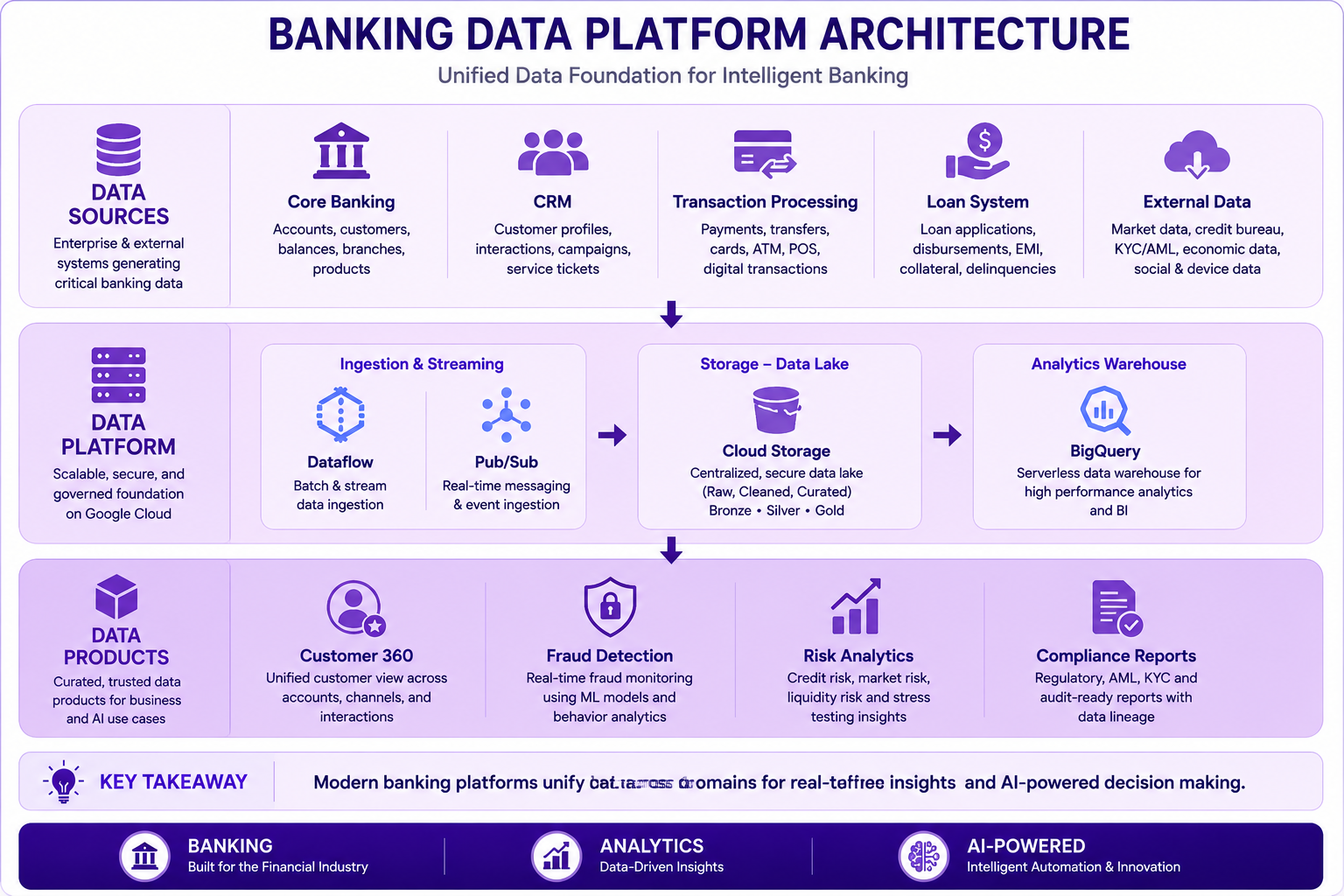
Prompt: Create a banking data platform architecture diagram showing:
Top Layer: Data Sources (Enterprise Systems)
- Core Banking, CRM, Transaction Processing, Loan System, External Data
- Color: Purple #F3E5F5
Middle Layer: Data Platform (GCP Services)
- Dataflow/Pub/Sub, Cloud Storage (Data Lake), BigQuery (Data Warehouse)
- Color: Purple #E1BEE7
Bottom Layer: Data Products (Analytical)
- Customer 360, Fraud Detection, Risk Analytics, Compliance Reports
- Color: Purple #CE93D8
Add flow arrows from top to bottom. Include key takeaway at bottom: "Modern banking platforms unify data across domains for real-time insights and AI-powered decision making." Enterprise-style clean layout.
Benefits of Modern Data Platforms
| Benefit | Description |
|---|---|
| Real-time Insights | Data available as events occur |
| Scalable | Handle petabytes of data cost-effectively |
| Unified View | Single source of truth (e.g., Customer 360) |
| AI/ML Ready | Features and vectors for AI applications |
| Governance | Data quality, lineage, and compliance |
| Cost Optimization | Pay only for what you use |
| Agility | Respond quickly to business needs |
| Innovation | Enable new data-driven use cases |
Challenges of Modern Data Platforms
| Challenge | Mitigation |
|---|---|
| Complexity | Simplify with managed services |
| Skill Gap | Training and hiring strategies |
| Data Quality | Implement data quality frameworks |
| Cost Management | Monitor and optimize usage |
| Security | Implement least-privilege access |
| Change Management | Organizational adoption strategy |
| Integration | Use APIs and connectors |
| Governance | Establish clear policies |
What Makes a Good Data Platform?
Scalable
- Handle growing data volumes
- Process data at any velocity
- Support future business requirements
Resilient
- Fault-tolerant architecture
- Data replication and backup
- Disaster recovery capabilities
Secure
- Data encryption at rest and in transit
- Fine-grained access control
- Auditing and compliance
Cost-Effective
- Optimized storage
- Pay-as-you-go pricing
- Resource auto-scaling
Governance-Friendly
- Data lineage
- Data quality
- Regulatory compliance
- Data catalog
AI in Modern Data Platforms
Modern data platforms increasingly leverage AI and machine learning:
Feature Stores
- Central repository for ML features
- Feature versioning
- Point-in-time correctness
- Real-time feature serving
Vector Databases
- Store embeddings
- Semantic search
- Similarity search
- RAG applications
Knowledge Graphs
- Entity relationships
- Contextual understanding
- Graph analytics
- Risk detection
AI-Powered Data Management
- Automated schema detection
- Intelligent data partitioning
- AI-driven optimization
- Self-healing pipelines
Our Tutorial Platform
Throughout this tutorial, we will progressively build:
Digital Banking Data Platform
Core Data Domains:
Customer Domain
Account Domain
Transaction Domain
Loan Domain
Analytics & AI Domain
In upcoming chapters, these domains will become:
- Conceptual Data Models
- Logical Data Models
- Physical Implementations
- BigQuery Tables
- ETL Pipelines
- Analytics Dashboards
- AI/ML Models
Best Practices
| # | Best Practice |
|---|---|
| 1 | Start with business requirements, not technology |
| 2 | Design for scalability from day one |
| 3 | Implement proper data governance early |
| 4 | Use the right storage for the right use case |
| 5 | Automate data quality checks |
| 6 | Monitor and optimize costs |
| 7 | Document architecture decisions |
| 8 | Implement security by design |
| 9 | Use managed services when possible |
| 10 | Plan for evolution and change |
Common Mistakes
| # | Common Mistake | Better Approach |
|---|---|---|
| 1 | Building for today only | Design for future needs |
| 2 | Ignoring cloud economics | Optimize for cost |
| 3 | Over-engineering | Start simple, evolve |
| 4 | No governance | Implement from day one |
| 5 | Ignoring data quality | Build quality checks |
| 6 | Technology-first approach | Business-first approach |
| 7 | Not understanding use cases | Align with business needs |
| 8 | Manual processes | Automate where possible |
| 9 | No monitoring | Implement observability |
| 10 | Forgetting about people | Invest in training |
Interview Questions
-
What is an enterprise data platform?
-
Explain the evolution of data platforms from silos to AI-ready.
-
What is the difference between a data lake and a data warehouse?
-
What is a lakehouse architecture?
-
What are the key components of a modern data platform?
-
What is the role of Google Cloud in modern data platforms?
-
How do modern data platforms support AI/ML?
-
What is the difference between structured, semi-structured, and unstructured data?
-
Explain the importance of data governance.
-
How do cloud data platforms compare to on-premise solutions?
-
What are the key drivers of data platform evolution?
-
How do modern data platforms enable digital transformation?
Practice Exercises
-
Identify five data sources in your organization and classify them by type:
- OLTP systems
- OLAP systems
- Semi-structured data
- Unstructured data
-
Draw a high-level architecture diagram of your organization's current data platform.
-
Identify three pain points with your current data platform.
-
List the technologies used in your organization's data platform.
-
Propose a modern data platform architecture for a specific use case in your organization.
Key Takeaways
- Enterprise data platforms have evolved significantly over decades
- Modern platforms support all data types and real-time processing
- Lakehouse combines the best of data lakes and warehouses
- Google Cloud provides a comprehensive data platform
- AI/ML capabilities are becoming central to data platforms
- Data governance and quality are critical for success
- Cost optimization is essential for cloud platforms
- The right architecture balances many competing priorities
Chapter Summary
In this chapter, you learned:
- What enterprise data platforms are
- Evolution from data silos to AI-ready platforms
- Differences between data lakes, warehouses, and lakehouses
- Google Cloud's data platform architecture
- Banking industry data platform example
- Benefits and challenges of modern platforms
- Best practices and common mistakes
- Key components of modern data platforms
You now have the foundation required to start designing modern enterprise data platforms.
Next Chapter
👉 Next Chapter: OLTP, OLAP, HTAP and Modern Analytics