
Chapter 08: Change Data Capture (CDC)
In the previous chapter, we explored Medallion architecture and learned how to progressively refine data from raw to business-ready across Bronze, Silver, and Gold layers.
In this chapter, we will dive into Change Data Capture (CDC), understand how to capture and process real-time data changes, and implement CDC pipelines for streaming analytics on Google Cloud.
Using our Digital Banking Platform case study, we will implement CDC to enable real-time fraud detection, customer 360 updates, and regulatory reporting.
🎯 Learning Objectives
By the end of this chapter, you will be able to:
- Understand what Change Data Capture is and why it matters
- Explain different CDC methods and approaches
- Implement CDC using Debezium and Datastream
- Design CDC pipelines on Google Cloud
- Process CDC events with Dataflow and Pub/Sub
- Understand event ordering and deduplication
- Handle schema evolution
- Apply best practices for CDC implementation
- Implement CDC for banking use cases
What is Change Data Capture?
Change Data Capture (CDC) is a technique for capturing and streaming changes made to a database in real-time.
CDC = Capture changes + Stream changes + Process changes
Think of CDC as:
- Database change log as a stream
- Real-time data replication
- Event-driven architecture
- Continuous data synchronization
Real-World Banking Example
A bank needs to detect fraud in real-time:
Traditional Approach (Batch):
Transaction occurs → Daily batch → Fraud detection → Next day
Fraud detected too late!

CDC Approach (Real-time):
Transaction occurs → CDC captures change → Stream processes → Real-time detection
Fraud detected immediately!
CDC Use Cases
Banking Use Cases
1. Real-time Fraud Detection
   - Monitor transactions as they occur
   - Immediate fraud flagging
   - Block suspicious activities

2. Customer 360 Updates
   - Update customer profiles in real-time
   - Sync across systems
   - Consistent view

3. Regulatory Compliance
   - Real-time AML monitoring
   - Immediate reporting
   - Audit trail

4. Operational Analytics
   - Real-time dashboards
   - Live metrics
   - Instant insights

5. Data Replication
   - Sync across regions
   - Disaster recovery
   - Multi-cloud
Cross-Industry Use Cases
- E-commerce: Real-time inventory updates
- Healthcare: Patient record synchronization
- Retail: Supply chain visibility
- Manufacturing: IoT data integration
- Telecommunications: Usage monitoring
CDC Methods
Log-Based CDC
Method: Read database transaction logs
Tools: Debezium, Oracle GoldenGate, AWS DMS
Characteristics:
- Low impact on source
- No schema changes needed
- Captures all changes
- Supports rollback

Banking Example:
- Read PostgreSQL WAL logs
- Stream to Pub/Sub
- Process with Dataflow
Trigger-Based CDC
Method: Database triggers capture changes
Tools: Custom implementations
Characteristics:
- High impact on source
- Requires schema changes
- Fine-grained control
- Custom logic possible

Banking Example:
- Triggers on transaction table
- Write to audit table
- Stream to analytics
Query-Based CDC
Method: Periodic queries for changes
Tools: Apache Sqoop, Custom scripts
Characteristics:
- Higher latency
- Lower complexity
- Good for batch
- Resource intensive

Banking Example:
- Hourly query for new records
- Incremental extraction
- Batch processing
CDC Method Comparison
| Aspect | Log-Based | Trigger-Based | Query-Based |
|---|---|---|---|
| Performance Impact | Low | High | Medium |
| Latency | Real-time | Real-time | Batch |
| Schema Changes | None Required | Required | None Required |
| Change Capture | All Changes | Custom | Incremental |
| Complexity | High | Medium | Low |
| Scalability | High | Medium | High |
| Cost | Low | Medium | Low |
| Use Case | Real-time | Custom Logic | Batch |
CDC Architecture on Google Cloud
Core Components
1. Source Database
   - Cloud SQL (PostgreSQL, MySQL)
   - Cloud Spanner
   - AlloyDB
   - On-premise databases

2. CDC Tool
   - Datastream (Google Cloud)
   - Debezium (Open Source)
   - Striim (Partner)

3. Messaging
   - Cloud Pub/Sub
   - Apache Kafka

4. Processing
   - Cloud Dataflow
   - Cloud Dataproc

5. Storage
   - BigQuery
   - Cloud Storage
   - Delta Lake
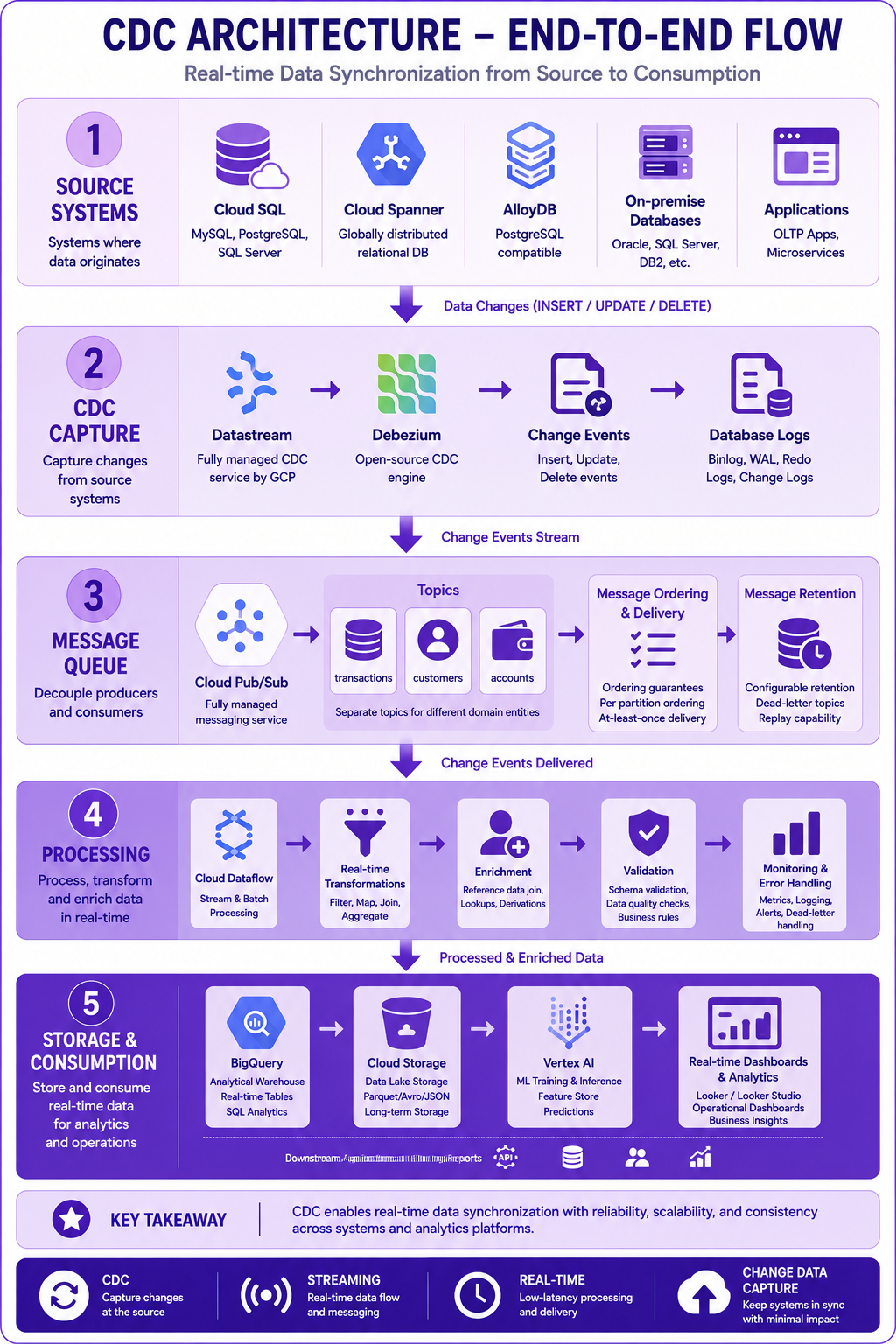
Prompt: Create a comprehensive CDC architecture diagram showing end-to-end flow. Use a 5-layer structure with purple gradient theme:
Layer 1: Source Systems (Top) - Purple #F3E5F5
- Cloud SQL (PostgreSQL/MySQL)
- Cloud Spanner
- AlloyDB
- On-premise Databases
- Applications
- Use database/server icons
Layer 2: CDC Capture - Purple #E1BEE7
- Datastream (Google Cloud)
- Debezium (Open Source)
- Change Events
- Database Logs (WAL, Binlog)
- Use capture/stream icons
Layer 3: Message Queue - Purple #CE93D8
- Cloud Pub/Sub
- Topics: transactions, customers, accounts
- Message Ordering
- Message Retention
- Use queue/message icons
Layer 4: Processing - Purple #AB47BC
- Cloud Dataflow (Streaming)
- Real-time Transformations
- Enrichment
- Validation
- Use processing/flow icons
Layer 5: Storage & Consumption (Bottom) - Purple #7B1FA2
- BigQuery (Analytics)
- Cloud Storage (Archive)
- Vertex AI (ML)
- Real-time Dashboards
- Use storage/analytics icons
Use downward arrows between layers. Include data flow labels and key takeaways. Footer tags: CDC, Streaming, Real-time, Change Data Capture. Enterprise-style clean layout with rounded corners and consistent iconography.
Google Cloud Datastream
Overview
Datastream is Google Cloud's fully managed CDC service.
Purpose: Capture changes from databases in real-time
Features:
- Serverless
- Change data capture
- Schema evolution support
- Multiple sources
- Exactly-once delivery
- Low latency
Supported Sources
Databases:
- Cloud SQL for MySQL
- Cloud SQL for PostgreSQL
- Cloud SQL for SQL Server
- AlloyDB
- Oracle (via connector)

Destinations:
- Cloud Storage
- BigQuery
- Cloud Pub/Sub
Datastream Configuration
# Datastream Configuration Example
datastream_stream:
  name: "banking-transactions-stream"
  source:
    type: "mysql"
    connection: "mysql-source-connection"
    database: "banking_db"
    tables:
      - "transactions"
      - "customers"
      - "accounts"
  destination:
    type: "bigquery"
    dataset: "banking_bronze"
  backfill:
    enabled: true
    parallelism: 16
    max_parallel_workers: 10
  schedule:
    frequency: "realtime"
Debezium CDC
Overview
Debezium is a distributed CDC platform.
Purpose: Stream database changes to Apache Kafka
Features:
- Open source
- Multiple database support
- Exactly-once semantics
- Schema evolution
- Community supported
Debezium with Google Cloud
# Debezium PostgreSQL Connector
{
  "name": "banking-pg-connector",
  "config": {
    "connector.class": "io.debezium.connector.postgresql.PostgresConnector",
    "database.hostname": "banking-postgres",
    "database.port": "5432",
    "database.user": "debezium",
    "database.password": "password",
    "database.dbname": "banking_db",
    "database.server.name": "banking",
    "table.include.list": "public.transactions,public.customers",
    "plugin.name": "pgoutput",
    "publication.autocreate.mode": "filtered",
    "slot.name": "banking_slot"
  }
}

# Debezium to Pub/Sub
- Debezium → Kafka → Kafka to Pub/Sub connector → Cloud Pub/Sub → Dataflow
CDC Data Processing with Dataflow
Real-time Processing Pipeline
// Dataflow pipeline for CDC processing
public class CDCPipeline {

  public static void main(String[] args) {

    Pipeline pipeline = Pipeline.create(options);

    // 1. Read from Pub/Sub
    PCollection<String> cdcEvents = pipeline
      .apply("Read from Pub/Sub",
        PubsubIO.readStrings()
          .fromSubscription("projects/banking/subscriptions/cdc-subscription"));

    // 2. Parse CDC events
    PCollection<Transaction> transactions = cdcEvents
      .apply("Parse CDC Events",
        ParDo.of(new ParseCDCEventFn()));

    // 3. Enrich transactions
    PCollection<EnrichedTransaction> enriched = transactions
      .apply("Enrich Data",
        ParDo.of(new EnrichmentFn()));

    // 4. Validate transactions
    PCollection<ValidatedTransaction> validated = enriched
      .apply("Validate",
        ParDo.of(new ValidationFn()));

    // 5. Write to BigQuery
    validated
      .apply("Write to BigQuery",
        BigQueryIO.writeTableRows()
          .to("banking.silver_transactions")
          .withWriteDisposition(WriteDisposition.WRITE_APPEND));

    pipeline.run();
  }
}
Event Ordering and Deduplication
Challenges
CDC Event Challenges:
1. Out-of-order events
2. Duplicate events
3. Late-arriving events
4. Schema evolution
5. Backfill events
Solutions
-- Handling duplicates with row number
CREATE OR REPLACE TABLE banking.silver_transactions AS
SELECT
  * EXCEPT(row_num)
FROM (
  SELECT
    *,
    ROW_NUMBER() OVER (
      PARTITION BY transaction_id
      ORDER BY event_timestamp DESC
    ) AS row_num
  FROM banking.bronze_transactions
)
WHERE row_num = 1;

-- Handling out-of-order with window functions
SELECT
  transaction_id,
  customer_id,
  transaction_amount,
  LAST_VALUE(transaction_amount) OVER (
    PARTITION BY transaction_id
    ORDER BY event_timestamp
    ROWS BETWEEN UNBOUNDED PRECEDING AND UNBOUNDED FOLLOWING
  ) AS final_amount
FROM banking.bronze_transactions;
Schema Evolution
Handling Schema Changes
-- Schema evolution example
-- Original schema
CREATE TABLE banking.silver_transactions (
  transaction_id STRING,
  customer_id INT64,
  transaction_amount NUMERIC,
  transaction_date DATE
);

-- Add new column (works with CDC)
ALTER TABLE banking.silver_transactions
ADD COLUMN merchant_category STRING;

-- Handle missing data for existing records
UPDATE banking.silver_transactions
SET merchant_category = 'UNKNOWN'
WHERE merchant_category IS NULL;
CDC Schema Evolution Strategies
| Strategy | Description | Use Case |
|---|---|---|
| Backward Compatibility | New columns optional | Safe evolution |
| Forward Compatibility | Handle missing columns | Safe read |
| Schema Registry | Versioned schemas | Enterprise use |
| Late Binding | Apply schema at read | Flexibility |
| Continuous Evolution | Incremental changes | Agility |
CDC Best Practices
| # | Best Practice |
|---|---|
| 1 | Start with a clear business case for real-time |
| 2 | Choose the right CDC method for your use case |
| 3 | Use managed services when possible |
| 4 | Handle schema evolution from day one |
| 5 | Implement event ordering and deduplication |
| 6 | Monitor CDC pipeline health |
| 7 | Plan for backfill scenarios |
| 8 | Secure CDC infrastructure |
| 9 | Test CDC failover scenarios |
| 10 | Document CDC data flow |
CDC Implementation Example
Banking CDC Pipeline
-- 1. Source table (Cloud SQL)
CREATE TABLE banking_db.transactions (
  transaction_id VARCHAR(36) PRIMARY KEY,
  customer_id VARCHAR(36),
  account_id VARCHAR(36),
  transaction_amount DECIMAL(15,2),
  transaction_type VARCHAR(50),
  transaction_date TIMESTAMP,
  created_at TIMESTAMP,
  updated_at TIMESTAMP
);

-- 2. CDC captures changes and streams to Pub/Sub

-- 3. Dataflow processes and writes to BigQuery

-- 4. Bronze layer in BigQuery
CREATE OR REPLACE TABLE banking.bronze_transactions
PARTITION BY DATE(transaction_date)
AS
SELECT
  transaction_id,
  customer_id,
  account_id,
  transaction_amount,
  transaction_type,
  transaction_date,
  -- Add CDC metadata
  _event_timestamp AS cdc_timestamp,
  _event_type AS cdc_operation,
  CURRENT_TIMESTAMP() AS ingested_at
FROM cdc_stream;

-- 5. Silver layer with quality checks
CREATE OR REPLACE TABLE banking.silver_transactions
PARTITION BY DATE(transaction_date)
CLUSTER BY customer_id
AS
SELECT
  transaction_id,
  customer_id,
  account_id,
  transaction_amount,
  transaction_type,
  transaction_date,
  -- Quality flags
  CASE
    WHEN transaction_amount > 0
      AND transaction_date IS NOT NULL
      AND customer_id IS NOT NULL
    THEN 'VALID'
    ELSE 'INVALID'
  END AS data_quality_status
FROM banking.bronze_transactions
WHERE ROW_NUMBER() OVER (
  PARTITION BY transaction_id
  ORDER BY cdc_timestamp DESC
) = 1;  -- Deduplicate
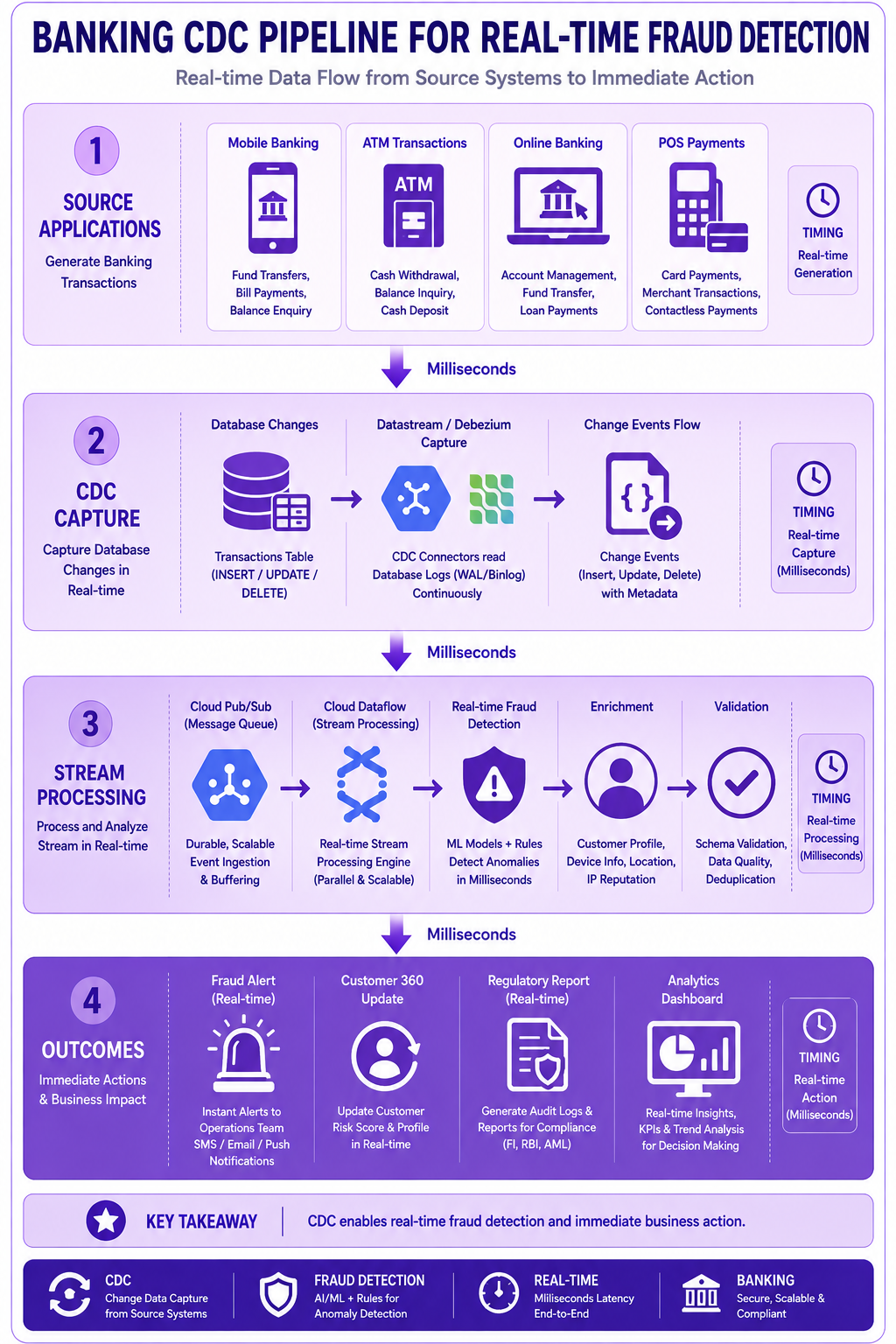
Prompt: Create a banking CDC pipeline diagram showing real-time fraud detection. Use a 4-layer structure with purple gradient theme:
Layer 1: Source Applications (Top) - Purple #F3E5F5
- Mobile Banking, ATM Transactions, Online Banking, POS Payments
- With app icons showing transaction generation
Layer 2: CDC Capture - Purple #E1BEE7
- Database Changes (Transactions Table)
- Datastream/Debezium Capture
- Change Events Flow
- "Real-time Capture"
Layer 3: Stream Processing - Purple #CE93D8
- Cloud Pub/Sub (Message Queue)
- Cloud Dataflow (Stream Processing)
- Real-time Fraud Detection, Enrichment, Validation
- "Real-time Processing"
Layer 4: Outcomes (Bottom) - Purple #AB47BC
- Fraud Alert (Real-time), Customer 360 Update, Regulatory Report, Analytics Dashboard
- With outcome icons
Use downward arrows showing flow. Include timing labels (Milliseconds). At bottom: Key takeaway: "CDC enables real-time fraud detection and immediate business action." Footer tags: CDC, Fraud Detection, Real-time, Banking. Enterprise-style clean layout with rounded corners.
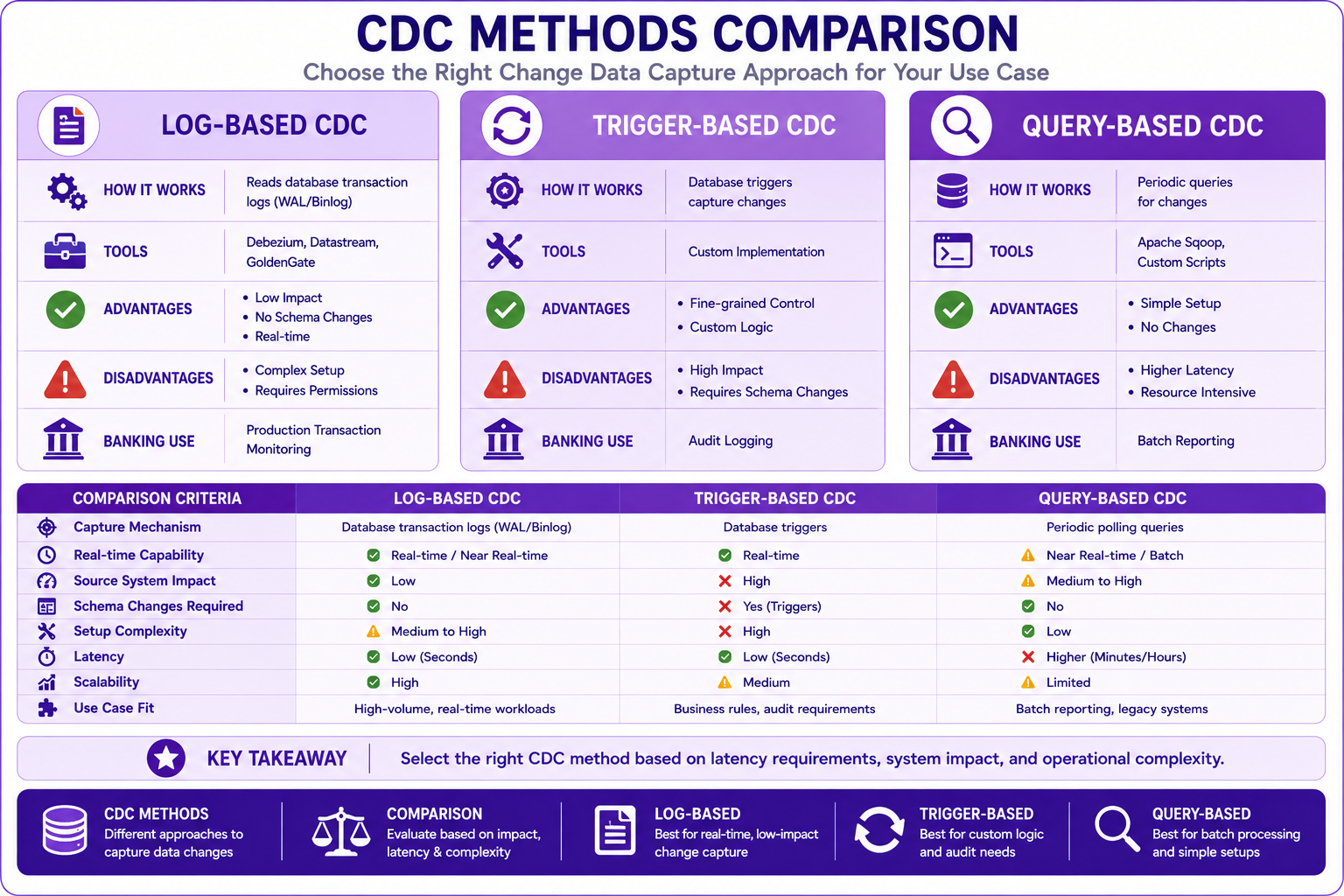
Prompt: Create a CDC methods comparison diagram showing Log-Based, Trigger-Based, and Query-Based approaches. Use a 3-column structure with purple gradient theme:
Column 1: Log-Based CDC (Left) - Purple #E1BEE7
- Title: "Log-Based CDC"
- Icon: 📝
- How it works: "Reads database transaction logs (WAL/Binlog)"
- Tools: "Debezium, Datastream, GoldenGate"
- Advantages: "Low Impact, No Schema Changes, Real-time"
- Disadvantages: "Complex Setup, Requires Permissions"
- Banking Use: "Production Transaction Monitoring"
Column 2: Trigger-Based CDC (Middle) - Purple #CE93D8
- Title: "Trigger-Based CDC"
- Icon: 🔄
- How it works: "Database triggers capture changes"
- Tools: "Custom Implementation"
- Advantages: "Fine-grained Control, Custom Logic"
- Disadvantages: "High Impact, Requires Schema Changes"
- Banking Use: "Audit Logging"
Column 3: Query-Based CDC (Right) - Purple #AB47BC
- Title: "Query-Based CDC"
- Icon: 🔍
- How it works: "Periodic queries for changes"
- Tools: "Apache Sqoop, Custom Scripts"
- Advantages: "Simple Setup, No Changes"
- Disadvantages: "Higher Latency, Resource Intensive"
- Banking Use: "Batch Reporting"
At bottom: Comparison matrix with key differences. Footer tags: CDC Methods, Comparison, Log-Based, Trigger-Based, Query-Based. Enterprise-style clean layout with rounded corners.
Common Mistakes
| # | Common Mistake | Better Approach |
|---|---|---|
| 1 | Ignoring schema evolution | Plan for schema changes |
| 2 | No event ordering | Implement ordering |
| 3 | Duplicate events | Deduplicate |
| 4 | No monitoring | Implement monitoring |
| 5 | Batch-only mindset | Design for streaming |
| 6 | No backfill planning | Plan backfill strategy |
| 7 | Ignoring security | Secure CDC pipeline |
| 8 | No fallback plan | Have fallback strategy |
| 9 | Over-engineering | Start simple |
| 10 | No documentation | Document thoroughly |
Interview Questions
-
What is Change Data Capture (CDC)?
-
What are the different CDC methods?
-
How does log-based CDC work?
-
What is Google Cloud Datastream?
-
What is Debezium and how does it work?
-
How do you handle event ordering in CDC?
-
How do you handle duplicate events?
-
What is schema evolution in CDC?
-
How do you implement CDC on Google Cloud?
-
What are the benefits of CDC over batch ETL?
-
How do you handle CDC failures?
-
What are the challenges of CDC implementation?
Practice Exercises
-
Set up Datastream for a Cloud SQL PostgreSQL database.
-
Configure a CDC pipeline from Cloud SQL to Pub/Sub.
-
Create a Dataflow pipeline to process CDC events.
-
Implement event deduplication in Dataflow.
-
Handle schema evolution in your CDC pipeline.
-
Monitor CDC pipeline health and latency.
-
Implement a backfill strategy.
-
Create a real-time fraud detection pipeline.
-
Design a failover strategy for CDC.
-
Implement data quality checks in CDC pipeline.
Key Takeaways
| # | Takeaway |
|---|---|
| 1 | CDC enables real-time data integration |
| 2 | Different CDC methods serve different needs |
| 3 | Log-based CDC is preferred for production |
| 4 | Google Cloud provides managed CDC solutions |
| 5 | Schema evolution must be handled |
| 6 | Event ordering and deduplication are critical |
| 7 | Monitoring is essential for CDC pipelines |
| 8 | CDC enables real-time analytics and AI |
Chapter Summary
In this chapter, you learned:
- ✅ What Change Data Capture is and why it matters
- ✅ Different CDC methods (Log-Based, Trigger-Based, Query-Based)
- ✅ Google Cloud Datastream
- ✅ Debezium CDC
- ✅ CDC architecture on Google Cloud
- ✅ Event ordering and deduplication
- ✅ Schema evolution strategies
- ✅ CDC for fraud detection
- ✅ Best practices and common mistakes
You now understand how to implement CDC pipelines for real-time data integration and analytics.
Next Chapter
👉 Next Chapter: Modern Normalization