
Chapter 21: Introduction to Graph Databases
In the previous chapter, we explored streaming and event modeling and learned how to design data models for real-time processing and event-driven architectures.
In this chapter, we will dive into Graph Databases—understanding their unique approach to data modeling, when to use them, and how they complement traditional relational and analytical models.
Using our Digital Banking Platform case study, we will explore how graph databases can model complex relationships, detect fraud rings, and power recommendation engines.
🎯 Learning Objectives
By the end of this chapter, you will be able to:
- Understand graph databases and their purpose
- Differentiate graph databases from relational databases
- Recognize when to use graph vs relational approaches
- Understand property graph and RDF graph models
- Identify graph use cases in banking
- Understand Google Cloud's graph capabilities
- Apply graph database best practices
- Design banking graph models
What is a Graph Database?
A graph database is a NoSQL database designed to treat relationships between data as equally important as the data itself, using graph structures for semantic queries.
Graph Database = Nodes (Entities) + Edges (Relationships) + Properties (Attributes)
Think of a graph database as:
- A map of connected information
- Relationships are first-class citizens
- Traversing connections is fast and natural
- Perfect for interconnected data
Real-World Banking Example
A bank needs to detect fraud rings involving multiple customers and merchants:
Relational Approach:
Customer table → Account table → Transaction table → Merchant table
Multiple joins required
Complex queries for connected fraud patterns

Graph Approach:
Customers connected to Accounts
Accounts connected to Transactions
Transactions connected to Merchants
Traverse connections naturally
Find fraud rings quickly
Graph vs Relational Databases
| Aspect | Relational Database | Graph Database |
|---|---|---|
| Data Model | Tables, rows, columns | Nodes, edges, properties |
| Relationships | Foreign keys, joins | First-class citizens |
| Query Language | SQL | Cypher, Gremlin, SPARQL |
| Performance | Good for structured data | Excellent for connected data |
| Schema | Fixed schema | Flexible schema |
| Complexity | Complex joins for deep queries | Simple traversals |
| Use Case | Transactional, reporting | Connected data, networks |
| Banking Use | Customer master | Fraud detection, recommendations |
Graph Database Models
Property Graph Model
Most common graph model
Components:
- Nodes (vertices) - Entities
- Edges (relationships) - Connections
- Properties - Attributes on nodes and edges
- Labels - Node types
- Relationship types - Edge types

Banking Example:
Node: Customer {name, age, segment}
Node: Account {type, balance}
Edge: OWNS {since_date}
Edge: TRANSACTED_WITH {amount, date}
RDF Graph Model
Resource Description Framework
Components:
- Subjects (resources)
- Predicates (properties)
- Objects (values or resources)
- Triples (subject-predicate-object)

Banking Example:
(Customer:John) - (hasAccount) -> (Account:A001)
(Account:A001) - (hasBalance) -> (15000)
Graph Database Use Cases in Banking
1. Fraud Detection
Problem: Identify complex fraud patterns
Graph Solution:
- Connect customers, accounts, transactions, merchants
- Detect money laundering rings
- Find suspicious patterns
- Identify fraud clusters

Banking Example:
- Connected fraud rings
- Money laundering detection
- Account takeover patterns
- Synthetic identity fraud
2. Customer 360
Problem: Complete view of customer relationships
Graph Solution:
- Connect customers, accounts, products
- Relationship networks
- Referral patterns
- Influencer identification

Banking Example:
- Customer relationship network
- Joint account holders
- Family connections
- Business relationships
3. Anti-Money Laundering (AML)
Problem: Detect suspicious money movements
Graph Solution:
- Track money flow patterns
- Identify suspicious structures
- Find hidden relationships
- Compliance reporting

Banking Example:
- Money laundering detection
- Beneficial ownership
- Shell company identification
- Transaction pattern analysis
4. Recommendation Systems
Problem: Suggest relevant products
Graph Solution:
- Customer preferences
- Product connections
- Similar customer segments
- Purchase patterns

Banking Example:
- Product recommendations
- Cross-selling opportunities
- Customer segment analysis
- Personalized offers
Graph Database Concepts
Nodes (Vertices)
Definition: Entities in a graph
Purpose: Store entity information
Characteristics:
- Have labels (types)
- Have properties (attributes)
- Can have multiple labels
- Unique identifiers

Banking Examples:
- Customer Node (label: Customer)
- Account Node (label: Account)
- Transaction Node (label: Transaction)
- Merchant Node (label: Merchant)
Edges (Relationships)
Definition: Connections between nodes
Purpose: Define relationships
Characteristics:
- Have types (relationship types)
- Have properties (attributes)
- Are directional or undirected
- Can connect any nodes

Banking Examples:
- OWNS (Customer → Account)
- TRANSACTED_WITH (Account → Merchant)
- PART_OF (Transaction → Account)
- REFERRED (Customer → Customer)
Properties
Definition: Attributes of nodes and edges
Purpose: Store descriptive data
Characteristics:
- Key-value pairs
- Various data types
- Flexible schema
- Can be indexed

Banking Examples:
- Customer: {name, age, segment}
- Account: {type, balance, status}
- OWNS Edge: {since_date, is_primary}
Cypher Query Language (Neo4j)
Basic Cypher Queries
-- Creating nodes
CREATE (c:Customer {
  customer_id: 'C001',
  name: 'John Doe',
  segment: 'Premium',
  age: 35
})

-- Creating relationships
MATCH (c:Customer {customer_id: 'C001'})
CREATE (a:Account {
  account_id: 'A001',
  type: 'Savings',
  balance: 15000
})
CREATE (c)-[:OWNS {since_date: '2020-01-01'}]->(a)

-- Querying nodes
MATCH (c:Customer {segment: 'Premium'})
RETURN c.name, c.age

-- Querying relationships
MATCH (c:Customer)-[:OWNS]->(a:Account)
WHERE a.balance > 10000
RETURN c.name, a.balance

-- Finding paths (Fraud Detection)
MATCH path = (c1:Customer)-[:OWNS]->(a:Account)
            -[:TRANSACTED_WITH]->(m:Merchant)
            <-[:TRANSACTED_WITH]-(a2:Account)
            <-[:OWNS]-(c2:Customer)
WHERE c1 <> c2
RETURN path
Google Cloud Graph Services
Neo4j on Google Cloud
Neo4j is a leading graph database
Available on Google Cloud Marketplace
Options:
- Neo4j Enterprise (Production)
- Neo4j Community (Development)
- Neo4j Aura (Managed cloud)

Key Features:
- ACID transactions
- Cypher query language
- High performance
- Scalable architecture
BigQuery Graph Analytics
BigQuery supports graph analytics via:
- SQL-based graph queries
- Recursive CTEs
- Graph algorithms
- Integration with third-party tools

Example: Graph analysis in BigQuery
WITH RECURSIVE customer_network AS (
  SELECT customer_id, name, 1 AS depth
  FROM customers
  WHERE customer_id = 'C001'
  UNION ALL
  SELECT c.customer_id, c.name, n.depth + 1
  FROM customers c
  JOIN customer_relationships r ON c.customer_id = r.related_customer_id
  JOIN customer_network n ON r.customer_id = n.customer_id
  WHERE n.depth < 3
)
SELECT * FROM customer_network;
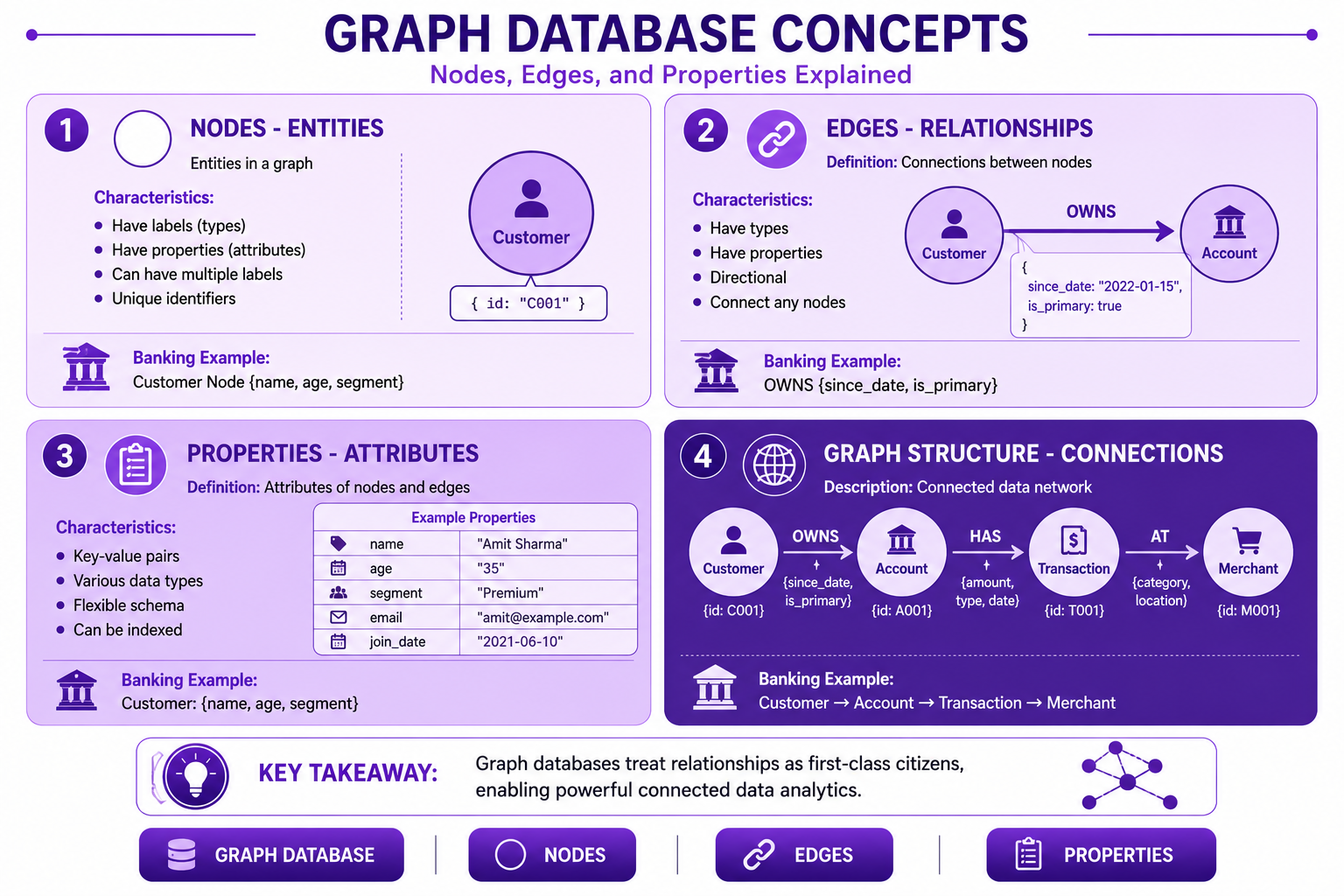
Prompt: Create a graph database concepts diagram showing nodes, edges, and properties. Use a 4-section structure with purple gradient theme:
Section 1: Nodes (Top Left) - Purple #E1BEE7
- Title: "Nodes - Entities"
- Icon: ⚪
- Definition: "Entities in a graph"
- Characteristics: Have labels (types), Have properties (attributes), Can have multiple labels, Unique identifiers
- Banking Example: "Customer Node {name, age, segment}"
- Visual: Circle with label "Customer"
Section 2: Edges (Top Right) - Purple #CE93D8
- Title: "Edges - Relationships"
- Icon: 🔗
- Definition: "Connections between nodes"
- Characteristics: Have types, Have properties, Directional, Connect any nodes
- Banking Example: "OWNS {since_date, is_primary}"
- Visual: Arrow connecting two nodes
Section 3: Properties (Bottom Left) - Purple #AB47BC
- Title: "Properties - Attributes"
- Icon: 📋
- Definition: "Attributes of nodes and edges"
- Characteristics: Key-value pairs, Various data types, Flexible schema, Can be indexed
- Banking Example: "Customer: {name, age, segment}"
- Visual: Property list with key-value pairs
Section 4: Graph Structure (Bottom Right) - Purple #7B1FA2
- Title: "Graph Structure - Connections"
- Icon: 🌐
- Description: "Connected data network"
- Visual: Network of connected nodes
- Banking Example: "Customer → Account → Transaction → Merchant"
At bottom: Key takeaway: "Graph databases treat relationships as first-class citizens, enabling powerful connected data analytics." Footer tags: Graph Database, Nodes, Edges, Properties. Enterprise-style clean layout with rounded corners.
Graph Modeling Patterns
Pattern 1: Simple Relationship
-- Customer owns Account
(Customer) -[:OWNS]-> (Account)
Pattern 2: Path with Multiple Relationships
-- Customer → Account → Transaction → Merchant
(Customer) -[:OWNS]-> (Account)
          -[:HAS_TRANSACTION]-> (Transaction)
          -[:WITH_MERCHANT]-> (Merchant)
Pattern 3: Relationship with Properties
-- Account Transaction with Amount
(Account) -[:TRANSACTED {amount: 1500, date: '2024-01-15'}]-> (Merchant)
Pattern 4: Hierarchical Structure
-- Organization hierarchy
(Branch) -[:PART_OF]-> (Region) -[:PART_OF]-> (Bank)
Pattern 5: Network Structure
-- Customer network
(Customer) -[:REFERRED]-> (Customer)
           -[:FAMILY_OF]-> (Customer)
           -[:BUSINESS_PARTNER_OF]-> (Customer)
Banking Graph Data Model
Complete Banking Graph Model
-- Create Nodes
CREATE (c:Customer {
  customer_id: 'C001',
  name: 'John Doe',
  email: 'john@email.com',
  segment: 'Premium',
  risk_score: 0.15
})

CREATE (a:Account {
  account_id: 'A001',
  type: 'Savings',
  balance: 15000.00,
  status: 'Active'
})

CREATE (t:Transaction {
  transaction_id: 'TXN001',
  amount: 1500.00,
  date: '2024-01-15',
  type: 'Purchase'
})

CREATE (m:Merchant {
  merchant_id: 'M001',
  name: 'Amazon',
  category: 'Retail'
})

CREATE (b:Branch {
  branch_id: 'B001',
  name: 'Downtown Branch',
  region: 'Northeast'
})

-- Create Relationships
CREATE (c)-[:OWNS {
  since_date: '2020-01-01',
  is_primary: true
}]->(a)

CREATE (a)-[:TRANSACTED {
  amount: 1500.00,
  date: '2024-01-15',
  type: 'Purchase'
}]->(t)

CREATE (t)-[:WITH_MERCHANT]->(m)

CREATE (c)-[:ASSOCIATED_WITH {
  relationship_type: 'Primary'
}]->(b)

-- Fraud Detection Query
MATCH (c1:Customer)-[:OWNS]->(a1:Account)
      -[:TRANSACTED]->(t:Transaction)
      -[:WITH_MERCHANT]->(m:Merchant)
      <-[:WITH_MERCHANT]-(t2:Transaction)
      <-[:TRANSACTED]-(a2:Account)
      <-[:OWNS]-(c2:Customer)
WHERE c1 <> c2
  AND t.date >= '2024-01-01'
RETURN c1.name, c2.name, m.name, t.amount, t2.amount
Graph vs Relational Decision Framework
When to Use Graph Databases
✅ Connected data is central
✅ Relationships are the focus
✅ Queries involve traversals
✅ Schema evolves frequently
✅ Performance on connected queries matters
✅ Complex relationship patterns need detection
✅ Data is highly interconnected

Banking Examples:
- Fraud detection networks
- Customer relationship networks
- Money laundering detection
- Recommendation engines
When Not to Use Graph Databases
❌ Simple data without complex relationships
❌ Mostly transactional workloads
❌ Data is not highly connected
❌ Need for complex aggregations
❌ Team lacks graph expertise

Banking Examples:
- Core banking transactions
- Simple CRUD operations
- Reporting and BI (use relational)
- Archival data
Hybrid Approach
Use Both When:
- Need transaction processing and relationship analytics
- Want best of both worlds
- Can replicate data between systems

Banking Example:
- Relational: Core banking, transactions
- Graph: Fraud detection, recommendations
- Sync between systems as needed
Graph Database Best Practices
| # | Best Practice | Banking Example |
|---|---|---|
| 1 | Model relationships first | Relationship-centric design |
| 2 | Use descriptive relationship types | OWNS, TRANSACTED_WITH |
| 3 | Keep node properties focused | Customer attributes only |
| 4 | Use indexes for frequent queries | customer_id index |
| 5 | Denormalize when needed | Pre-compute paths |
| 6 | Plan for graph evolution | Flexible schema |
| 7 | Use appropriate graph algorithms | PageRank for influence |
| 8 | Monitor query performance | Profile complex queries |
| 9 | Document graph model | Visual graph diagrams |
| 10 | Implement data quality checks | Validate graph structure |
Common Mistakes
| # | Common Mistake | Better Approach |
|---|---|---|
| 1 | Treating graph like relational | Embrace graph thinking |
| 2 | Over-normalizing relationships | Keep relationships simple |
| 3 | No indexes on key properties | Index frequently queried |
| 4 | Complex node properties | Keep focused |
| 5 | Ignoring relationship direction | Use meaningful direction |
| 6 | Not modeling relationships | Model them explicitly |
| 7 | No data quality checks | Validate graph integrity |
| 8 | Using graph for simple data | Use relational instead |
| 9 | Not documenting model | Document thoroughly |
| 10 | Ignoring performance | Profile and optimize |
Interview Questions
-
What is a graph database?
-
How does a graph database differ from a relational database?
-
What are the key components of a graph database?
-
What is a property graph?
-
What is an RDF graph?
-
What is Cypher query language?
-
When would you use a graph database vs a relational database?
-
What are graph use cases in banking?
-
What is the difference between nodes and edges?
-
How do you model relationships in a graph?
-
What is the role of Neo4j in graph databases?
-
How does Google Cloud support graph databases?
Practice Exercises
-
Design a graph model for banking relationships.
-
Create nodes for customers, accounts, and merchants.
-
Define relationships between nodes.
-
Write Cypher queries to find customer connections.
-
Model a fraud detection graph.
-
Query customer relationship networks.
-
Implement a recommendation graph.
-
Use graph algorithms for fraud detection.
-
Model money laundering patterns.
-
Integrate graph data with BigQuery.
Key Takeaways
| # | Takeaway |
|---|---|
| 1 | Graph databases excel at connected data |
| 2 | Relationships are first-class citizens |
| 3 | Nodes are entities, edges are relationships |
| 4 | Properties provide context |
| 5 | Cypher is the query language for Neo4j |
| 6 | Graph databases are ideal for fraud detection |
| 7 | Use graph for relationship-heavy use cases |
| 8 | Hybrid approaches combine graph and relational |
Chapter Summary
In this chapter, you learned:
- ✅ What graph databases are and their purpose
- ✅ Differences between graph and relational databases
- ✅ Property graph and RDF graph models
- ✅ Key graph concepts (nodes, edges, properties)
- ✅ Cypher query language
- ✅ Graph use cases in banking
- ✅ Google Cloud graph services
- ✅ Best practices and common mistakes
You now understand the fundamentals of graph databases and when to use them for connected data analytics.
Next Chapter
👉 Next Chapter: Property Graph Modeling