
Chapter 28: Responsible AI, Governance and Enterprise Capstone
In the previous chapter, we explored AI-assisted data modeling and learned how artificial intelligence can accelerate, automate, and enhance data modeling tasks across the entire data lifecycle.
In this final chapter, we will bring everything together—exploring Responsible AI, Data Governance, and the Enterprise Capstone Project—understanding how to build trustworthy AI systems, implement robust data governance, and apply all the concepts from this course to a complete enterprise solution.
Using our Digital Banking Platform case study, we will design a comprehensive enterprise data platform that incorporates responsible AI practices, governance frameworks, and all the modeling techniques learned throughout this course.
🎯 Learning Objectives
By the end of this chapter, you will be able to:
- Understand responsible AI principles and their importance
- Implement data governance frameworks for AI
- Design ethical AI systems for banking
- Apply fairness, accountability, and transparency in AI
- Implement regulatory compliance for AI
- Build a complete enterprise data platform
- Apply all course concepts to a capstone project
- Design for production-ready AI systems
What is Responsible AI?
Responsible AI is the practice of designing, developing, and deploying AI systems that are ethical, fair, transparent, accountable, and beneficial to society.
Responsible AI = Fairness + Accountability + Transparency + Privacy + Safety + Inclusivity
Think of Responsible AI as:
- Building AI that people can trust
- Ensuring AI treats everyone fairly
- Being transparent about how AI works
- Taking responsibility for AI outcomes
- Protecting privacy and data rights
Real-World Banking Example
A bank deploys an AI system for credit scoring:
Traditional AI Approach:
- Train model on historical data
- Deploy without bias checking
- No transparency to customers
- No accountability for decisions
- Result: Potential bias, regulatory issues

Responsible AI Approach:
- Audit training data for bias
- Test model for fairness across groups
- Provide explanations to customers
- Monitor outcomes for bias
- Result: Fair, transparent, compliant system
Responsible AI Principles
1. Fairness
Definition: AI systems should treat all people fairly
Key Concepts:
- Algorithmic fairness
- Bias detection and mitigation
- Equal treatment across groups
- Accessibility for all

Banking Example:
- Credit scoring without demographic bias
- Fraud detection without false targeting
- Equal access to financial services
2. Accountability
Definition: Organizations should be accountable for AI outcomes
Key Concepts:
- Clear ownership and responsibility
- Audit trails and logging
- Error correction mechanisms
- Human oversight

Banking Example:
- Responsible for credit decisions
- Audit trail for AI decisions
- Customer recourse processes
- Human review for critical decisions
3. Transparency
Definition: AI systems should be understandable and explainable
Key Concepts:
- Explainable AI (XAI)
- Clear documentation
- Accessible information
- Disclosure of AI usage

Banking Example:
- Explain credit decisions to customers
- Document AI models thoroughly
- Disclose AI in loan processes
- Provide understandable explanations
4. Privacy
Definition: AI systems should protect data privacy
Key Concepts:
- Data protection and security
- Consent and control
- Data minimization
- Privacy-preserving AI

Banking Example:
- Protect customer financial data
- Secure AI model training
- Consent for data usage
- Privacy-preserving techniques
5. Safety and Security
Definition: AI systems should be safe and secure
Key Concepts:
- Robustness against attacks
- Safety in critical decisions
- Resilience and reliability
- Security against threats

Banking Example:
- Robust fraud detection
- Secure AI systems
- Resilient to adversarial attacks
- Safety in automated decisions
6. Inclusivity
Definition: AI systems should be inclusive and accessible
Key Concepts:
- Universal design
- Accessibility for all users
- Diverse perspectives
- Inclusive development

Banking Example:
- Accessible customer interfaces
- Diverse development teams
- Consideration of all user needs
- Bias-free design
Implementing Responsible AI
Fairness and Bias Detection
-- Bias detection in AI models
CREATE OR REPLACE PROCEDURE banking.analyze_model_fairness(
  model_name STRING,
  sensitive_attribute STRING
)
AS
  -- Analyze predictions across groups
  WITH predictions AS (
    SELECT
      customer_id,
      sensitive_group,
      predicted_credit_score,
      actual_credit_score
    FROM ML.PREDICT(
      MODEL banking.credit_score_model,
      (SELECT * FROM banking.test_customers)
    )
  ),
  fairness_metrics AS (
    SELECT
      sensitive_group,
      COUNT(*) AS count,
      AVG(predicted_credit_score) AS avg_predicted,
      AVG(actual_credit_score) AS avg_actual,
      AVG(predicted_credit_score - actual_credit_score) AS avg_error,
      STDDEV(predicted_credit_score - actual_credit_score) AS std_error,
      SUM(CASE WHEN predicted_credit_score > 700 THEN 1 ELSE 0 END) AS approved_count,
      SUM(CASE WHEN actual_credit_score > 700 THEN 1 ELSE 0 END) AS actual_approved
    FROM predictions
    GROUP BY sensitive_group
  ),
  fairness_report AS (
    SELECT
      *,
      approved_count / count AS approval_rate,
      actual_approved / count AS actual_approval_rate,
      (approved_count / count) - (actual_approved / count) AS bias_gap
    FROM fairness_metrics
  )
  SELECT
    sensitive_group,
    count,
    ROUND(approval_rate * 100, 2) AS approval_rate_pct,
    ROUND(actual_approval_rate * 100, 2) AS actual_approval_rate_pct,
    ROUND(bias_gap * 100, 2) AS bias_gap_pct,
    CASE
      WHEN ABS(bias_gap) > 0.10 THEN 'HIGH_BIAS'
      WHEN ABS(bias_gap) > 0.05 THEN 'MEDIUM_BIAS'
      ELSE 'LOW_BIAS'
    END AS bias_level
  FROM fairness_report
  ORDER BY bias_gap DESC;
Explainable AI (XAI)
-- Explainable AI with Vertex AI
-- Using SHAP or Integrated Gradients

CREATE OR REPLACE PROCEDURE banking.explain_ai_prediction(
  customer_id STRING,
  model_name STRING,
  OUT explanation JSON
)
AS
  -- Generate explanation using Vertex AI Explainability
  SELECT
    ML.EXPLAIN_PREDICT(
      MODEL banking.credit_score_model,
      (SELECT * FROM banking.customer_features WHERE customer_id = customer_id)
    )
  INTO explanation;

  -- Parse explanation into human-readable format
  WITH feature_importance AS (
    SELECT
      feature_name,
      attribution_score,
      ABS(attribution_score) AS importance
    FROM UNNEST(JSON_EXTRACT_ARRAY(explanation, '$.attributions'))
  ),
  top_features AS (
    SELECT
      feature_name,
      ROUND(attribution_score, 4) AS attribution,
      ROUND(100 * importance / SUM(importance) OVER (), 2) AS contribution_pct
    FROM feature_importance
    ORDER BY importance DESC
    LIMIT 5
  )
  SELECT
    ML.GENERATE_TEXT(
      MODEL banking.gemini_model,
      CONCAT(
        'Explain the credit score prediction for customer ' || customer_id,
        ' based on the following feature contributions:',
        STRING_AGG(
          feature_name || ': ' || CAST(contribution_pct AS STRING) || '%',
          ', '
        )
      )
    )
  INTO explanation;
AI Monitoring and Governance
-- AI monitoring dashboard
CREATE OR REPLACE TABLE banking.ai_monitoring_dashboard
PARTITION BY monitoring_date
AS
WITH daily_metrics AS (
  SELECT
    CURRENT_DATE() AS monitoring_date,
    model_name,
    COUNT(*) AS predictions_count,
    AVG(prediction_score) AS avg_score,
    STDDEV(prediction_score) AS std_score,
    -- Performance metrics
    AVG(CASE WHEN prediction_accurate THEN 1.0 ELSE 0.0 END) AS accuracy,
    -- Bias metrics
    AVG(CASE WHEN sensitive_group = 'GROUP_A' THEN prediction_score END) AS group_a_score,
    AVG(CASE WHEN sensitive_group = 'GROUP_B' THEN prediction_score END) AS group_b_score,
    -- Drift metrics
    AVG(ABS(feature_value - historical_avg) / historical_std) AS feature_drift
  FROM banking.ai_predictions
  GROUP BY model_name
)
SELECT
  monitoring_date,
  model_name,
  predictions_count,
  ROUND(accuracy * 100, 2) AS accuracy_pct,
  ROUND(avg_score, 2) AS avg_score,
  ROUND(ABS(group_a_score - group_b_score), 4) AS bias_gap,
  ROUND(feature_drift, 2) AS feature_drift_score,
  CASE
    WHEN accuracy < 0.80 THEN 'ALERT'
    WHEN bias_gap > 0.10 THEN 'ALERT'
    WHEN feature_drift > 2.0 THEN 'ALERT'
    ELSE 'OK'
  END AS monitoring_status
FROM daily_metrics;
Data Governance Framework
Governance Components
1. Data Catalog
   - Data asset inventory
   - Metadata management
   - Data discovery

2. Data Quality
   - Quality metrics
   - Monitoring and alerts
   - Remediation processes

3. Data Lineage
   - Data flow tracking
   - Impact analysis
   - Audit trails

4. Access Control
   - Role-based access
   - Data classification
   - Privacy controls

5. Compliance
   - Regulatory compliance
   - Policy enforcement
   - Audit readiness
Implementing Data Governance
-- Data Catalog with DataPlex
CREATE OR REPLACE TABLE banking.data_catalog
AS
SELECT
  table_catalog,
  table_schema,
  table_name,
  column_name,
  data_type,
  is_nullable,
  description,
  -- Governance metadata
  data_owner,
  data_classification,
  retention_period,
  last_updated,
  quality_score,
  -- AI-generated metadata
  ML.GENERATE_TEXT(
    MODEL banking.gemini_model,
    CONCAT(
      'Generate a business description for the ',
      table_name, ' table and its columns for a data catalog:',
      'Table: ', table_name,
      'Columns: ', column_list
    )
  ) AS business_description
FROM banking.INFORMATION_SCHEMA.COLUMNS;

-- Data Quality Dashboard
CREATE OR REPLACE VIEW banking.v_data_quality_dashboard
AS
SELECT
  table_name,
  column_name,
  total_rows,
  null_count,
  null_percentage,
  distinct_count,
  duplicate_count,
  quality_score,
  quality_status,
  last_checked,
  CASE
    WHEN quality_score >= 95 THEN 'EXCELLENT'
    WHEN quality_score >= 85 THEN 'GOOD'
    WHEN quality_score >= 70 THEN 'FAIR'
    ELSE 'POOR'
  END AS quality_grade
FROM banking.data_quality_metrics
WHERE last_checked >= DATE_SUB(CURRENT_DATE(), INTERVAL 1 DAY);

-- Data Lineage Tracking
CREATE OR REPLACE TABLE banking.data_lineage
AS
WITH lineage_events AS (
  SELECT
    job_id,
    job_type,
    creation_time,
    query,
    destination_table,
    referenced_tables
  FROM banking.INFORMATION_SCHEMA.JOBS
  WHERE job_type = 'QUERY'
    AND query LIKE '%CREATE%TABLE%'
)
SELECT
  job_id,
  creation_time,
  destination_table,
  referenced_tables,
  ML.GENERATE_TEXT(
    MODEL banking.gemini_model,
    CONCAT(
      'Trace the lineage for table: ', destination_table,
      ' from query: ', query
    )
  ) AS lineage_analysis
FROM lineage_events;
Regulatory Compliance
Key Regulations
1. GDPR (General Data Protection Regulation)
   - Data protection
   - Right to explanation
   - Data portability

2. CCPA (California Consumer Privacy Act)
   - Consumer privacy rights
   - Data deletion requests
   - Opt-out rights

3. Basel III
   - Risk management
   - Capital adequacy
   - Stress testing

4. AML/KYC (Anti-Money Laundering / Know Your Customer)
   - Customer identification
   - Transaction monitoring
   - Suspicious activity reporting

5. Fair Lending Laws
   - Equal credit opportunity
   - Fair housing
   - Non-discrimination
Compliance Implementation
-- Regulatory compliance reporting
CREATE OR REPLACE PROCEDURE banking.generate_compliance_report(
  report_type STRING,
  report_date DATE
)
AS
  -- Generate report based on type
  CASE report_type
    WHEN 'GDPR' THEN
      -- GDPR compliance report
      SELECT
        customer_id,
        data_retention_days,
        consent_status,
        data_processing_purpose
      FROM banking.gdpr_compliance
      WHERE effective_date <= report_date;

    WHEN 'AML' THEN
      -- AML compliance report
      SELECT
        transaction_id,
        customer_id,
        transaction_amount,
        risk_score,
        suspicious_flag
      FROM banking.aml_transactions
      WHERE transaction_date >= DATE_SUB(report_date, INTERVAL 30 DAY);

    WHEN 'FAIR_LENDING' THEN
      -- Fair lending report
      SELECT
        application_id,
        applicant_demographics,
        loan_amount,
        approval_status,
        apr_rate,
        demographic_group
      FROM banking.loan_applications
      WHERE application_date <= report_date;
  END CASE;

-- AI compliance monitoring
CREATE OR REPLACE TABLE banking.ai_compliance_log
AS
SELECT
  timestamp,
  model_name,
  prediction_id,
  customer_id,
  -- Record all predictions for audit
  prediction_result,
  confidence_score,
  sensitive_attributes,
  -- Compliance flags
  CASE
    WHEN sensitive_attributes IS NOT NULL THEN 'REQUIRES_REVIEW'
    WHEN prediction_result = 'REJECTED' THEN 'RECORD_REASON'
    ELSE 'COMPLIANT'
  END AS compliance_status,
  -- Store explanations for transparency
  model_explanation
FROM banking.ai_predictions
WHERE timestamp >= DATE_SUB(CURRENT_DATE(), INTERVAL 7 YEAR);
Enterprise Capstone Project
Project Overview
Project: Enterprise Banking Data Platform

Objective:
Design and implement a complete enterprise data platform
for a digital bank using all concepts from this course.

Key Requirements:
1. Data Integration (CDC from multiple sources)
2. Data Lakehouse (Bronze, Silver, Gold layers)
3. Analytical Models (Star, Snowflake, OBT)
4. Data Vault (Hubs, Links, Satellites)
5. Graph Models (Fraud detection, relationship analytics)
6. Vector Search (Semantic search, RAG)
7. Knowledge Graph (Customer 360, AML)
8. AI-Ready Data (Feature stores, ML models)
9. Responsible AI (Fairness, explainability)
10. Governance (Data catalog, quality, lineage)
Capstone Implementation
-- ============================================
-- CAPSTONE: Enterprise Banking Data Platform
-- ============================================

-- 1. Landing Zone (Bronze Layer)
CREATE OR REPLACE TABLE banking.bronze_transactions
AS
SELECT * FROM staging.transactions_raw;

-- 2. Clean Zone (Silver Layer)
CREATE OR REPLACE TABLE banking.silver_transactions
PARTITION BY DATE(transaction_date)
CLUSTER BY customer_id
AS
SELECT
  transaction_id,
  customer_id,
  account_id,
  transaction_date,
  transaction_amount,
  transaction_type,
  merchant_category,
  -- Quality checks
  CASE
    WHEN transaction_amount > 0
      AND transaction_date IS NOT NULL
      AND customer_id IS NOT NULL
    THEN 'VALID'
    ELSE 'INVALID'
  END AS data_quality_status
FROM banking.bronze_transactions
WHERE data_quality_status = 'VALID';

-- 3. Analytical Zone (Gold Layer)
-- Star Schema
CREATE OR REPLACE TABLE banking.fact_transactions AS
SELECT
  t.transaction_id,
  d.date_sk,
  c.customer_sk,
  a.account_sk,
  b.branch_sk,
  m.merchant_sk,
  t.transaction_amount,
  t.fee_amount,
  t.transaction_count
FROM banking.silver_transactions t
JOIN banking.dim_date d ON t.transaction_date = d.full_date
JOIN banking.dim_customer c ON t.customer_id = c.customer_id
JOIN banking.dim_account a ON t.account_id = a.account_id
LEFT JOIN banking.dim_branch b ON t.branch_id = b.branch_id
LEFT JOIN banking.dim_merchant m ON t.merchant_id = m.merchant_id;

-- 4. Data Vault Layer
-- Hub
CREATE OR REPLACE TABLE banking.hub_customer (
  customer_hk STRING PRIMARY KEY,
  customer_id STRING NOT NULL,
  load_date TIMESTAMP,
  record_source STRING
);

-- Satellite
CREATE OR REPLACE TABLE banking.sat_customer_info (
  customer_hk STRING NOT NULL,
  load_date TIMESTAMP,
  record_source STRING,
  end_date TIMESTAMP,
  first_name STRING,
  last_name STRING,
  email STRING,
  phone STRING
);

-- Link
CREATE OR REPLACE TABLE banking.link_customer_account (
  link_hk STRING PRIMARY KEY,
  customer_hk STRING NOT NULL,
  account_hk STRING NOT NULL,
  load_date TIMESTAMP,
  record_source STRING,
  relationship_type STRING
);

-- 5. Graph Layer
CREATE OR REPLACE TABLE banking.graph_customer_network
AS
WITH customer_connections AS (
  SELECT
    c1.customer_id AS source_customer,
    c2.customer_id AS target_customer,
    COUNT(DISTINCT t.transaction_id) AS transaction_count,
    SUM(t.transaction_amount) AS total_amount
  FROM banking.fact_transactions t
  JOIN banking.dim_customer c1 ON t.customer_sk = c1.customer_sk
  JOIN banking.dim_customer c2 ON t.account_sk = c2.account_sk
  WHERE c1.customer_id <> c2.customer_id
  GROUP BY c1.customer_id, c2.customer_id
)
SELECT
  source_customer,
  target_customer,
  transaction_count,
  total_amount,
  CASE
    WHEN transaction_count > 10 AND total_amount > 100000 THEN 'HIGH_CONNECTION'
    WHEN transaction_count > 5 AND total_amount > 50000 THEN 'MEDIUM_CONNECTION'
    ELSE 'LOW_CONNECTION'
  END AS connection_strength
FROM customer_connections;

-- 6. Vector Search Layer
CREATE OR REPLACE TABLE banking.vector_customer_embeddings
AS
SELECT
  customer_id,
  ML.GENERATE_TEXT_EMBEDDING(
    MODEL banking.embedding_model,
    CONCAT(
      'Customer: ', first_name, ' ', last_name,
      ', Segment: ', customer_segment,
      ', Products: ', products_held
    )
  ) AS embedding
FROM banking.dim_customer;

-- 7. Knowledge Graph Layer
CREATE OR REPLACE TABLE banking.knowledge_graph_customer
AS
SELECT
  customer_id,
  name,
  customer_segment,
  risk_score,
  -- Graph relationships
  ARRAY_AGG(STRUCT(
    account_id,
    account_type,
    balance
  )) AS accounts,
  ARRAY_AGG(DISTINCT merchant_category) AS merchant_categories,
  ARRAY_AGG(DISTINCT connected_customer_id) AS connected_customers
FROM banking.dim_customer c
LEFT JOIN banking.dim_account a ON c.customer_sk = a.customer_sk
LEFT JOIN banking.fact_transactions t ON a.account_sk = t.account_sk
LEFT JOIN banking.dim_merchant m ON t.merchant_sk = m.merchant_sk
LEFT JOIN banking.graph_customer_network g ON c.customer_id = g.source_customer
GROUP BY customer_id, name, customer_segment, risk_score;

-- 8. AI-Ready Feature Store
CREATE OR REPLACE TABLE banking.feature_store_customer
PARTITION BY feature_date
AS
SELECT
  customer_id,
  feature_date,
  -- Customer features
  age,
  customer_segment,
  risk_profile,
  -- Behavior features
  avg_transaction_amount_30d,
  transaction_count_30d,
  days_since_last_active,
  -- Predictions
  churn_probability,
  fraud_risk_score,
  -- Metadata
  model_version,
  feature_version
FROM banking.customer_features_processed;

-- 9. Responsible AI Layer
CREATE OR REPLACE VIEW banking.v_ai_fairness_report
AS
SELECT
  model_name,
  sensitive_attribute,
  group_name,
  approval_rate,
  loan_approval_rate,
  bias_gap,
  bias_level,
  mitigation_strategy
FROM banking.ai_fairness_metrics
WHERE model_name = 'credit_scoring_model';

-- 10. Governance Layer
CREATE OR REPLACE TABLE banking.governance_assets
AS
SELECT
  asset_name,
  asset_type,
  data_owner,
  data_classification,
  retention_period,
  quality_score,
  last_audit_date,
  compliance_status
FROM banking.data_catalog
WHERE data_classification IN ('SENSITIVE', 'REGULATED');
Enterprise Capstone Reference Architecture
Complete Architecture
┌─────────────────────────────────────────────────────────────────────┐
│                      Data Sources                                   │
│  Core Banking │ CRM │ Mobile Apps │ ATM │ External │ Partners     │
├─────────────────────────────────────────────────────────────────────┤
│                      Data Ingestion                                 │
│         CDC (Debezium) │ Streaming (Pub/Sub) │ Batch              │
├─────────────────────────────────────────────────────────────────────┤
│                      Data Lakehouse                                 │
│  ┌──────────────┐  ┌──────────────┐  ┌──────────────┐             │
│  │ Bronze (Raw) │→│ Silver (Clean)│→│ Gold (Curated)│             │
│  └──────────────┘  └──────────────┘  └──────────────┘             │
├─────────────────────────────────────────────────────────────────────┤
│                      Data Vault                                     │
│     Hubs │ Links │ Satellites │ Business Vault                     │
├─────────────────────────────────────────────────────────────────────┤
│                      Analytical Models                              │
│     Star │ Snowflake │ OBT │ Dimensional Models                    │
├─────────────────────────────────────────────────────────────────────┤
│                      Graph & Vector                                 │
│     Property Graph │ Knowledge Graph │ Vector Embeddings           │
├─────────────────────────────────────────────────────────────────────┤
│                      AI & ML                                        │
│     Feature Store │ ML Models │ RAG │ Responsible AI              │
├─────────────────────────────────────────────────────────────────────┤
│                      Data Governance                               │
│     Data Catalog │ Quality │ Lineage │ Compliance │ Security      │
├─────────────────────────────────────────────────────────────────────┤
│                      Consumption                                    │
│     BI Dashboards │ AI Applications │ APIs │ Reports               │
└─────────────────────────────────────────────────────────────────────┘
Best Practices Summary
| # | Best Practice | Banking Example |
|---|---|---|
| 1 | Implement responsible AI from day one | Fair credit scoring |
| 2 | Document all AI models | Model cards |
| 3 | Monitor for bias continuously | Fairness dashboard |
| 4 | Provide explainability | Customer-facing explanations |
| 5 | Implement robust governance | Data catalog, lineage |
| 6 | Ensure regulatory compliance | GDPR, AML, Fair Lending |
| 7 | Build privacy-preserving AI | Differential privacy |
| 8 | Regular model audits | Monthly fairness reviews |
Common Mistakes
| # | Common Mistake | Better Approach |
|---|---|---|
| 1 | Ignoring bias until deployment | Test for bias during development |
| 2 | No transparency | Provide explanations |
| 3 | Not documenting models | Maintain model documentation |
| 4 | No monitoring | Continuous monitoring |
| 5 | One-time fairness check | Regular fairness audits |
| 6 | No governance framework | Implement governance |
| 7 | Ignoring privacy | Privacy-preserving techniques |
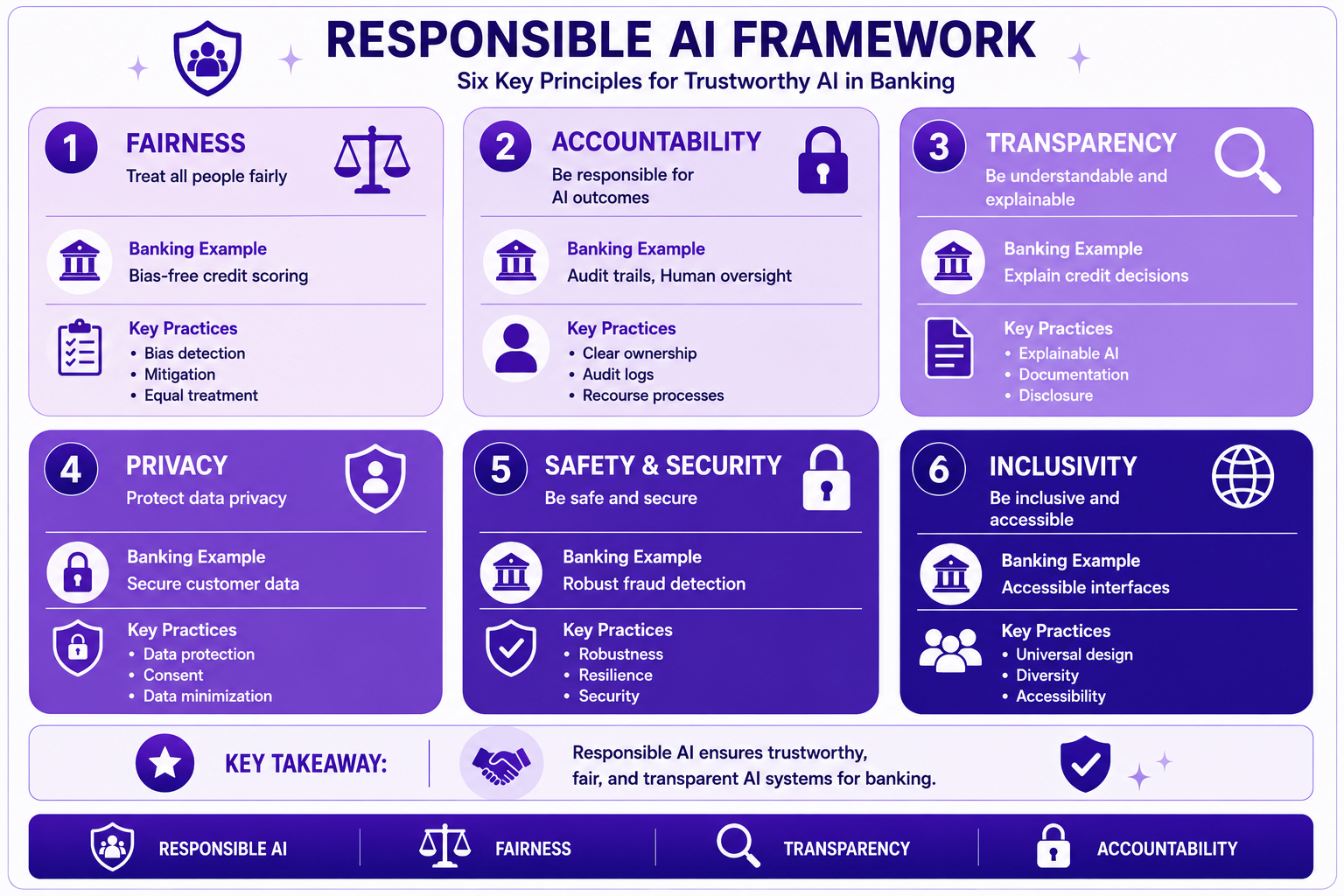
Prompt: Create a Responsible AI framework diagram showing the six key principles. Use a 6-section circular or vertical structure with purple gradient theme:
Principle 1: Fairness (Top Left) - Purple #E1BEE7
- Title: "Fairness"
- Icon: ⚖️
- Description: "Treat all people fairly"
- Banking Example: "Bias-free credit scoring"
- Key Practices: "Bias detection, Mitigation, Equal treatment"
Principle 2: Accountability (Top Center) - Purple #CE93D8
- Title: "Accountability"
- Icon: 🔒
- Description: "Be responsible for AI outcomes"
- Banking Example: "Audit trails, Human oversight"
- Key Practices: "Clear ownership, Audit logs, Recourse processes"
Principle 3: Transparency (Top Right) - Purple #AB47BC
- Title: "Transparency"
- Icon: 🔍
- Description: "Be understandable and explainable"
- Banking Example: "Explain credit decisions"
- Key Practices: "Explainable AI, Documentation, Disclosure"
Principle 4: Privacy (Bottom Left) - Purple #7B1FA2
- Title: "Privacy"
- Icon: 🛡️
- Description: "Protect data privacy"
- Banking Example: "Secure customer data"
- Key Practices: "Data protection, Consent, Data minimization"
Principle 5: Safety (Bottom Center) - Purple #4A148C
- Title: "Safety & Security"
- Icon: 🔐
- Description: "Be safe and secure"
- Banking Example: "Robust fraud detection"
- Key Practices: "Robustness, Resilience, Security"
Principle 6: Inclusivity (Bottom Right) - Purple #311B92
- Title: "Inclusivity"
- Icon: 🌍
- Description: "Be inclusive and accessible"
- Banking Example: "Accessible interfaces"
- Key Practices: "Universal design, Diversity, Accessibility"
At bottom: Key takeaway: "Responsible AI ensures trustworthy, fair, and transparent AI systems for banking." Footer tags: Responsible AI, Fairness, Transparency, Accountability. Enterprise-style clean layout with rounded corners.
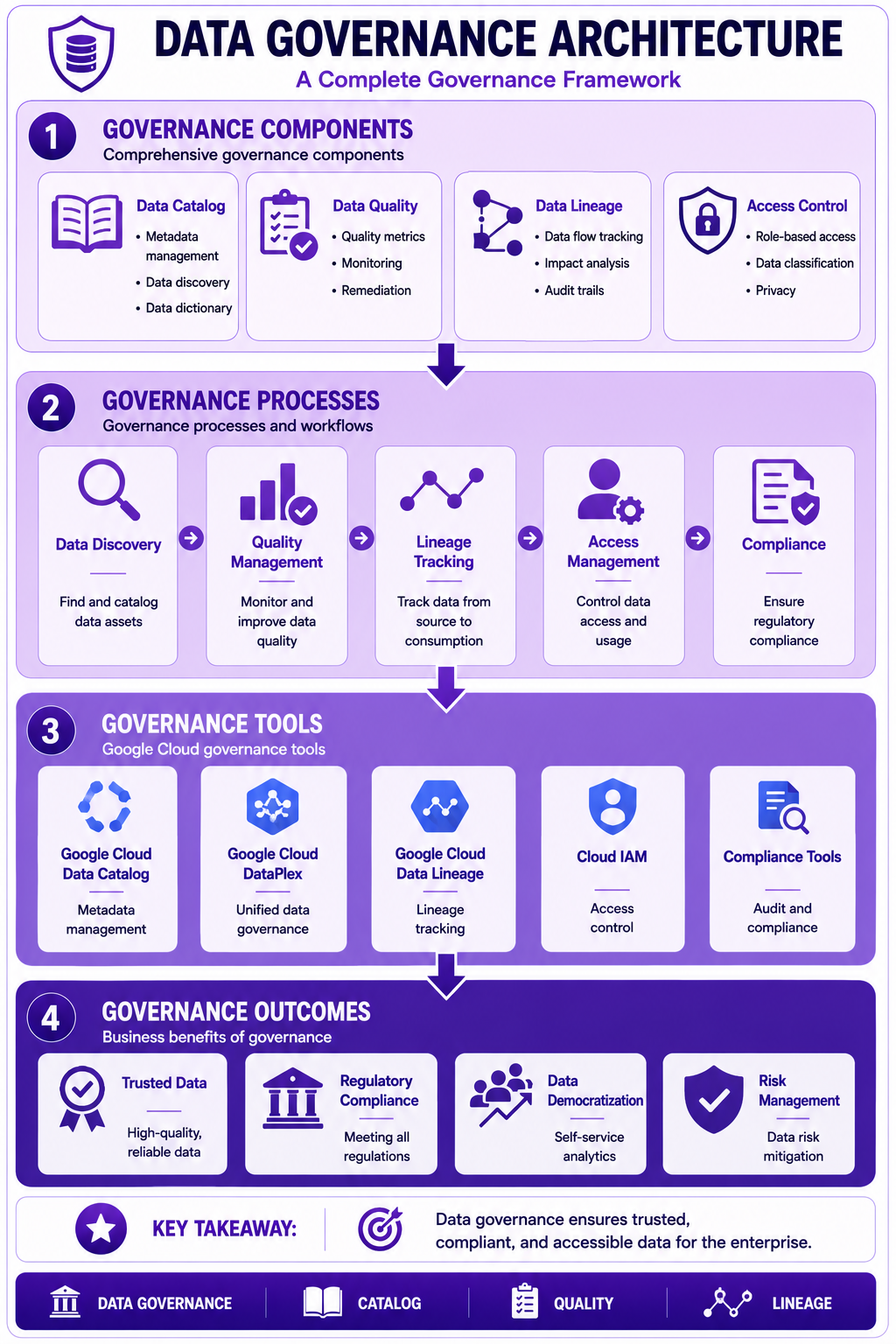
Prompt: Create a data governance architecture diagram showing the complete governance framework. Use a 4-layer structure with purple gradient theme:
Layer 1: Governance Components (Top) - Purple #E1BEE7
- Data Catalog: Metadata management, Data discovery, Data dictionary
- Data Quality: Quality metrics, Monitoring, Remediation
- Data Lineage: Data flow tracking, Impact analysis, Audit trails
- Access Control: Role-based access, Data classification, Privacy
- Icons for each component
- Description: "Comprehensive governance components"
Layer 2: Governance Processes - Purple #CE93D8
- Data Discovery: Find and catalog data assets
- Quality Management: Monitor and improve data quality
- Lineage Tracking: Track data from source to consumption
- Access Management: Control data access and usage
- Compliance: Ensure regulatory compliance
- Icons for processes
- Description: "Governance processes and workflows"
Layer 3: Governance Tools - Purple #AB47BC
- Google Cloud Data Catalog: Metadata management
- Google Cloud DataPlex: Unified data governance
- Google Cloud Data Lineage: Lineage tracking
- Cloud IAM: Access control
- Compliance Tools: Audit and compliance
- Icons for tools
- Description: "Google Cloud governance tools"
Layer 4: Governance Outcomes (Bottom) - Purple #7B1FA2
- Trusted Data: High-quality, reliable data
- Regulatory Compliance: Meeting all regulations
- Data Democratization: Self-service analytics
- Risk Management: Data risk mitigation
- Icons for outcomes
- Description: "Business benefits of governance"
Use downward arrows between layers. Include key takeaway at bottom: "Data governance ensures trusted, compliant, and accessible data for the enterprise." Footer tags: Data Governance, Catalog, Quality, Lineage. Enterprise-style clean layout with rounded corners.
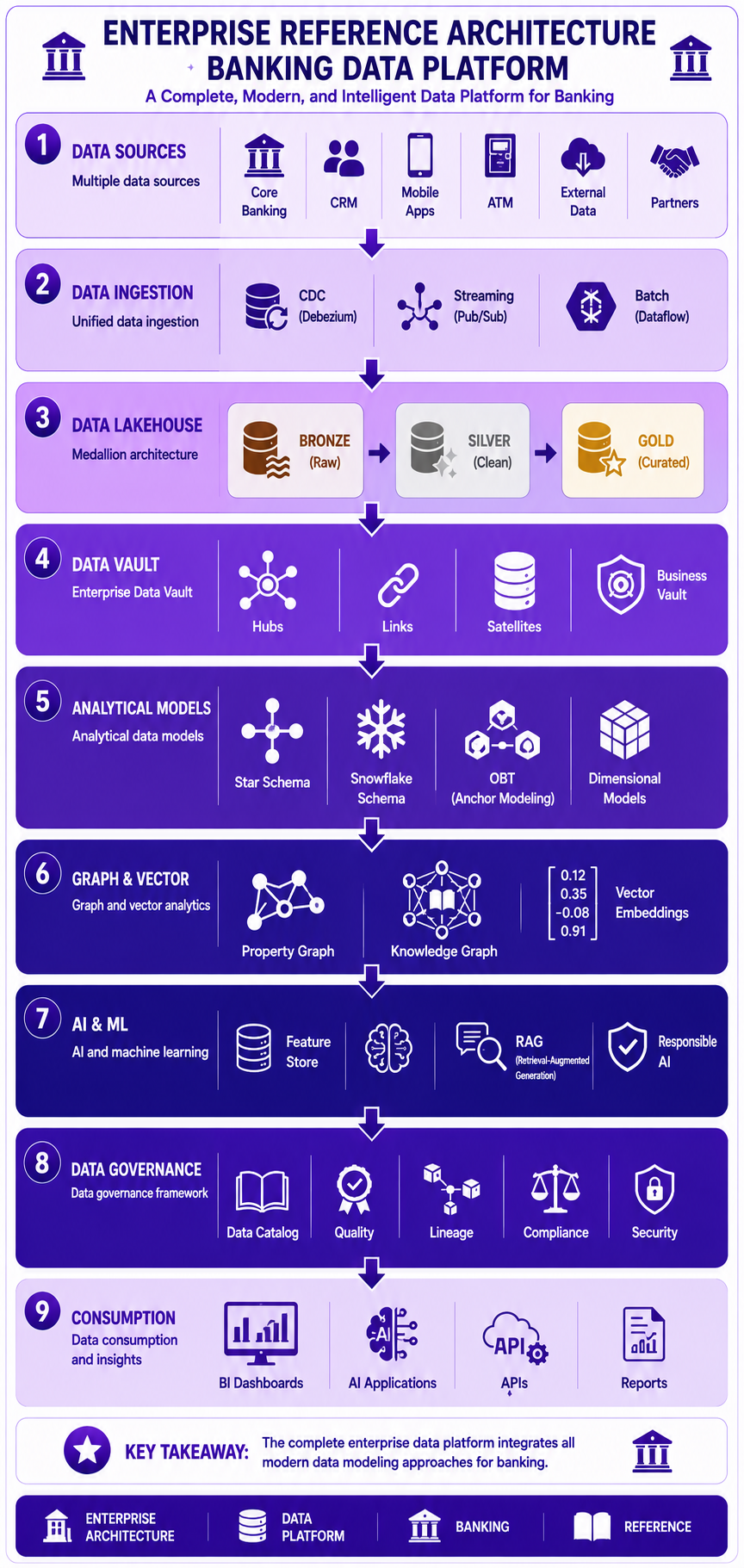
Prompt: Create an enterprise reference architecture diagram showing the complete banking data platform. Use a 9-layer vertical structure with purple gradient theme:
Layer 1: Data Sources (Top) - Purple #E1BEE7
- Core Banking, CRM, Mobile Apps, ATM, External Data, Partners
- Icons for each source
- Description: "Multiple data sources"
Layer 2: Data Ingestion - Purple #CE93D8
- CDC (Debezium), Streaming (Pub/Sub), Batch (Dataflow)
- Icons for ingestion
- Description: "Unified data ingestion"
Layer 3: Data Lakehouse - Purple #AB47BC
- Bronze (Raw) → Silver (Clean) → Gold (Curated)
- Arrows showing progression
- Description: "Medallion architecture"
Layer 4: Data Vault - Purple #7B1FA2
- Hubs, Links, Satellites, Business Vault
- Icons for Data Vault components
- Description: "Enterprise Data Vault"
Layer 5: Analytical Models - Purple #4A148C
- Star, Snowflake, OBT, Dimensional Models
- Icons for models
- Description: "Analytical data models"
Layer 6: Graph & Vector - Purple #311B92
- Property Graph, Knowledge Graph, Vector Embeddings
- Icons for graph and vector
- Description: "Graph and vector analytics"
Layer 7: AI & ML - Purple #1A237E
- Feature Store, ML Models, RAG, Responsible AI
- Icons for AI/ML
- Description: "AI and machine learning"
Layer 8: Data Governance - Purple #0D47A1
- Data Catalog, Quality, Lineage, Compliance, Security
- Icons for governance
- Description: "Data governance framework"
Layer 9: Consumption (Bottom) - Purple #E1BEE7
- BI Dashboards, AI Applications, APIs, Reports
- Icons for consumption
- Description: "Data consumption and insights"
Use downward arrows between layers. Include key takeaway at bottom: "The complete enterprise data platform integrates all modern data modeling approaches for banking." Footer tags: Enterprise Architecture, Data Platform, Banking, Reference. Enterprise-style clean layout with rounded corners.
Interview Questions
-
What is responsible AI and why is it important?
-
What are the key principles of responsible AI?
-
How do you detect bias in AI models?
-
What is explainable AI and how is it implemented?
-
What is a model fairness report?
-
How do you implement data governance?
-
What are the key components of data governance?
-
How do you ensure regulatory compliance in AI?
-
What are the best practices for responsible AI?
-
How do you monitor AI models for fairness?
-
What is the role of Google Cloud in responsible AI?
-
How do you build a complete enterprise data platform?
Practice Exercises
-
Implement fairness analysis for a credit scoring model.
-
Build an explainable AI system for loan decisions.
-
Create a data governance framework for banking.
-
Implement regulatory compliance reporting.
-
Design a complete enterprise data platform.
-
Build an AI monitoring dashboard.
-
Implement data lineage tracking.
-
Create a data quality dashboard.
-
Design a responsible AI strategy.
-
Build the capstone enterprise solution.
Key Takeaways
| # | Takeaway |
|---|---|
| 1 | Responsible AI ensures fair, transparent, accountable systems |
| 2 | Data governance is essential for trusted data |
| 3 | Regulatory compliance requires proactive management |
| 4 | Explainable AI builds trust with stakeholders |
| 5 | Continuous monitoring ensures ongoing fairness |
| 6 | Privacy-preserving AI protects customer data |
| 7 | A complete enterprise platform integrates all approaches |
| 8 | Responsible AI is a journey, not a destination |
Chapter Summary
In this final chapter, you learned:
- ✅ What responsible AI is and its principles
- ✅ How to detect and mitigate bias in AI
- ✅ Explainable AI and transparency
- ✅ Data governance framework and implementation
- ✅ Regulatory compliance for banking AI
- ✅ Complete enterprise reference architecture
- ✅ Capstone project implementation
- ✅ Best practices and common mistakes
You now have a comprehensive understanding of modern data modeling on Google Cloud, from foundational concepts to advanced AI-ready platforms.
Course Conclusion
Throughout this 40-hour journey, you have learned:
- ✅ Foundations of modern data architecture
- ✅ BigQuery and Lakehouse architecture
- ✅ Modern relational modeling
- ✅ Analytical modeling (Star, Snowflake, OBT)
- ✅ Data Vault modeling
- ✅ Graph data modeling
- ✅ AI-ready data platforms
- ✅ Vector search and embeddings
- ✅ Knowledge graphs and RAG
- ✅ AI-assisted data modeling
- ✅ Responsible AI and governance
You are now prepared to design, implement, and govern enterprise-scale data platforms on Google Cloud.